Greek Superstitions: Evil Eye and Spitting in Greece
A plain-English guide to Greek superstitions visitors may notice: the evil eye, spitting to ward off bad luck, Tuesday the 13th, salt, knives and bread.
On this page
Greek superstitions are not staged for visitors. They show up in ordinary moments: a blue glass eye hanging from a rear-view mirror, a grandmother murmuring ftou three times after praising a baby, a friend refusing to take a knife directly from your hand. Knowing a few of these customs makes everyday encounters easier to read and less likely to be misjudged.
Belief is not uniform. Interviews collected by the Dartmouth Folklore Archive with people of Greek heritage found that older generations tend to observe the customs more firmly, while younger people often repeat them without believing they have any power. Regional variation is also noted. Treat what follows as a guide to what you may see, not a claim about what every Greek person believes.
Everyday Culture, Not a Visitor Performance
Many of these practices are learned inside families, passed down from grandparents, parents, aunts and uncles, and repeated without much ceremony. In the Dartmouth interviews, informants described hearing the customs from older relatives and carrying some of them out even when they did not take the supernatural element seriously. That mix of habit, affection and caution is probably the most useful frame for a visitor: pay attention, but do not expect a lecture or a performance.
What is the evil eye in Greece? The evil eye, to mati, is a belief that envy or jealousy can cause harm through a look. People wear or display a blue glass eye charm as protection, and a special prayer called xematiasma is said to undo it.
Why do Greeks spit three times? The gesture is a slight puff, written ftou, rather than actual spitting. It is said three times to chase away bad luck or the evil eye, often after a compliment or when bad news is mentioned.
Why is Tuesday the 13th unlucky in Greece? Greece treats Tuesday the 13th as the unlucky date rather than Friday the 13th. Explanations offered include the link between Tuesday and the god of war, the fall of Constantinople on a Tuesday in 1453, and the idea that troubles come in threes.
One writer on Greek culture notes that superstitions seem to blend religion and older pagan practice and that they vary between towns and regions. The same gesture can be casual in one household and firmly observed in another. If you see a custom in a shop, a home or a taverna, the safest reading is that it belongs to that person or family rather than to the whole country.
The Evil Eye (to Mati): The Blue Glass Charm
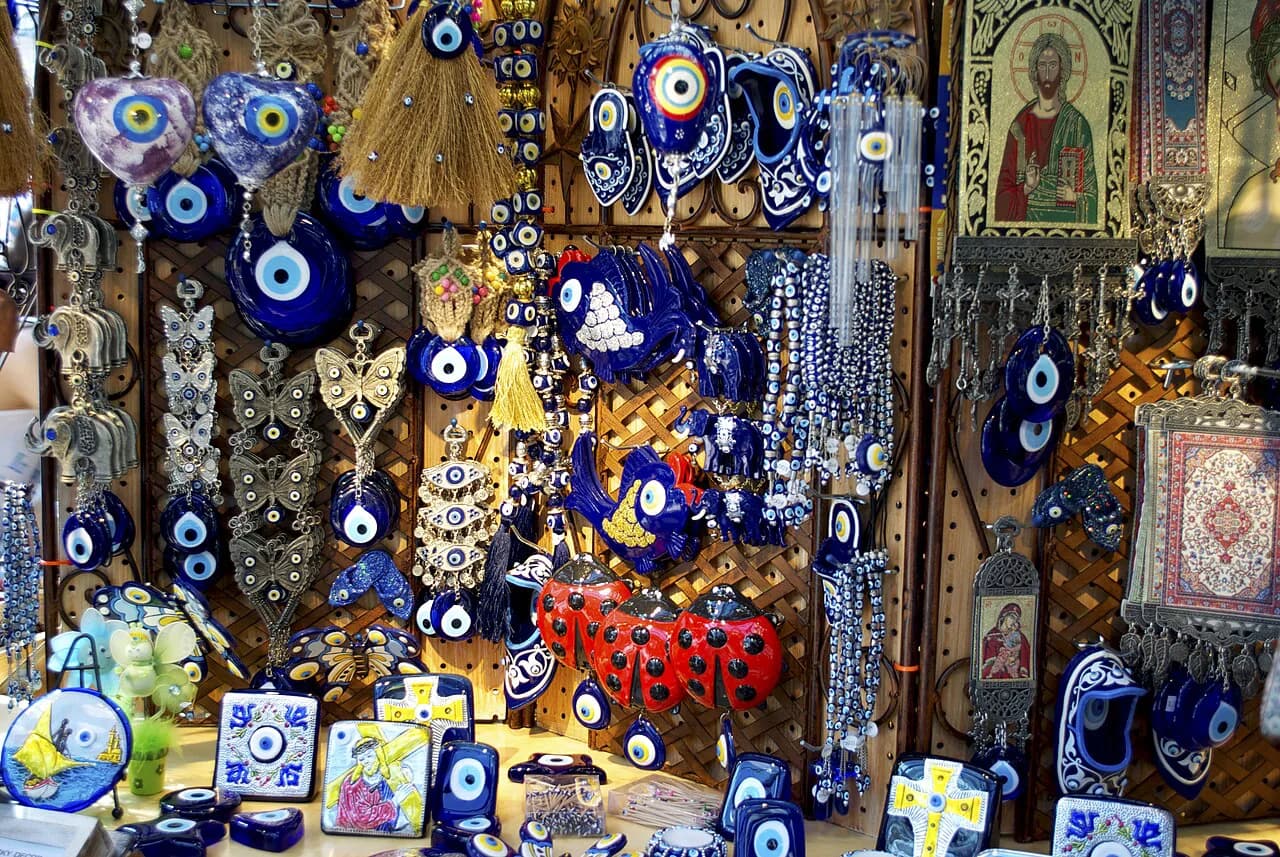
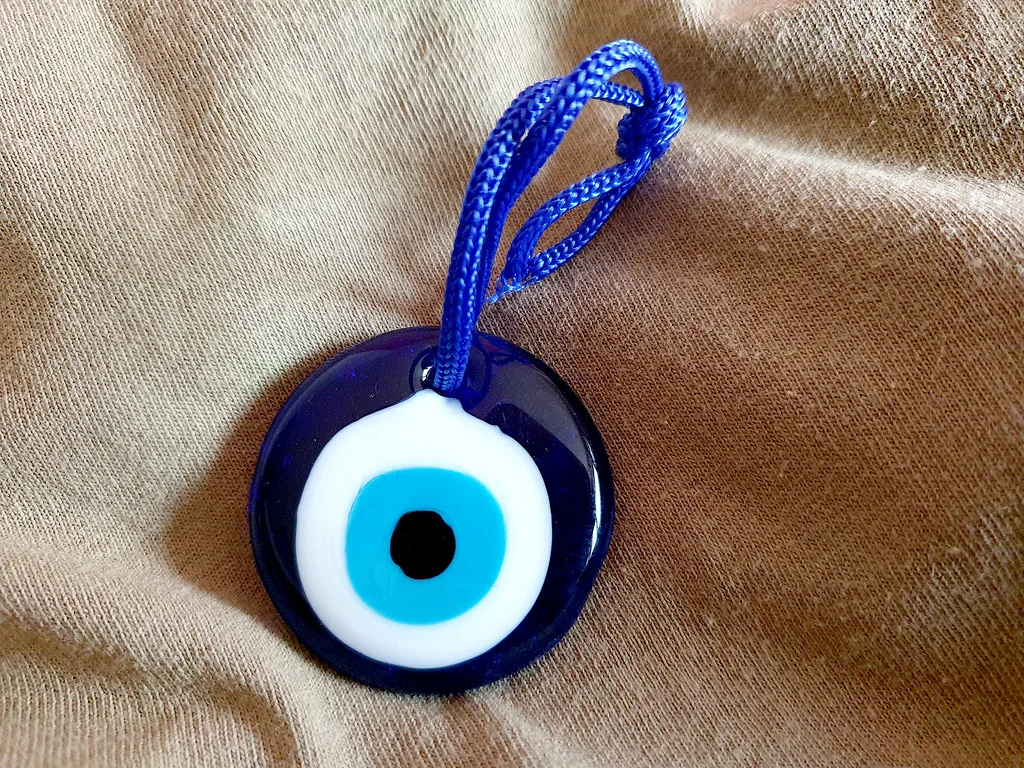
The evil eye, called to mati in Greek, is the best-known of these beliefs. The idea is that envy or jealousy, whether intended or not, can cause harm through a look. The blue glass charm shaped like an eye is worn or displayed as protection, which is why you see it on jewellery, keychains, doorways and car mirrors. It is sold widely as a souvenir, but for many Greeks it is more than that. For a broader look at everyday etiquette, see our guide to Greek Customs for Visitors.
The belief is old: one overview traces the notion of matiasma back at least six centuries before the Christian era. The charm is a small, portable form of protection rather than a decoration with no meaning. If you buy one, treat it as a cultural object rather than a novelty, and avoid waving it around as a joke.
Matiasma and Xematiasma: What the Belief Says Happens
When someone is thought to have caught the evil eye, the belief is that they feel unwell in body and mind. The remedy is xematiasma, roughly the undoing of the eye: a special prayer said by someone believed to have the gift. That person might be a relative, and the fooodlove account notes a tradition that the cure stays potent when handed down across genders, from a woman to a man to a woman, for example.
This is a belief, not a medical treatment, and there is no reason to seek it out as a visitor. If a Greek friend or host mentions that someone has the eye or needs a xematiasma, the polite response is curiosity, not diagnosis. Do not offer medical opinions, and do not ask to watch a prayer as if it were an attraction.
Spitting That Is Not Really Spitting: Ftou Ftou Ftou
The most easily misread custom is the spitting gesture. It is not actual spitting: it is a slight puff, often written ftou, said three times to chase away bad luck, misfortune or the devil. You may hear it after someone praises a baby or a beautiful child, or after bad news is mentioned. The idea is to make the evil eye or misfortune look elsewhere. It is not rude, and no one is being insulted.
If it happens in your direction, the best response is to ignore it or smile. Do not recoil, and do not try to copy it unless you are among people you know well; a visitor imitating the gesture can easily land wrong. The custom is about protection, not rejection.
Tuesday the 13th Instead of Friday the 13th
In Greece the unlucky date is Tuesday the 13th, not Friday the 13th. The explanations offered vary. One travel source links Tuesday to Mars, the god of war, and notes that Constantinople fell to the Ottomans on a Tuesday in 1453. Another writer points to the word Triti, meaning third, and the idea that troubles come in threes, alongside the number twelve being treated as perfect. These are explanations people give, not settled facts.
The practical effect is that some people avoid scheduling weddings, business openings or other major starts on that date. If you are invited to an event and the date is moved, it is not necessarily about your plans. You do not need to rearrange your trip around it, but it helps to know why a Greek friend might hesitate.
Touch Red (Piase Kokkino): When Two People Say the Same Thing
If two people say the same thing at the same moment, the custom is to say piase kokkino, meaning touch red, and both reach for something red nearby. The belief is that speaking in unison is an omen of an argument, and touching red cancels it. The nearest red object might be a bag, a sign or a piece of clothing. The gesture is quick and usually light-hearted, but it is taken seriously enough to be repeated.
If you find yourself saying the same word as a Greek companion, you can join in by touching the nearest red thing. It is an easy way to show you have noticed the custom without making a fuss.
Salt, Garlic and Bread: Household Customs
Salt appears in several small household customs. One is sprinkling a little salt behind an unwanted visitor as they leave, which is said to make them go. Another is the idea that spilling salt is unlucky, countered by tossing a pinch over the left shoulder. Garlic, called skordo, is hung near doorways or kept in vehicles to ward off negativity. These are beliefs about protection and etiquette, not health measures.
Bread carries its own respect. Dropping bread on the ground is considered disrespectful, and the custom is to pick it up and kiss it as an apology. If you see a Greek host handling bread carefully, that is why. At table, the simplest rule is to treat bread as food with meaning rather than as an accessory.
Knives and Perfume: Gifts With Strings Attached
Handing someone a knife directly is considered bad luck, because it is thought to cut the bond between two people. The usual workaround is to set the knife down on a table and let the other person pick it up. If a knife is handed over by mistake, a small coin can be exchanged to neutralise it. Perfume as a gift is treated in a similar way, and a coin given in return is said to cancel the bad luck.
As a visitor, you can avoid the issue by placing a knife on the table rather than passing it hand to hand. If you are given perfume and want to follow the custom, offer a coin in return. The value does not matter, and the exchange is what counts.

Shoes, Sweeping and Stepping Over People
A few household rules are worth knowing. Leaving shoes on their side or upside down is considered a bad omen, and the usual fix is to turn them upright. Sweeping someone's feet with a broom, even by accident, is thought to prevent them from marrying. Stepping over a person who is sitting or lying down is also considered bad luck, and the counter is to step back over them in the opposite direction.
None of this requires you to change how you sit or walk. If you accidentally step over someone, a quick apology is enough; if they wave it off, let it go. The rules are about care and respect, not about policing guests.
What Visitors Should Do, and What to Avoid Assuming
The safest approach is to notice without performing. You do not need to spit, touch red or hang garlic, and you should not assume a Greek friend believes any of it just because they follow the custom. Ask if you are curious, and accept a short answer. The Dartmouth interviews show that many younger people observe the customs without believing they have power, which is a reminder that practice and belief are separate things.
Do not turn a custom into a photo opportunity, and do not mock it. The blue eye charm in a shop is a good example: buying one is fine, but joking about the evil eye in front of someone who takes it seriously is not. If you are unsure, watch what others do and follow the tone of the room.
Around the Table: Toasts and Small Etiquette
One drinking custom is simple: a toast is gia mas with wine, beer or ouzo, but not with coffee. Raising a coffee cup in a toast is said to bring bad luck, and a Greek companion may look at you oddly if you try it. If you want to understand what a Greek toast means, the phrase is often explained alongside other everyday expressions such as yamas meaning.
At a taverna, the customs that matter most are the ordinary ones: order a few dishes to share, let your host lead the toast, and do not make a performance of refusing food. If you hear opa, it is celebration rather than a superstition; the phrase is explained in our guide to What "Opa" Means in Greece. A few basic Greek phrases also help when you want to thank a host or ask what a dish contains.
For the practical side of eating out, from dish names to sharing plates, see what to eat in Greece. The customs above are background, not a menu. If you are planning a visit to the ruins, our guide to ancient sites in greece places them alongside the food stops worth building a day around. If your travels take you to the islands, our guide to things to do in Rhodes also pairs historic sights with tavernas worth a stop. Prices and opening hours vary by place and season, so check the taverna's own listing before you go.
Plan Your Visit
Greek superstitions are most useful to a visitor as a reading of small moments: a charm on a mirror, a muttered ftou, a knife set down on the table. You do not need to believe any of it. You only need to be curious and to avoid treating a living custom as a joke.
Keep the practical side separate. Customs do not set opening hours or prices, and island restaurants may close for the season. Check the specific place before you travel, and let the superstitions be what they are: part of everyday life, not a schedule.
Explore more Greece sauna guides
Frequently Asked Questions
What is the evil eye in Greece?
The evil eye, to mati, is a belief that envy or jealousy can cause harm through a look. People wear or display a blue glass eye charm as protection, and a special prayer called xematiasma is said to undo it. The charm is sold widely as a souvenir, but for many Greeks it has real meaning.
Why do Greeks spit three times?
The gesture is a slight puff, written ftou, rather than actual spitting. It is said three times to chase away bad luck or the evil eye, often after a compliment or when bad news is mentioned. It is a protective custom, not an insult.
Why is Tuesday the 13th unlucky in Greece?
Greece treats Tuesday the 13th as the unlucky date rather than Friday the 13th. Explanations offered include the link between Tuesday and the god of war, the fall of Constantinople on a Tuesday in 1453, and the idea that troubles come in threes. These are explanations people give, not settled facts.
Should I hand someone a knife in Greece?
It is better to set the knife down on the table and let the other person pick it up. Handing it directly is thought to cut the bond between two people. If it is handed over by mistake, a small coin can be exchanged to cancel the bad luck.
Can I toast with coffee in Greece?
It is better not to. A toast is gia mas with wine, beer or ouzo, but toasting with coffee is considered bad luck. If you want to join a toast, raise a glass of wine or ouzo and let your host lead.
Do young Greek people still believe these superstitions?
Practice and belief are separate. Interviews collected by the Dartmouth Folklore Archive found that older generations tend to observe the customs more firmly, while younger people often repeat them without believing they have any power. Regional and family variation also matters.
Sources
Notes for eating well in Greece
Optional updates to our guides.
You might also like



Continue reading
More guides you'll find useful