Greek Name Days in Greece: What They Are & How to Join
Greek name days often matter as much as birthdays, and the person celebrating does the treating. Here is how the custom works and what a visitor should do.
On this page
In Greece a birthday is a private, family-scale affair, but a name day can fill a taverna. If you are travelling in late spring or mid-August you may find yourself pulled into a table for someone you have just met, and it helps to know what is going on.
The custom is simple once you have the vocabulary: η γιορτή (i giorti) means the celebration, and it belongs to the saint or holy event linked to your name rather than to the day you were born. This guide covers what to say, when the dates fall and what an invitation actually commits you to.
What a Greek name day actually is
A name day is the feast day of the saint or holy event connected to a person's name, marked in the Greek Orthodox calendar. Because the church commemorates saints throughout the year, most traditional Greek names map onto a specific date, so a person called Maria or George has a fixed celebration that friends and colleagues already know. It is a church-calendar occasion first and a party second, which is why the date is public knowledge rather than something announced by invitation.
What is a Greek name day? It is the feast day of the saint or holy event connected to a person's name in the Greek Orthodox calendar. Rather than marking the date of birth, it marks the day the church commemorates the name's patron, and it is often celebrated with as much warmth as a birthday, with calls, messages and a meal.
Do I pay if I am invited to a name-day dinner? No. The custom is that the person celebrating does the treating, which can range from bringing sweets to the office to paying for the table at a taverna.
What should I say to someone on their name day? Say Χρόνια πολλά (Chronia polla), which means "many years" and is used for name days, birthdays and holidays alike. You can follow it with Και του χρόνου (Kai tou chronou), meaning "and next year", or use Να χαίρεσαι το όνομά σου (Na hairese to onoma sou) to wish them joy in their name.
The Greek word for the celebration is η γιορτή (i giorti), and you will hear people ask whose γιορτή it is today as casually as you might ask about a birthday. The system is not perfectly tidy: some names are celebrated on more than one date depending on the origin of the name, and names without a direct saint connection are often celebrated on All Saints Day.
That imperfection matters for planning. If a Greek friend tells you their γιορτή is coming up, do not assume the date you find in a search is the one their family keeps; families sometimes follow a regional or parish calendar rather than a general list. Knowing how these observances sit within the wider set of greek customs keeps the day in proportion: it is a social obligation with a warm face, not a ceremony you need to dress for.
Why name days can outshine birthdays
Name days are public in a way birthdays are not. Church and printed calendars list the saints and commemorations for every day, so neighbours, colleagues and distant relatives all know when a common name is being celebrated without being told. For someone called Konstantinos or Eleni, that means a stream of calls and messages through the day rather than a single evening out.
The result is a celebration with more momentum and less planning than a birthday party. People drop by, ring, or send a message, and the day can extend into an evening at a taverna without anyone having issued a formal invitation.
The core custom: the person celebrating does the treating
The detail that surprises visitors most is who pays. The person whose name day it is does the treating, which can mean bringing sweets to the office, buying coffee for a group or picking up the bill when everyone goes out to eat. If you are invited to a table, you are the guest, and offering to split the bill is not the expected move.
Practically, this shapes the evening. A name-day table is not the moment to grab the cheque to show gratitude; a small gift, a bottle for the table or a round of drinks later in the evening fits the mood better than a contested bill. If you want to reciprocate, do it on your own ground another day.
Fixed dates and dates that move with Easter
Most name days sit on the same calendar date every year, but a few are tied to Pascha (Easter) and shift with it. George is a clear example: the celebration is usually marked on April 23, but when that date falls on or before Pascha the feast moves to Bright Monday, the day after Easter Sunday. The same moveable logic covers the Saturday of Lazarus and Great and Holy Sunday, so a name attached to those days changes date every year.
This is why a date you have seen for a name can be wrong in a given year, and why Greeks themselves check a calendar rather than rely on memory. If you are planning a meal around someone's celebration, confirm the date with them rather than with a website.
The two big dates travellers notice: May 21 and August 15
Two name days are large enough that visitors feel them without being invited. May 21 is the feast of Saints Constantine and Helen, a major celebration for anyone called Konstantinos or Eleni, and August 15, the Dormition of the Theotokos, is one of the best-known name days of the year for people called Maria.
Both dates fall in warm months when Greeks travel and eat out, so tables fill with families marking the day together. That is the trade-off to weigh: if you have your heart set on a particular taverna on either night, treat it like a public holiday weekend and plan around the crowd rather than expecting a quiet corner. If you are also hoping to see the ancient sites in greece during these weeks, book those days with the same caution.

Names with more than one date, and names with none
Greek name days are not a clean one-to-one database. Some names are celebrated on several dates depending on which saint or origin a family follows, and names with no direct saint link are often gathered onto All Saints Day instead. A single lookup can therefore mislead even when the day it gives is a real one.
Labrini is a good illustration of why you should not trust a confident answer. An alphabetical list of saints and namedays shows Lambrini among the names tied to the moveable Great and Holy Sunday of Pascha and, separately, has entries under 5 July for the similar but distinct name Lampados. The spelling is close enough in Latin script that a search can easily hand you the wrong saint's day.
If someone called Labrini invites you, ask which date their family keeps rather than presenting a date you found online. The answer costs nothing and avoids the awkwardness of turning up on the wrong evening.
What you may see as a visitor
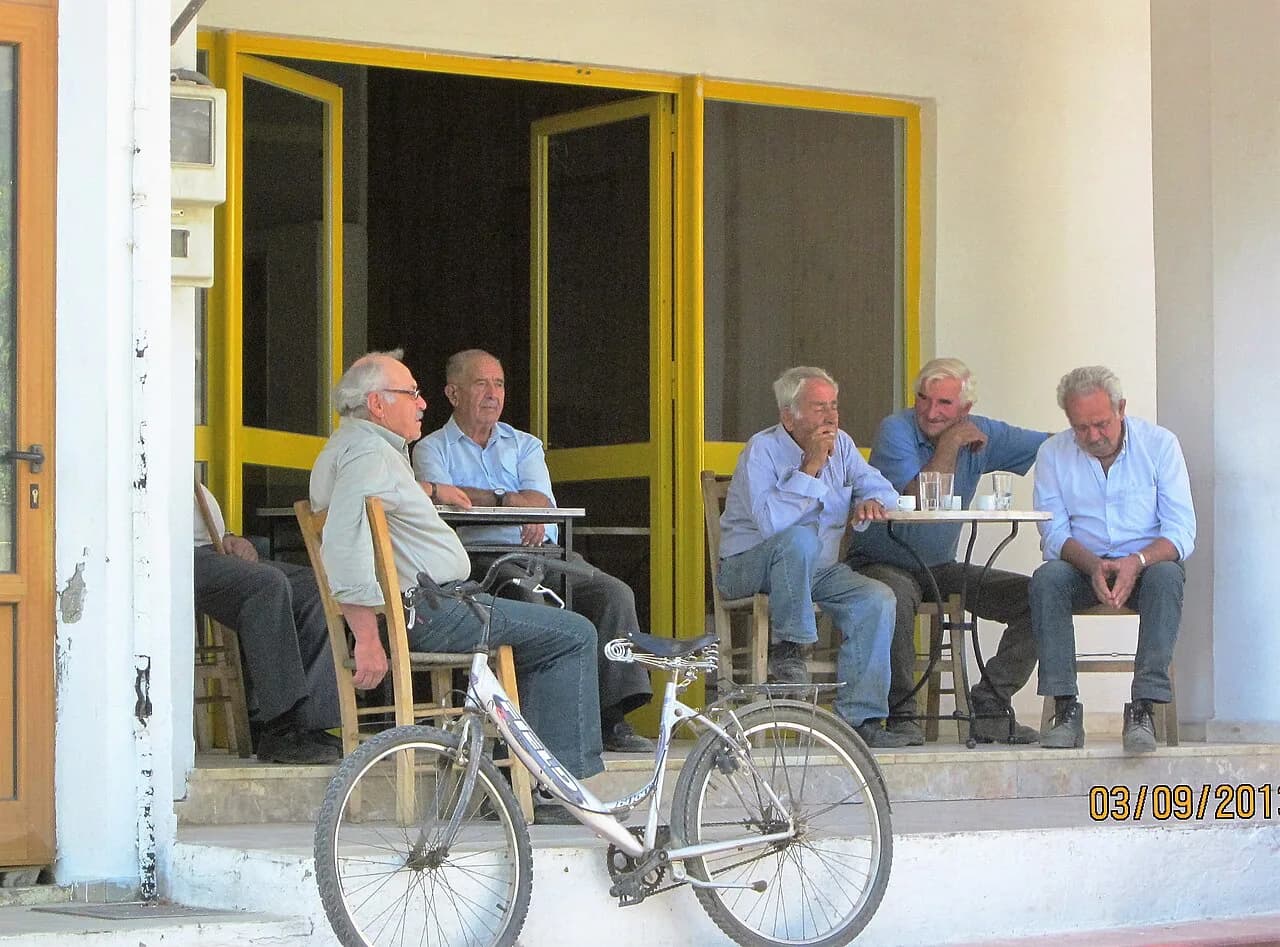
The visible signs of a name day are social rather than ceremonial. You may notice a long table of mixed ages at a taverna, a phone that keeps buzzing with messages, or a colleague arriving with a box of sweets for everyone. In a village, a house may fill with visitors through the afternoon.
For a traveller the useful reading is this: a busy restaurant with one very long table is probably a family celebration, not a waitlist problem to solve. Booking ahead or eating earlier is the practical response, and many places will simply be fuller than a normal weekday.
What to say: three phrases that do the work
If you know someone is celebrating, one phrase covers almost every situation: Χρόνια πολλά (Chronia polla), which literally means "many years" and works for name days, birthdays and holidays. Add Και του χρόνου (Kai tou chronou), meaning "and next year", to wish them another celebration in twelve months.
A third, warmer option is Να χαίρεσαι το όνομά σου (Na hairese to onoma sou), roughly "may you enjoy your name". It is the phrase that fits a name day specifically, and it lands well even with imperfect pronunciation.
Avoid "happy birthday" unless the person has told you it is their birthday, because on a name day it marks you as someone who has not understood the occasion. If you are unsure how to pronounce the words, repeat them once softly before saying them out loud and people will happily correct you. Building a small stock of basic greek phrases before you travel pays off in exactly this sort of moment.
If you are invited to a table: what to bring and how to pace
An invitation to a name-day table is generous and informal, so keep your contribution small. Flowers, a box of sweets from a bakery, a bottle of wine or a round of drinks later in the evening are all normal gestures; a large gift can embarrass the host who is meant to be doing the treating.
Expect a slow meal. Greek taverna meals are built for lingering, with dishes arriving in stages and conversation filling the gaps, so do not schedule anything for immediately afterwards. Arriving on time is fine; leaving early is the thing that reads as odd, so plan your evening around the table rather than the other way round.
On the food itself, the table will usually be a spread of shared plates rather than individual mains. Knowing a few of the dish names in advance makes it easier to join in when plates are passed around and someone asks whether you want more of something you have not met before, and a browse through what to eat in Greece is a sensible primer. If your travels take you to the islands, our Corfu food guide covers the same kind of shared taverna table with a local accent.
When glasses are raised, someone may shout a toast you have heard but not understood. The opa meaning is worth knowing before you sit down, because it comes up not only at celebrations but at any table where a plate is broken or a dance begins.
Major feast days and eating out
The practical knock-on effect of a big name day is on restaurants. On dates like August 15 and May 21, family groups book tables in advance, restaurants run fuller and later sittings, and the quiet corner you hoped for may not exist. Smaller inland towns can feel busier than the beach resorts because families return home for the day.
If your trip overlaps a major feast, choose one of two strategies: reserve where you want to eat, or eat early and treat the rest of the evening as a walk. Trying to walk in at peak time on a name day is the option least likely to work.
How to check a date without guessing
Use a printed or church calendar rather than a search result, especially for names tied to moveable feasts. Parish websites and the printed calendar of a local church list the commemorations for each day, and the people celebrating will always be the best source for their own family's date.
When a list contradicts another list, believe the person rather than the page. Greek nameday compilations vary in how they handle rare names, variant spellings and moveable feasts, and the source that looks most complete is not necessarily the one a family follows.
Common names and the dates usually linked to them
Some pairings recur often enough to be useful reference points. Konstantinos and Eleni share May 21, Maria is linked to August 15, and George is usually marked on April 23 unless Easter moves it. These are the dates most likely to fill a restaurant or bring a friend's phone to life while you are in Greece.
For less common names, and for names whose spelling varies in English, expect disagreement between sources. The alphabetical lists are useful for confirming that a name is celebrated at all, but they are not a single authority, and some entries flag variant traditions openly rather than resolving them.
Plan Around the Celebration
The main thing to carry away is that a name day is a public occasion with a host who pays, a table that runs long, and a date that is sometimes fixed and sometimes tied to Easter. Learn one phrase, Χρόνια πολλά, and you can greet almost anyone you meet on their celebration.
If you are planning a trip across a major name day, book your table and keep the evening loose. The broader patterns of Greek Customs and Etiquette around tables, greetings and celebrations are worth reading before you go, so that a spontaneous invitation feels like an opportunity rather than a test.
Explore more Greece sauna guides
Frequently Asked Questions
What is a Greek name day?
It is the feast day of the saint or holy event connected to a person's name in the Greek Orthodox calendar. Rather than marking the date of birth, it marks the day the church commemorates the name's patron, and it is often celebrated with as much warmth as a birthday, with calls, messages and a meal.
Do I pay if I am invited to a name-day dinner?
No. The custom is that the person celebrating does the treating, which can range from bringing sweets to the office to paying for the table at a taverna. As a guest you are not expected to split the bill; a small gift, flowers or a bottle for the table is a more appropriate gesture.
What should I say to someone on their name day?
Say Χρόνια πολλά (Chronia polla), which means "many years" and is used for name days, birthdays and holidays alike. You can follow it with Και του χρόνου (Kai tou chronou), meaning "and next year", or use Να χαίρεσαι το όνομά σου (Na hairese to onoma sou) to wish them joy in their name. Avoid "happy birthday" unless it really is their birthday.
Are Greek name day dates always the same each year?
Most fall on a fixed calendar date, but some are tied to Pascha and move with it. George, for example, is usually marked on April 23 but shifts to Bright Monday when April 23 falls on or before Pascha. Check a church or printed calendar for the year you are travelling rather than relying on memory.
When is Maria's name day?
Maria is one of the best-known name days of the year, marked on August 15 in connection with the Dormition of the Theotokos. Because that date falls in high season, restaurants and family tables can be much busier than usual, so reserve ahead or eat earlier if you want to go out that evening.
Is Labrini's name day on a fixed date?
Sources do not agree clearly enough to give one date. An alphabetical list of saints and namedays places Lambrini among names tied to the moveable Great and Holy Sunday of Pascha, while a similar but distinct name, Lampados, appears under 5 July. Ask the person which date their family keeps.
What happens if a name has no saint associated with it?
Names without a direct saint connection are often celebrated on All Saints Day instead. Some names can also be celebrated on more than one date depending on the name's origin or the tradition a family follows, which is why a single online lookup can be misleading.
Will restaurants be busier on big name days?
Yes, particularly around August 15 and May 21, when family groups mark the day with a meal out. Tables are often booked in advance and sittings run later, so reserve if you have a specific place in mind or eat early and treat the rest of the evening as a walk.
Sources
Notes for eating well in Greece
Optional updates to our guides.
You might also like

Continue reading
More guides you'll find useful