Basic Greek Phrases for Travelers: Greetings, Ordering and Directions
Learn basic Greek phrases for greetings, ordering food and drink, asking directions and prices, with plain-English meanings and when to use each one.
On this page
Most travellers need fewer Greek phrases than they expect, but they need them in the right order. A greeting when you walk into a bakery, a polite request when you order, a question about the bill, and a way to ask where the square is will carry you through most short exchanges in Greece. This guide groups phrases by the situation rather than alphabetically, so you can practise the ones you will actually use on your first day.
Two things trip people up. First, Greek is written in its own alphabet, so guides offer transliterations, and those spellings drift between sources: the same hello appears as giásas, yassas or geia depending on who wrote it. Second, Greek has a formal and an informal way of addressing people, and choosing wrongly is the most common small mistake visitors make with staff and strangers.
Below, each phrase is explained in plain English at first use, with a note on who to say it to and what response to expect. Anything that changes between visits, such as a shop's opening hours or a ferry departure, should be checked directly with the business or operator rather than learned as a phrase.
Why a Few Greek Phrases Change the Interaction
A short attempt at Greek does practical work. It signals that you see the person serving you rather than only the transaction, which is the same courtesy logic that runs through much of what visitors notice as Greek Customs and Etiquette: greetings first, requests after, thanks on leaving. That pattern holds in a taverna, a kiosk and a hotel reception desk alike.
How do you say hello in Greek at different times of day? Use kalimera, meaning good morning, in the morning, kalo apogevma, good afternoon, in the early afternoon, and kalispera, good evening, later in the day. One teaching source places kalimera between 6:00 and 12:00, kalo apogevma from 12:00 to 18:00 and kalispera after 18:00.
What is the difference between yassas and yassou? Yassas is the formal or plural hello, used with strangers, staff and people older than you. Yassou is the informal singular version, used with friends or people you already know well.
How do you ask how much something costs in Greek? Say poso kani, which literally means how much does it cost. It works at a market stall, in a shop and on a menu board.
You do not need grammar. Five or six fixed phrases, delivered with a smile, cover the greeting, the request, the thank-you and the goodbye. Where the conversation goes beyond that, switching to English is normal and expected in tourist areas, and no one will be offended by it after you have opened in Greek.
One related expression you will hear constantly in tavernas and at celebrations is opa, used as an exclamation rather than a sentence. If you want to understand what it signals before someone shouts it across a table, What "Opa" Means in Greece covers the contexts where it appears and where it does not.
Pronunciation Ground Rules Before You Start
Greek words carry a stress mark, and putting the emphasis on the right syllable matters more than perfect consonants. In transliterations the stressed syllable is often shown with an accent, as in kaliméra, so read the accent as an instruction to lean on that vowel. Getting the stress right makes you far easier to understand than polishing individual sounds.
The letters that trip up English speakers are gamma and the digraphs. Gamma, written g in transliteration, is a soft breathy sound closer to a swallowed h than a hard g, which is why the same word can appear as giásas or yassas in different guides. Neither spelling is wrong; they are two attempts to render one sound in Latin letters.
Treat transliteration as a rough map, not a standard. Sources differ on vowel pairs and on whether to write an h at the start of a word, so if a phrase in one guide looks unfamiliar in another, compare the sound rather than the letters. The Greek script version, where a source gives it, is the reliable reference.
Greetings by Time of Day
Greek greetings are tied to hours more tightly than English ones, and the division is straightforward. One widely used teaching source places kalimera, meaning good morning, between 6:00 and 12:00, kalo apogevma, good afternoon, from 12:00 to 18:00, and kalispera, good evening, after 18:00. Treat these as guidance on when each greeting is normally used rather than a strict timetable.
For a general hello that works at any hour, use yassas with strangers and staff, and yassou with friends or people your own age you have already met. That formal and informal split is the single most useful distinction to learn, because it decides which version you use at a hotel check-in desk versus a bar where you have been chatting.
If you want the time-of-day greetings in more depth, including how they are used in everyday conversation, the guide to kalimera meaning walks through the morning greeting and its close relatives. It is worth reading before your first morning in a bakery queue, where kalimera is the standard opener.
Please, Thank You and Excuse Me
Two words do most of the polite work. Efharisto means thank you, and parakalo means please, but it also serves as the standard reply when someone thanks you, roughly the equivalent of you're welcome. Learning parakalo as a two-way word saves confusion the first time a waiter says it back to you.
A short thank-you goes a long way at the end of a meal or when leaving a shop, and there is a fuller phrase for warmer thanks. If you want the variants and when each fits, How to Say Thank You in Greek (Efcharistó) and What to Say Back explains the difference between the quick word and the longer expression.
For getting attention without sounding abrupt, a simple excuse me plus eye contact is enough; the Greek phrase exists but the tone matters more than the words. Avoid waving or calling across a room in a small taverna, where staff will usually reach you anyway.
Ordering Food and Drink
The most reusable food phrase is a request frame: boro na paro, meaning can I have, followed by the item. A teaching source gives the pattern with three examples — a dessert, a drink and a glass of wine — which is enough to swap in whatever you actually want. Use it at a bar when ordering a drink and at the table when the dessert menu arrives. If the menu itself is the puzzle, the guide to what to eat in Greece pairs the dish names with what actually arrives on the plate; if you would rather see the phrases in action, our Chania food guide shows how ordering plays out across a harbour town's tavernas.
Wine is worth naming specifically rather than asking for a generic drink, because the answer will often be a choice between house wine by the glass or a bottle. If you want to toast the table, the word is yamas, said while raising glasses. Yamas Meaning covers the toast and the slightly longer version, stin ygeia mas, which literally refers to health and is used as a blessing.
Asking for the bill is the one phrase people most often need and least often prepare. Ask at the end of the meal rather than catching staff on the way past, and expect the bill to be brought to the table rather than paid at a till in smaller places. In busy seasonal tavernas, settling promptly frees the table, which matters at peak dinner hours.
Reading a Menu Without the Alphabet
Dish names are easier to learn than phrases because they repeat across menus. Rather than memorising a long list, learn the handful you are most likely to order, then match them on the page: a Greek salad, a grilled meat or fish plate, a pie from a bakery, a plate of small dishes to share. If you want the full spread explained dish by dish, Traditional Greek Food maps names to what arrives on the plate.
Knowing a few dish words also changes what you can ask for. If a menu lists small plates meant for sharing, ordering two or three between two people is normal, whereas a single main each is the pattern in a more conventional restaurant. Ask how many dishes staff suggest for your table size rather than guessing.
Bakery counters are the best low-pressure place to practise. Pointing plus a phrase works, sizes and types are visible, and the exchange is short. Expect to pay at the counter as you order rather than at the table, and have small change ready at busy morning hours.
Asking Prices and Paying in Shops
The price question is poso kani, literally how much does it cost, and it works in a shop, at a market stall or on a menu board. A language source lists it as a core shopping phrase for exactly this reason. Ask before you commit, especially where items are sold by weight and the final amount is not obvious.
If you want to try something on, the phrase is boro na to dokimaso prota, meaning can I try it first. In smaller shops the owner will usually tell you where the fitting area is rather than leaving you to find it. For taking an item, boro na paro afto covers can I have this, which is the same request frame you use for food.
Prices for dishes and drinks vary by island, season and whether you sit with a view, so no fixed figure is reliable. Check the menu board or ask before ordering, particularly for fish sold by weight, where the final cost depends on the size of the fish you are shown.
Asking for Directions: The Square and the Metro
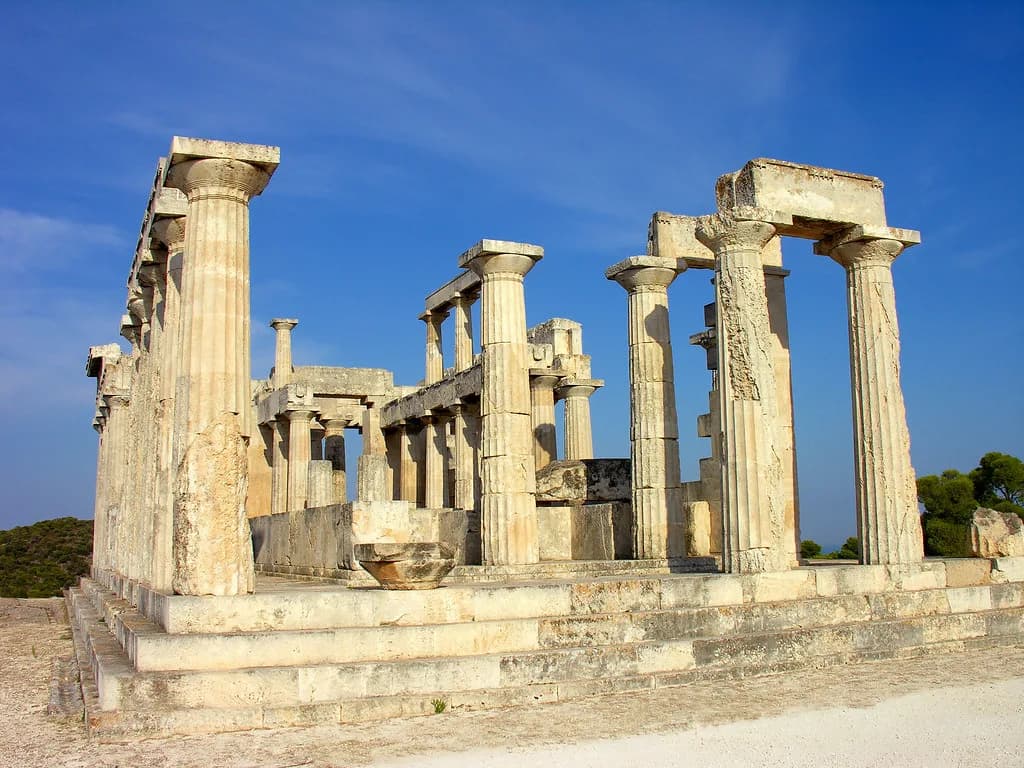
Two direction questions cover most city situations. Pou ine i plateia means where is the square, and it is the most useful single question in a Greek town, because the plateia is usually the centre for cafes, buses and orientation. Pou ine o stathmos tou metro means where is the metro station, useful in Athens and nowhere else, since other cities have no metro. If your day is built around ruins, the same landmark-first habit helps when navigating between ancient sites in Greece.
Understand the shape of the answer before you ask. People will often reply with a landmark, a direction and a distance in minutes on foot, plus a gesture, rather than street names. Listen for the landmark and watch the hand; a short answer with a pointed finger is a complete answer, not a truncated one.
If you are heading to a major sight, ask for the nearest square or metro stop rather than the site itself, then follow signs. In Athens this approach works well for the Acropolis of Athens and the surrounding old streets, where the metro stop and the pedestrian entrance are not the same point.
Numbers and Time for Hours and Departures
You rarely need a full number system. Learn one to ten for prices and platform or gate numbers, and you can handle most counter exchanges. For anything more precise, showing the number on your phone or writing it down is faster and less error-prone than listening for it in a noisy port.
Times are where a language gap has real consequences. Ferry departures and museum hours are fixed, printed facts, so confirm them in writing — on the operator's site, the ticket office screen or the posted schedule at the entrance — rather than relying on a spoken answer you half understood.
When you ask about opening hours, the useful follow-up is whether the place closes midday, since some shops and offices keep split hours. Ask and then check the door sign, which usually states the schedule clearly in numerals you can read without Greek.
Emergencies and Asking for Help
Two phrases are worth memorising before you fly. Voithia means help, and chriazome enan giatro means I need a doctor. A language source lists both among its emergency phrases, and they are the ones you will not have time to look up in the moment.
In practice, emergencies in Greece are handled in English as often as not, especially in tourist areas, so saying the Greek phrase and then switching is fine. Keep your accommodation address saved in Greek script as well as English; it is what a taxi driver or a phone operator will need.
Tone, Gestures and When to Switch to English
Volume and directness do not translate neatly. A request said in a flat tone can sound blunt even in polite words, so soften it with a smile and a rising intonation at the end. This matters more in small shops and family tavernas than in busy city bars, where speed is the priority.
Some gestures carry meaning that visitors misread. A single upward nod of the head often means no rather than yes, and a hand flick can dismiss a question rather than answer it. When a reply seems to contradict the words, watch the face and the hand together, and ask a follow-up question.
The wider pattern of gift-giving, hosting and small courtesies is covered in Greek Hospitality Explained, which is useful context for why a complimentary small pour or a plate of something may arrive without being ordered. Accepting it with a thank-you is the correct response; treat it as a gesture, not a bill item.
A Five-Phrase Starter Set
If you learn nothing else, take these five: yassas as a general hello with staff, kalimera in the morning, efharisto for thank you, parakalo for please and you're welcome, and poso kani when you need a price. Together they cover arriving, ordering, paying and leaving in almost any small establishment.
Practise them aloud before you land, because the stress pattern is what people recognise. Reading them silently gives you a false confidence that disappears at a counter. Say each one five times with the emphasis on the marked syllable, then stop; over-rehearsing produces a stiff delivery that defeats the purpose.
Beyond the five, add only the phrases tied to your own itinerary — direction questions if you are navigating a city on foot, food phrases if you plan to eat out often. A short list you can actually retrieve under pressure beats a long one you have to search for.
Plan Your Visit
Build your phrase list around the moments you will actually face: a bakery counter in the morning, a taverna table in the evening, a shop where you want to check a price, and a street corner where you need the square. Five or six phrases, said with the stress in the right place, do more than a page of vocabulary you cannot recall.
For anything fixed — opening hours, ferry times, ticket prices — confirm in writing with the business or operator rather than relying on a remembered phrase. Language gets you the conversation; the printed schedule gets you the correct answer.
Explore more Greece sauna guides
Frequently Asked Questions
How do you say hello in Greek at different times of day?
Use kalimera, meaning good morning, in the morning, kalo apogevma, good afternoon, in the early afternoon, and kalispera, good evening, later in the day. One teaching source places kalimera between 6:00 and 12:00, kalo apogevma from 12:00 to 18:00 and kalispera after 18:00. For a general hello that works at any hour, yassas is the safe choice with staff and strangers.
What is the difference between yassas and yassou?
Yassas is the formal or plural hello, used with strangers, staff and people older than you. Yassou is the informal singular version, used with friends or people you already know well. If you are unsure at a hotel desk, a shop counter or a first meeting, use yassas; you will hear yassou once a conversation turns friendly.
How do you ask how much something costs in Greek?
Say poso kani, which literally means how much does it cost. It works at a market stall, in a shop and on a menu board. Ask before you commit where items are sold by weight and the total is not obvious, and expect the answer as a spoken number, so having a notepad or your phone ready helps.
What Greek phrases do I need to order food and drink?
The key frame is boro na paro, meaning can I have, followed by the item, such as a dessert, a drink or a glass of wine. Add yamas when you raise a glass, and efharisto when you finish. If a menu lists small sharing plates, ask staff how many dishes they suggest for your table rather than ordering one main each by default.
How is Greek transliterated, and why do spellings differ between guides?
Greek is written in its own alphabet, so guides spell words in Latin letters, and no single system is standard. The same hello appears as giásas, yassas or geia because gamma is a soft breathy sound with no exact English equivalent. Compare the sounds rather than the letters, and rely on the Greek script version when a source gives one.
What does po po po mean in Greek?
It is an exclamation rather than a phrase with a fixed translation, used to express surprise, mild exasperation or admiration depending on tone. You may hear it at a table when something arrives or when a story takes a turn. Tone and context carry the meaning, so watch the speaker's face rather than looking for a literal equivalent.
Sources
Notes for eating well in Greece
Optional updates to our guides.
You might also like

Continue reading
More guides you'll find useful