Greek Souvenirs: What to Buy in Greece and What's Local
Work out which Greek souvenirs are genuinely local, from olive oil and mastiha to komboloi and ceramics, plus how to pack liquids, glass and food.
On this page
Shopping for Greek souvenirs goes better once you accept that the category covers two very different things. One is food and drink made in a particular place, such as olive oil, honey, herbs, mastiha or kitron, and the other is a handmade object such as ceramics, leather sandals or worry beads. The rest, and there is a lot of it, is imported stock with a blue-and-white paint job that looks the same in every port.
The useful question is not what to buy but where a thing was made and how it will survive the trip home. A jar of thyme honey from an island producer carries more of the trip than a fridge magnet, but it weighs more and can break. The sections below take each family of souvenirs in turn, name the places that are genuinely associated with a product, and set out the packing trade-off so you can decide before you are standing in a shop with a suitcase already at its limit.
Edible Greek Souvenirs: Olive Oil, Olives, Capers, Honey and Herbs
Olive oil is the souvenir most travellers plan for, and the label matters more than the tin. Extra virgin is the top grade, and one source notes that it makes up at least 80 percent of Greek olive oil production, which means the term appears everywhere and is not by itself a sign of small-scale origin. Look for a named producer, a region and a harvest date rather than a decorative tin. Crete is often cited as the source of prize-winning oil, but treat that as a claim rather than a ranking and buy what you can taste or what names its producer.
What is the best thing to buy in Greece? There is no single answer, but the items most tied to a specific place are olive oil with a named producer, honey and herbs from island producers, kitron from Naxos, mastiha from Chios, loukoumi from Syros and Vinsanto from Santorini. For a non-food souvenir, komboloi worry beads and handmade leather sandals last longer than most gifts and are small or useful rather than decorative clutter.
Which Greek souvenirs are actually made in Greece? Look for a producer, village or island on the label. Ouzo is protected and must be made in Greece or Cyprus, kitron is produced on Naxos, mastiha comes from Chios, NISSOS beer is made on Tinos and Mikònu beer on Mykonos.
What Greek food souvenirs can I bring home? The easiest are dry and light: dried herbs, mountain tea, sealed boxes of loukoumi and halva, and olive oil soap. Olive oil, olives, capers, honey and spoon sweets need to be in sealed jars or tins and packed for leaks.
Olives, capers and honey are lighter, cheaper and easier to justify. Kalamata olives are the famous dark variety, and you will also see stuffed and mixed packs; capers are the pickled flower buds that go into a Greek salad, and they vary in size and flavour by island, with Santorini's volcanic soil credited for a distinctive version. Honey shows up in supermarkets and tourist shops across the islands and is often described as small-batch rather than mass-produced. Dried herbs and mountain tea are the easiest food souvenirs of all: flat, light and unlikely to break.
If you want food souvenirs that are actually tied to the places you visited, work through what to eat in Greece first and buy the products behind the dishes you liked. A Cycladic herb blend, a jar of spoon sweet or a bag of mountain tea from a women's cooperative shop is a better record of a trip than anything printed with a landscape. This is also where the volume problem appears: oil and honey are heavy, so buy them late in the trip and pack them as if they will leak, because eventually one will.
Spoon sweets deserve a note because the name is misleading: they are fruit preserves served on a small plate with a spoon, almost like a runny jam, and they are excellent stirred into yoghurt. Quince is a common version, and you will see other fruits depending on the season and the island. Buy them in sealed jars, not open tubs, if they are going in checked luggage.
Cheese is the one food souvenir that needs a decision rather than a packing trick. Naxos is known for a wide range of local cheeses, but soft cheese plus a long flight plus a warm suitcase is a bad combination, and importing dairy depends on the rules of the country you are flying to. Check your destination's customs guidance before buying, and if the answer is no, spend the money on olive oil instead.
Drinks Worth the Luggage: Ouzo, Tsipouro, Kitron, Beer and Vinsanto
Ouzo is the anise-flavoured spirit most associated with Greece, and the name is legally protected, so a bottle labelled ouzo was made in Greece or Cyprus. Tsipouro is a different drink, a grape-based spirit closer to a rough brandy, and it is the better buy if you want something less sweet and less connected to the tourist image. Both come in glass, so wrap them in clothing in the middle of the suitcase rather than the outer pocket, and accept the weight.
Kitron is the clearest example of a drink that makes sense only if you have been to the right island: it is a citron-fruit liqueur produced on Naxos, where it comes in several strengths. Buying it on Naxos is a genuine local purchase; buying it elsewhere is just buying a bottle. The same logic applies to Vinsanto, the sweet dried-grape wine associated with Santorini, which makes a better gift than a generic red because the style is tied to the island's volcanic vineyards.
Greek craft beer has become a real souvenir category. Mikònu beers are brewed on Mykonos, where the brewery also runs tastings, and NISSOS from Tinos is widely stocked, including in Athens. Cans are lighter than bottles and less likely to break, but they cannot go in hand luggage under most airline security rules. If you want to bring beer home, plan for a checked bag and skip it if you are travelling carry-on only.
Alcohol allowances are set by the country you are entering, not by Greece, and they vary far too much to summarise reliably here. The honest answer is to look up your own destination's duty-free limits before you buy a second bottle, because the customs officer at the other end applies those rules, not the shop assistant. Keep receipts, keep bottles sealed and in original packaging, and do not rely on the seller's advice about what is allowed where you live.
Mastiha from Chios: Tears, Powder and Products
Mastiha is a resin harvested from the mastic tree, which grows commercially on Chios, and it is sold in three main forms. The small hard drops known as tears are the most travel-friendly, because heat does not affect them. Powdered mastiha is easier to use in cooking but is sensitive to heat, which matters if it is going into a hot suitcase. Mastiha-based beauty products sit in a third category: pleasant, but no longer really a food souvenir.
You do not have to go to Chios to buy it. Mastiha products are sold in Athens, and packaged food versions turn up around the islands, so it is a workable last-minute buy if you run out of shopping days. The trade-off is price and provenance clarity: a shop on Chios or a producer's own outlet is easier to trace than a shelf in a mixed souvenir store. Ask where the resin came from if you care, and buy the tears rather than the powder if you are unsure about heat.
Sweet Souvenirs: Loukoumi, Amygdalata and Halva
Loukoumi is the Greek version of Turkish delight, a gelled sweet dusted in icing sugar, and two islands are especially associated with it. Syros is known for loukoumi, and Chios makes a mastiha-flavoured version. It travels well in sealed boxes, weighs little and makes a sensible gift for colleagues. Amygdalata, the almond sweets associated with Andros, are made with almond paste and often rose water, and they need a little more care because they are softer.
Halva is the other sweet worth understanding before you buy. The word covers two quite different things in Greece: a jelly-like set sweet, and a firm, pale, crumbly block made from tahini, the sesame paste, which is the version usually sold boxed for travel. The packed block is heavy for its size and squashes easily, so put it near the top of the bag rather than under shoes.
Santorini's speciality food shopping goes beyond the obvious wine and tomatoes, and the island has a well-developed shopping scene in its main towns. If you are working out where to spend your last afternoon, this guide to shopping in Santorini covers the practical geography of where the shops are. If you are island-hopping toward the Peloponnese, our guide to things to do in Nafplio covers a mainland town where the shopping is smaller-scale and easier to trace. The main point to keep in mind is that the further you go from the caldera, the more everyday the stock and the lower the tourist markup.
Handmade and Craft Souvenirs: Komboloi, Mati, Olive Wood, Ceramics and Leather
The komboloi, or worry beads, are the string of beads Greeks hold and click in their hands, traditionally an amber or coral set, and they come in a huge price range from cheap tourist versions to serious collector pieces. They are a better souvenir than they look: small, unbreakable and genuinely used. Buy from a shop that sells beads rather than a general souvenir store and you can ask about the material.
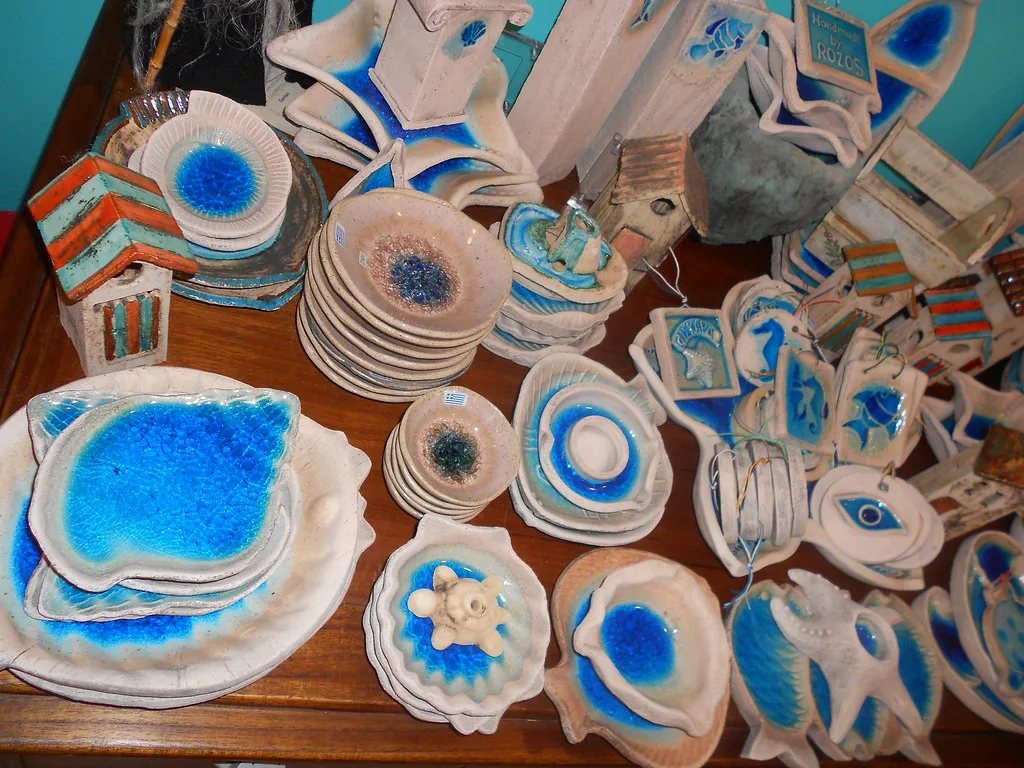
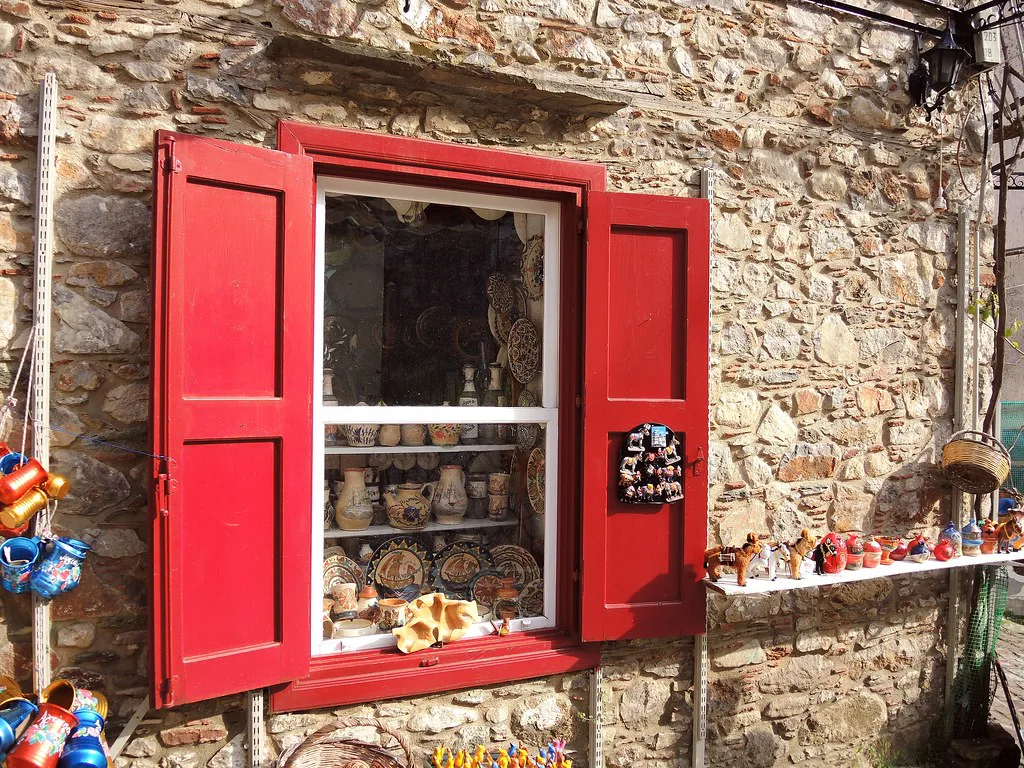
The mati, or Greek evil eye, is the blue glass amulet said to deflect envy and bad luck, and it is now printed on everything from keyrings to jewellery. It is the cheapest meaningful gift in Greece and the first thing to get generic. If you want something that lasts, buy a glass piece or a piece of jewellery rather than a printed tote. Ceramics, small painted churches and textile goods follow the same rule: the handmade version in a gallery or workshop is worth the extra money, the mass-produced version on a harbour strip is not.
Olive wood is the most obvious decorative buy, because the tree is the symbol the country is built on. Shops in Santorini and elsewhere sell olive wood from kitchen utensils to backgammon sets, and the quality varies hugely with the grain and finish. Check for cracks and loose joints in the shop, since returning a warped board from home is not realistic.
Handmade leather sandals are the one souvenir that improves with use, and they can be made to fit within a few days on islands such as Naxos and Santorini. In Athens, Olgianna Melissinos Sandals, in the Monastiraki area near Plaka, sells designs based on ancient Greek sandals and fits them to your feet. The Grand Avenue of ancient sites, including the Acropolis of Athens, is a short walk away, which makes it easy to combine a fitting with a morning of sightseeing.
Art, Replicas and Religious Icons
Museum shops are the reliable place to buy replicas, because the objects are licensed copies of things in the collection rather than loose interpretations of Greekness. Archaeological museum shops stock replica jewellery, vases and frescoes, and you can also find versions in tourist shops at wildly different quality. The trade-off is price against provenance: if you want a copy of a specific piece, buy it where it is labelled as such.
Religious icons are a serious purchase for some travellers and a decorative one for others. Tinos, where the Panagia Evangelistria church draws pilgrims, has streets of shops selling icons of every size, and the island is the most natural place to buy them because the market exists for worshippers, not only for visitors. Paintings and sculptures are the other fragile category: buy them at the end of the trip, ask for them to be packed flat, and carry them rather than checking them if you can.
Souvenirs for Kids and Small Gifts
Children's souvenirs are where the imported stock problem is worst, because the same plastic owl appears in every shop. Better options are mythology-based games and books, children's T-shirts in Greek designs, and stationery, which is cheap, light and gets used. Notepads and pencils seem dull until you are buying for four nieces and nephews at once.
For colleagues and neighbours, the best gifts are the edible ones you can split. Loukoumi, halva and sealed boxes of sweets divide easily, and olive oil soap is a light, cheap option that survives being squashed. This is the category where buying several small things beats buying one impressive object nobody has room for.
Buying Local and Avoiding Overpriced Olive Oil and Honey
The clearest sign that a food souvenir is local is that it names a producer, a village or an island. Honey sold in supermarket jars on the island where it was made is generally better value than the identical-looking jar in a caldera-view shop, and herb blends from a women's cooperative shop are usually both cheaper and more specific. Buy from producers or cooperative shops when you can, and save the harbour-front gift shops for last-minute small items.
There is an obvious split between souvenir shops and dedicated food retail, and a source on Greek souvenir shops argues that talking to shopkeepers is itself part of the purchase, because you get information you will not find on a label. That is true at both ends: a producer can tell you which olive oil is the current harvest, and a concept store can tell you who made the piece. The point is to ask rather than to judge by the window display.
Bargaining is not the norm in Greek food shops, but there is room in some small stores and markets depending on the owner and the item. Treat any discount as a bonus rather than a plan, and remember that the best cushion against overpaying is knowing what the product is before you walk in.
Packing and Customs: Liquids, Glass and Cheese
Packing logic is simple once you decide to follow it: bottles and jars go in the middle of the checked bag, wrapped in clothing, inside a sealed plastic bag; glass and ceramics go in hand luggage surrounded by soft items if the airline allows it; and heavy foods go at the top so they do not crush anything. Buy fragile goods on your last full day, not at the airport, so there is time to repack.
Customs is the part you must look up for your own country rather than rely on a blog. Meat, dairy, fresh fruit and vegetables are commonly restricted, and alcohol duty allowances vary widely, so check your destination's official border or agriculture website before you buy cheese or a second bottle. The shop's opinion does not count at the border. Rules and allowances change, so look up current details close to departure rather than months ahead.
Where to Shop by Area
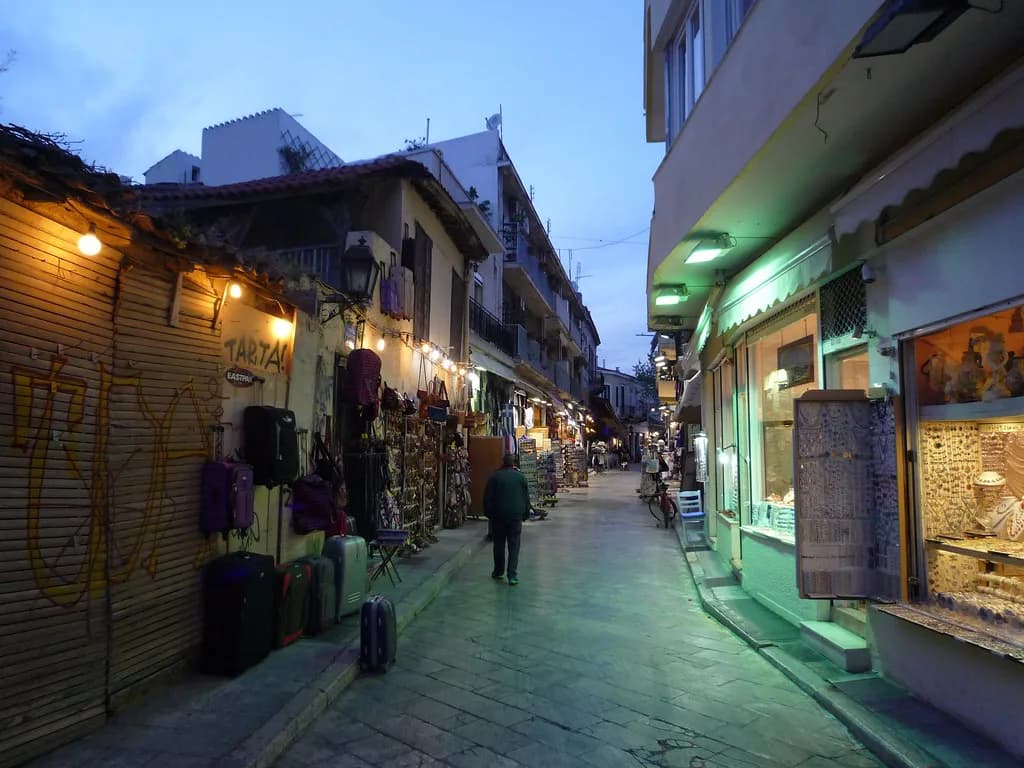
In Athens, Monastiraki and Plaka are the obvious browsing area for everything from worry beads to leather sandals, and it is where you will find the densest concentration of shops. Walk the back streets away from the squares for slightly calmer prices. The trade-off is convenience against authenticity: the central area has the best studios for leather and beads, but it also has the most imported stock, so check what you are buying and where it was made.
Santorini is the island where shopping is most tied to place: the Fabrica Shopping Centre is one of the organised stops, and Oia's Nik. Nomikou street carries a dense strip of shops. If you are planning a day of it, this guide to shopping in Oia covers the layout. On the caldera side expect to pay for the address as much as the object, and buy the serious pieces elsewhere if the view is doing most of the pricing.
Elsewhere, buy by island and by product rather than by shop. Kitron belongs to Naxos, mastiha to Chios, loukoumi to Syros, amygdalata to Andros, Vinsanto to Santorini, capers to Tinos and Santorini and herbs to wherever you are walking. If you see the same product in three shops on three islands without any local link, it is probably not local, and it will be there when you get home if you really want it.
Common Mistakes to Avoid
The most common mistake is buying the same imported item in every port, which turns souvenirs into extra luggage. The second is leaving fragile purchases until the last morning, when there is no time to find packing material or a post office. The third is buying heavy food early in a multi-island trip and carrying it for two weeks; buy olive oil and honey at the end, and buy it in the town you are flying home from if you can.
The last mistake is skipping the check on what your airline will accept and what your country will allow. A bag of almonds and a bottle of tsipouro are easy to carry but not always easy to clear, and the responsibility sits with you rather than the shop. Do a two-minute check before you buy the second bottle. One final reminder: opening hours and stock change with the season, particularly outside high summer, so check current details before you make a special trip to a specific shop.
Plan Your Souvenir Shopping
The best Greek souvenirs are the ones that carry a place with them: a jar of thyme honey and a bag of mountain tea, a bottle of kitron from Naxos, a set of komboloi from a proper bead shop, or a pair of leather sandals made to fit near Monastiraki. Work out which of those you actually want before you go, and the shopping stops being a chore and becomes part of the trip.
Whichever you choose, buy the food and drink in the last days, pack glass and liquids as if they will leak, and check your own customs rules rather than trusting shop advice. The fridge magnets will survive the flight; the good stuff needs a little planning.
Explore more Greece sauna guides
Frequently Asked Questions
What is the best thing to buy in Greece?
There is no single answer, but the items most tied to a specific place are olive oil with a named producer, honey and herbs from island producers, kitron from Naxos, mastiha from Chios, loukoumi from Syros and Vinsanto from Santorini. For a non-food souvenir, komboloi worry beads and handmade leather sandals last longer than most gifts and are small or useful rather than decorative clutter.
Which Greek souvenirs are actually made in Greece?
Look for a producer, village or island on the label. Ouzo is protected and must be made in Greece or Cyprus, kitron is produced on Naxos, mastiha comes from Chios, NISSOS beer is made on Tinos and Mikònu beer on Mykonos. Plain souvenir stock, such as magnets, printed bags and generic ceramics, is often imported, so ask where a piece was made before paying for it.
What Greek food souvenirs can I bring home?
The easiest are dry and light: dried herbs, mountain tea, sealed boxes of loukoumi and halva, and olive oil soap. Olive oil, olives, capers, honey and spoon sweets need to be in sealed jars or tins and packed for leaks. Cheese, fresh produce and meat are commonly restricted by destination countries, so check your own border rules before buying dairy.
How do I pack olive oil and ouzo in my suitcase?
Put bottles and jars in the middle of the checked bag, wrapped in clothing and inside a sealed plastic bag, so they are cushioned on all sides. Do not put them in an outer pocket where they take the impact. Buy fragile or bottled items on your last full day rather than the morning of departure, and check your airline's rules on liquids before you rely on hand luggage.
What souvenirs should I buy in Athens?
Monastiraki and Plaka have the densest concentration of shops for komboloi, leather sandals, ceramics and replicas. Olgianna Melissinos Sandals, in the Monastiraki area near Plaka, sells sandals based on ancient Greek designs and fits them to your feet. Buy small items in the centre, and save heavy food and oil for the end of the trip.
Are there customs limits on Greek souvenirs?
Yes, and they are set by the country you are entering rather than by Greece. Alcohol allowances, dairy and meat restrictions and rules on plants all vary, so check your destination's official customs or agriculture website before you buy. Keep receipts, leave bottles sealed in original packaging, and do not rely on a shop assistant's advice about what your country permits.
What are good Greek souvenirs for kids?
Mythology-based games and books, stationery, T-shirts with Greek designs and small sealed sweets work well because they are light and actually get used. Avoid the plastic character toys that appear in every shop. Children's clothing in Greek styles is also widely sold, and the smaller sizes are easy to pack.
Is it worth buying olive wood or ceramics?
Both are worth it if you buy the handmade version from a workshop, gallery or museum shop rather than a harbour-front stall. Inspect olive wood for cracks and loose joints, and ask for ceramics to be wrapped flat for carrying. The trade-off is weight and fragility against a piece you will use for years, so buy them at the end of the trip when you know your luggage limits.
Sources
Notes for eating well in Greece
Optional updates to our guides.
You might also like
Continue reading
More guides you'll find useful