Greek Pharmacies: Green Cross, Hours and Duty Rotas
Greek pharmacies wear a green cross and are pharmacist-run. Learn how opening hours, the Sunday duty rota and finding an open pharmacy work.
On this page
A pharmacy in Greece is a farmakeio, and it does not look much like a drugstore at home. The counter is staffed by qualified pharmacists who serve customers themselves, ask what the product is for and hand over most items rather than leaving you to browse shelves. Knowing how the sign, the hours and the duty system fit together saves a lot of walking.
The basics are simple: look for the green cross, expect a lunchtime gap on weekdays, and rely on the rota system rather than a single late-night shop for after-hours needs. The sections below cover each part, from the word on the sign to what is worth packing before you leave.
What a Greek pharmacy is: farmakeio, the green cross and the counter
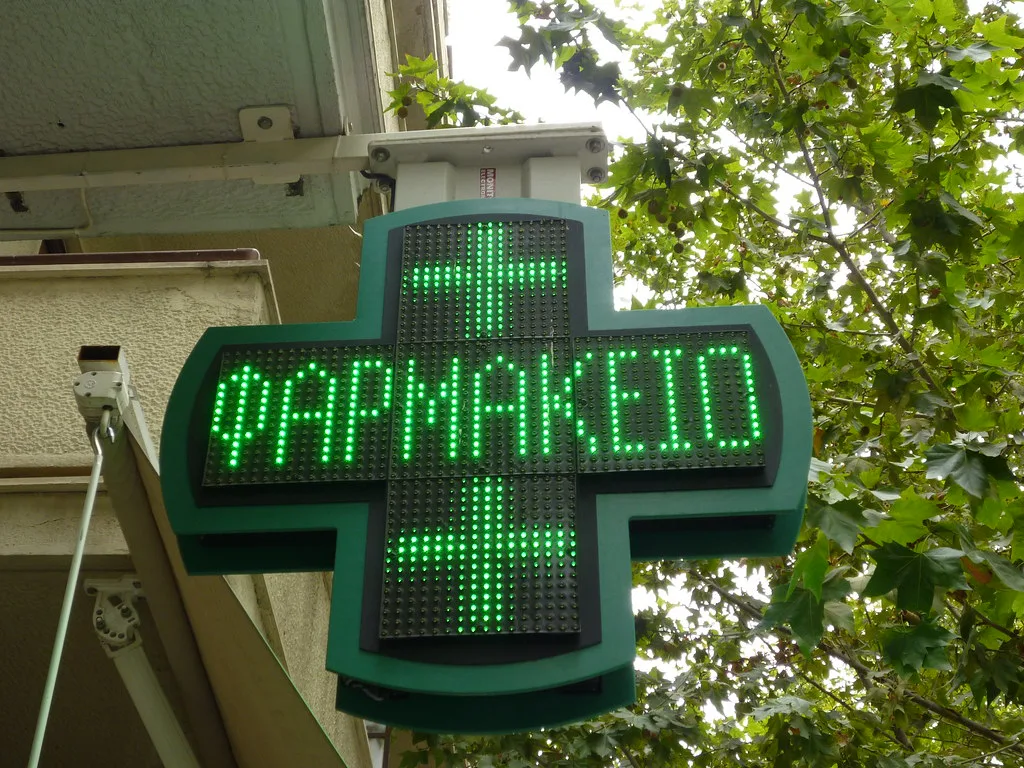
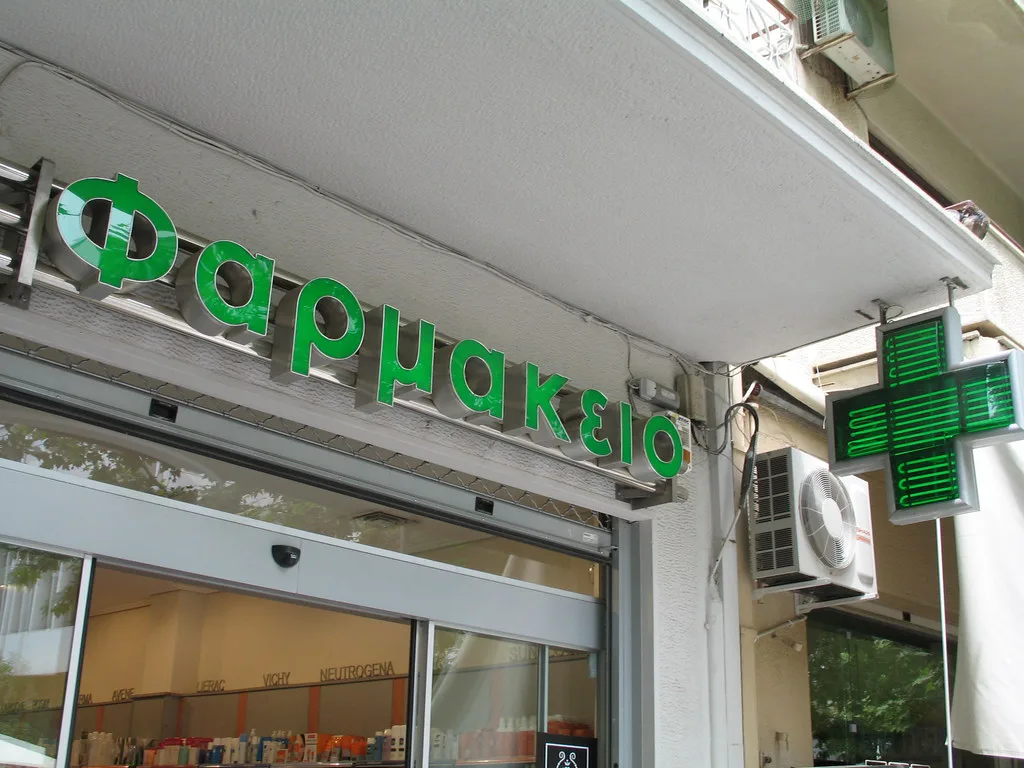
The Greek word for pharmacy is farmakeio, written φαρμακείο on shopfronts and signage. The universal marker is a green cross, often illuminated, which is the fastest way to identify one from across a street or square in an unfamiliar town. In cities you may pass several within a few blocks.
What is the Greek word for pharmacy? The word is farmakeio, written φαρμακείο on signs. Pharmacies are marked outside by a green cross, often lit, which is the easiest way to spot one in an unfamiliar street or square.
Are pharmacies open on Sundays in Greece? Most are closed on Sundays, with cover provided by the duty rota, which rotates among a defined set of shops. The shop on duty changes daily, so check the day's list.
How do I find a 24-hour pharmacy in Athens? There is no single fixed all-night pharmacy for the whole city. After-hours cover is organised through the duty rota, listed by county and region for Attica, so look up which pharmacy is on duty for your area on the day you need it.
Inside, the model is advice-led rather than self-service. You describe the problem at the counter and the pharmacist selects a product, explains how to use it and takes payment; many items are kept behind the counter or in drawers rather than on open shelves. This is why the staff member who greets you is usually a pharmacist, not a shop assistant, and why a short conversation in English or with translation help is normal.
Treat the pharmacist as the person who decides what is appropriate for your situation. This guide explains the system and what is sold, not what you should take; for anything beyond a minor everyday item, ask the pharmacist or see a doctor.
Typical opening hours: the weekday split, Saturday and Sunday
The common Greek pattern is a split weekday: pharmacies open in the morning, close for a long midday break, and reopen for a late-afternoon and early-evening session. Individual shops vary, and city-centre pharmacies often run longer or continuous hours than neighbourhood ones, so the pattern is a planning aid rather than a guarantee.
Saturdays are usually shorter, often mornings only, and most pharmacies are closed on Sundays apart from those on the duty rota. If you need something specific, check the shop's own hours before making a trip rather than assuming a nearby pharmacy will be open.
Public holidays follow the same logic: expect closures, with cover provided by the rota. Build a small buffer of any regular item into your first day in a new town, especially if you are heading to a smaller island where the next pharmacy may be some distance away. If your route takes in Crete, the same first-day stocking-up approach works well alongside the practical pointers in our guide to things to do in Heraklion.
The duty rota (efimeria): how after-hours and Sunday cover works
Greek pharmacies share out evenings, nights, Sundays and holidays through a duty rota, so that a defined set of shops stays open when the rest close. The rota changes daily, and the shop on duty is not necessarily the one nearest your hotel, so it is worth checking before you set out rather than walking to the first green cross you see.
Pharmacies on duty usually display a notice on the door or window naming the day's duty pharmacy and its address, which lets you chain from a closed shop to an open one even without a phone. The same information is published in local listings and on regional pharmacy association pages.
Because the rota is updated day by day, an address copied from an old blog post or a screenshot from last week can send you to a closed door. Check the day's list on the day you need it, and note that the duty pharmacy may be a taxi ride or a longer walk from where you are staying.
Finding the Athens duty list by county and region
For Athens and the wider Attica region, the duty list is organised by county and then by region within it, so you select your area and see which pharmacies are on duty there. The county-and-region structure matters: a single central number or one fixed address will not cover the whole metropolitan area, which spreads well beyond the centre.
A general pharmacy directory is useful for the daytime case, when you simply want the nearest open shop rather than the duty one. It maps pharmacies across Greece and gives locations and directions, which helps when you are in an unfamiliar neighbourhood and want to confirm what is within walking distance.
As a concrete example of a city-centre pharmacy, the Pharmacy of Athens lists its address as Panepistimiou 25-29 in central Athens, with a published telephone number for ordering and customer service, a weekday call-centre window, and free delivery above a stated order threshold. Read those details from the shop itself before relying on them, since addresses and thresholds are exactly the kind of thing that changes.
Anyone who has just changed money or is working out a budget for the trip may want the wider picture on costs and payments, covered in the guide to the currency in greece.
Over-the-counter versus prescription: what you can buy
Greek pharmacies sell a wide range of non-prescription items, and in practice the pharmacist's judgement decides what is handed over. Everyday products such as sun cream, insect repellent, rehydration sachets, plasters and similar first-aid supplies are the routine purchase; medicines that require a prescription in Greece will not be sold without one.
If you take regular medication, bring enough for the trip plus a margin, keep it in original packaging, and carry a copy of your prescription or a doctor's letter if the medicine is controlled or injectable. Rules on bringing medicines into the country are set by the authorities rather than the pharmacy, so confirm the current requirements with your airline and the Greek embassy or consulate before travelling.
Do not ask a pharmacist to substitute a prescription medicine or to advise on dosages for a condition; that is a medical decision, and the correct route is a doctor or a local health facility. The pharmacy's role is to dispense and explain what has been prescribed.
Brands and product types: what Greek pharmacies stock
Greek pharmacies lean heavily towards dermocosmetics, sun care, supplements and baby products, with international brands sitting alongside Greek ones. The Pharmacy of Athens site, for example, groups brands including Korres, Apivita, Frezyderm, La Roche-Posay, Vichy and Avene alongside supplements and fertility products, which gives a fair sense of the mix in a well-stocked city shop.
For travellers this is practical: high-factor sunscreen, after-sun, insect repellent and rehydration salts are easy to buy locally, so there is no need to fill a suitcase with them. Greek pharmacies are also a sensible stop for a European plug adapter if you have forgotten one; the greece plug type guide explains which fittings the country uses.
If you want to plan meals and market stops around your days, a look at what to eat in Greece helps you slot shopping and eating into the same neighbourhood walks as your errands. Picking up sun cream or first-aid supplies in a central neighbourhood is an easy pairing with a market visit, much as planning ancient sites in greece works best alongside your other errands.
Island and small-town pharmacies: fewer options, plan ahead
Outside Athens and the big mainland cities, pharmacies are fewer and often smaller, and the duty rota rotates among a short list of shops rather than a long one. On smaller islands there may be very little choice at a given hour, and the duty pharmacy can be in the main town while you are staying in a coastal village.
The safe approach is to refill regular medication before leaving a city, and to treat the last days on an island as a reason to check your supply rather than hoping to top up locally. A pharmacy may have a narrower range of brands than an Athens shop, so if a particular product matters to you, bring it.
Seasonal patterns affect some island businesses, but opening arrangements vary by place and year and are not something to assume for a specific pharmacy. Ask your accommodation host which pharmacy serves the area and how the duty rota works that week.
Practical etiquette: queuing, asking and language basics
Queues are common and informal: join the line at the counter and wait your turn rather than browsing, since most goods are behind the counter anyway. Keep your request short, and have the product name written down or a photo of the packaging if you use a specific brand.
Useful words are farmakeio for pharmacy and efimeria for the duty rota; a simple question about which pharmacy is open today is usually understood in English in cities and tourist areas, less so in remote villages. Pharmacists in Greece are trained professionals and many speak some English, so a plain description of the problem is normally enough.
Payment is by cash or card at most city pharmacies, but carry some cash for small island shops where card acceptance can be less reliable. For a broader look at how payments and cash work on the trip, see the guide to the currency.
Quick reference: what to confirm before you rely on a pharmacy
Before you count on a pharmacy for a specific need, confirm four things: that it is open at the hour you plan to go, that it stocks the item or can order it, whether a prescription is required, and, if it is after hours, that it is the pharmacy on duty that day. Each answer comes from the shop or the day's rota list, not from a general guide.
It is also worth knowing your backup before you need it: the nearest hospital or health centre, the number of your travel insurer, and enough of any regular medication to get you home. A few minutes of planning at the start of a trip removes most of the friction of a pharmacy visit abroad.
Plan Your Visit
Greek pharmacies work on a simple visual cue and a cooperative rota: find the green cross, expect split hours on weekdays, and check the day's duty list for evenings, Sundays and holidays. The pharmacist at the counter is the person who advises and dispenses, so a short, direct question gets you further than scanning shelves.
Before you travel, pack regular medication with a margin, keep prescriptions handy and note the address of one central pharmacy in each city on your route. On the islands, treat supplies as something to secure in town rather than something to assume in the village.
Explore more Greece sauna guides
Frequently Asked Questions
What is the Greek word for pharmacy?
The word is farmakeio, written φαρμακείο on signs. Pharmacies are marked outside by a green cross, often lit, which is the easiest way to spot one in an unfamiliar street or square.
Are pharmacies open on Sundays in Greece?
Most are closed on Sundays, with cover provided by the duty rota, which rotates among a defined set of shops. The shop on duty changes daily, so check the day's list.
How do I find a 24-hour pharmacy in Athens?
There is no single fixed all-night pharmacy for the whole city. After-hours cover is organised through the duty rota, listed by county and region for Attica, so look up which pharmacy is on duty for your area on the day you need it.
Can I buy medicine without a prescription in Greece?
Pharmacies sell many non-prescription items such as sun care, insect repellent and first-aid supplies, and the pharmacist decides what to hand over. Medicines that require a prescription in Greece are not sold without one, so bring your own supply and paperwork.
What is a duty pharmacy in Greece?
A duty pharmacy is the shop that stays open outside normal hours under the efimeria rota, covering evenings, nights, Sundays and holidays. Its details are usually posted on other pharmacies' doors and published in regional listings that change daily.
Do Greek pharmacies speak English?
In Athens, other cities and tourist areas, many pharmacists speak some English and a plain description of what you need usually works. In remote villages English may be limited, so writing the product name or showing a photo of the packaging helps.
Sources
Notes for eating well in Greece
Optional updates to our guides.
You might also like

Continue reading
More guides you'll find useful