Greek Desserts: 12 Sweets to Try in Greece and What They Are
A practical guide to Greek desserts: what galaktoboureko, bougatsa, loukoumades and spoon sweets are, how they are served, and what to order with coffee.
On this page
Sweets in Greece are not a single course but a series of small moments: a warm pastry in the morning, a syrupy square with a small cup of coffee at four, a shared plate at the end of a taverna meal. Knowing that rhythm helps you order sensibly, because the same names appear in bakeries, cafés and restaurant dessert menus in quite different forms. This guide explains what each dessert actually is, which pastry terms unlock a menu, and how to decide between a bakery box and a plated dessert.
How Sweets Fit Into a Greek Day
Breakfast is where many travelers first meet Greek desserts without realizing it. Bougatsa, a semolina custard baked in a puff pastry wrap, is often eaten in the morning as well as later in the day, which makes a bakery stop a practical start rather than an indulgence. A sit-down breakfast will usually offer yogurt with honey and fruit; see the guide to greek breakfast for how those morning plates are put together.
What are typical Greek sweets? The most common are syrup pastries such as baklava and kataifi rolls, custard sweets such as galaktoboureko and bougatsa, fried honey puffs called loukoumades, syrup-soaked cakes such as portokalopita and revani, and coffee-shop spoon sweets. Christmas brings melomakarona and kourabiedes, which are less common in summer.
What is a traditional Greek custard dessert? Galaktoboureko is the best-known: a semolina custard baked in filo pastry and soaked in syrup. Bougatsa uses a similar custard in puff pastry and is often eaten at breakfast.
Are Greek desserts eaten at breakfast? Yes, bougatsa in particular is commonly eaten in the morning, and bakeries selling it open early. Yogurt with honey is the other typical breakfast sweet.
The afternoon coffee is the second sweet moment. In a kafeneio or a café, a small pastry or a spoon sweet is ordered alongside the cup rather than after it, and the sweet is often lighter than a restaurant dessert. The third moment is the end of a taverna meal, when a plate of fruit, a slice of cake or a few loukoumades may arrive; it is worth asking what is on offer that day, since many kitchens rotate what they serve and change prices and dates with the season.
Quick Glossary: The Pastry Words That Unlock a Menu
Three words do most of the work. Filo is the very thin sheet pastry layered with butter, nuts or custard. Kataifi is shredded filo, which looks like fine noodles and is usually rolled around nuts and soaked in syrup. Semolina, a coarse wheat flour, appears in custard fillings, cakes and puddings, and is the reason so many Greek sweets have a slightly grainy, dense texture rather than a light sponge.
The second distinction is between custard-filled and syrup-soaked. Custard sweets such as galaktoboureko and bougatsa are built around a milk-and-semolina filling and are best eaten the day they are made. Syrup sweets such as baklava, kataifi rolls and saragli keep far better because sugar syrup acts as a preservative, which is why they dominate bakery trays and travel well in a box.
A third useful term is glyko, meaning sweet, which appears in glyka tou koutaliou, the spoon sweets served with coffee. Recognizing it on a menu tells you that you are looking at a preserve rather than a baked pastry. Once these words are familiar, most dessert counters become readable at a glance, even without a translation.
Custard Desserts: Galaktoboureko and Bougatsa
Galaktoboureko is a custard baked inside filo pastry and then soaked in syrup, so it combines a soft, milky center with a crisp top layer. Because the filo softens quickly once syrup is poured, it is at its best on the day it is baked, which makes a morning or midday bakery visit a better bet than buying a slice to eat the next day. Ask for it slightly warm if the shop has a fresh tray.
Bougatsa uses a similar semolina custard but wraps it in puff pastry instead of filo, giving a flakier, more layered shell. In some shops it is sold as a breakfast item and in others as an afternoon snack, so opening hours rather than tradition decide when you find it. A third relative, galaktopita, is a semolina milk pie, which is denser and more like a set custard tart than either of the two above.
If you want one traditional Greek custard dessert to try first, galaktoboureko is the one most often named as the benchmark, since it shows both the custard and the syrup technique in one piece. Order a single square with a coffee rather than a larger portion, because the combination of milk and syrup is filling. For savory morning pastries and the wider bakery repertoire, the guide to traditional greek food explains what else sits alongside these sweets.
One practical warning: custard sweets do not sit well in summer heat. If you are buying to take away, ask the shop to pack them separately from anything warm, and eat them within a few hours rather than carrying them around all afternoon.
Nut-and-Syrup Pastries: Baklava, Kataifi Rolls and Saragli
Baklava is the best-known member of this family: many thin layers of filo with chopped nuts between them, sweetened with syrup or honey. The nuts vary by shop, and a mix of walnut, almond and pistachio is common, with cinnamon often in the filling. The finished tray is cut into diamonds or squares and sold by the piece or by weight.
Kataifi rolls use the same idea but with shredded pastry wrapped around an almond or walnut filling, which gives a different texture: crisper on the outside and more fibrous inside. Saragli is essentially baklava rolled into cylinders rather than cut flat, sometimes called baklava cigars. The practical difference is mostly shape and the nut-to-pastry ratio, so if you dislike a very syrupy piece, a rolled version is often a little firmer.
These are the pastries that survive a journey best. A bakery will usually box them in a single layer, and they will keep for several days if kept dry; a hot car or a beach bag will not do them any favors. This is also the category to choose if you want to buy a small assortment and taste several types in one sitting rather than committing to one large piece.
Loukoumades: Honey Puffs and How They Are Served
Loukoumades are small balls of deep-fried dough, served warm and drenched in honey, sometimes with cinnamon or walnuts on top. They are made to order in most places, which is why the queue outside a dedicated shop moves slowly but the portion arrives hot. They are best eaten immediately, standing or at a nearby table, because they go soft once they cool.
Portions are usually generous, so a small paper cone is enough for two people who have already eaten. In a taverna they may appear as a shared dessert at the end of the meal, while a street-side shop sells them as a snack at any hour. For the wider context of counter food and how it is ordered, see the guide to greek street food.
Cakes From the Bakery: Portokalopita, Karithopita, Revani and Milopita
These are the cakes you will see cut into squares and sold by weight in bakery windows. Portokalopita is an orange cake, moist and syrup-based, with a dense texture that comes from shredded filo or semolina in the batter. Karithopita is a walnut cake, and revani is a semolina sponge soaked in sugar syrup, usually lighter in color and very moist.
Milopita is an apple cake, closer to what a northern European bakery would call a coffee cake, and often less syrupy than the others. A useful buying rule: if you want something to carry, choose the drier cakes such as karithopita or milopita; if you plan to eat within the hour, the syrup-soaked portokalopita and revani are worth the mess. Buying by weight lets you ask for a small slice of each rather than a whole piece. If your travels take you to the Cyclades, the same bakery-to-taverna rhythm applies, and our guide to Things to Do in Naxos: Beaches, Mountain Villages & Portara shows where those counter stops fit around a day of sightseeing.
Spoon Sweets and the Vanilla Submarine
Spoon sweets, glyka tou koutaliou, are fruits or nuts preserved in thick syrup and served on a small spoon, often with a glass of cold water and a Greek coffee. Cherry, fig, apricot and watermelon are common, and the same preserve is sometimes spooned over yogurt as a topping. They are the standard sweet offered in a kafeneio and rarely appear on a restaurant dessert menu.
The vanilla submarine, called ypovrichio, works on the same principle but with a scoop of sweet vanilla paste on a spoon plunged into cold water. A version made with mastiha, the resin from mastic trees on Chios, is also common and gives a piney, slightly bitter flavor. You lift the spoon and eat the paste, or stir it into the water so the drink sweetens as you go. For more on the coffee that accompanies these, see the guide to greek coffee.
Seasonal Cookies: Melomakarona and Kourabiedes
Melomakarona are honey cookies, dark and syrup-soaked, and they are strongly associated with Christmas. Kourabiedes are almond shortbread cookies dusted with icing sugar, also a Christmas sweet, and dry enough that they need a coffee alongside. Outside the winter months you may not find them at all, which makes them a timing decision rather than something to search for in July.
If your trip falls in the Christmas season, a bakery box of both is the simplest way to try them, and they travel better than custard sweets. If you visit in summer, don't spend the day hunting for them; choose a syrup pastry or a cake instead, and check what the shop has on the tray that day.
Puddings and Chilled Sweets: Rizogalo and Halva
Rizogalo is Greek rice pudding, made with milk and rice and usually served cold in summer, sometimes with cinnamon on top. It is one of the few desserts that is genuinely refreshing in heat, and it is sold in small tubs in bakeries as well as on dessert menus. Halva is a semolina pudding, dense and sweet, with a texture closer to a set cake than to a creamy dessert.
Halva is not to everyone's taste because of its coarse, grainy texture, so if you are unsure, ask for a small piece rather than a full portion. Both of these keep well and can be bought earlier in the day without spoiling, which makes them a practical option for a long bus or ferry journey.
Sweets With a Regional Story: Diples and Mastiha
Diples are thin sheets of dough fried and folded into curls, then drizzled with honey and walnuts. They are associated with the Peloponnese but are now sold across Greece, particularly at festivals and in bakeries that specialize in regional sweets. Their shape makes them fragile, so they are usually boxed loosely rather than stacked.
Mastiha, the resin from mastic trees on Chios, turns up in sweets and drinks on the island and beyond, including the vanilla submarine mentioned earlier. It has a distinctive flavor that some travelers love and others find medicinal, so it is worth trying a small amount first. Chios itself is the place to see how the resin is produced, though sweets made with it are sold widely.
Drinks to Pair With Greek Sweets
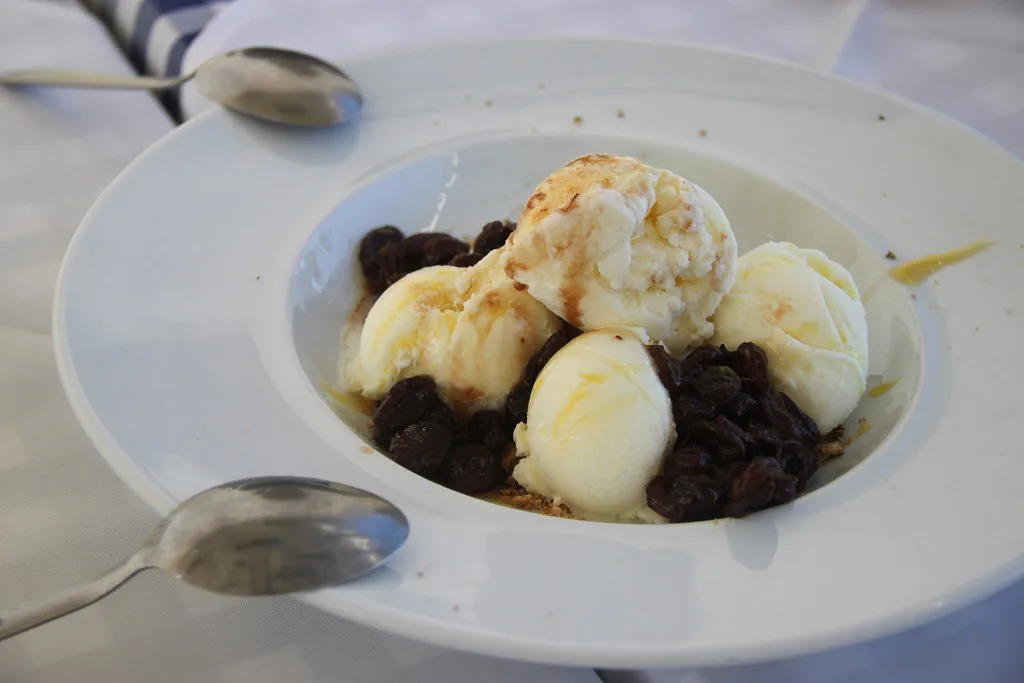
Greek coffee is the most common partner: a small, strong cup balances the sugar in a syrup pastry, and it is served in a briki with the grounds settled at the bottom. Ask for it plain, medium or sweet if you have a preference, since it is made to order. A glass of cold water usually arrives alongside, especially with spoon sweets.
For a lighter pairing, a plain yogurt drink or a glass of water works better than a soft drink with very sweet pastries. If you are having sweets at the end of a meal with ouzo or tsipouro, keep the portion small, since both drinks are strong and the combination can overwhelm the pastry.
How to Order: Portions, Sharing and Buying by Weight
In a bakery, most pastries are sold by the piece or by weight, so you can ask for a small square of several kinds rather than one large slice. Pointing at the tray is normal and works even if you don't speak Greek. Ask for the piece to be cut in half if you are sharing, since many squares are designed for one person with coffee rather than as a dessert after a full meal.
In a taverna, dessert may be included, offered as a small plate, or listed on the menu with a price; ask before assuming. In a café, a spoon sweet often comes automatically with a coffee, while a pastry is ordered separately. Knowing which venue you are in is the quickest way to avoid ordering more than you intended.
Practical Notes: Bakery Trays vs Restaurant Menus and Takeaway in the Heat
Bakery trays and restaurant dessert menus overlap less than you might expect. The bakery is where you find the full range of syrup pastries, cakes by weight and custard sweets; the restaurant dessert menu tends to be shorter and may feature only one or two items, often a cake or a plate of fruit. If a particular dessert matters to you, buy it at a bakery during the day rather than hoping it appears after dinner.
Heat is the main practical risk. Custard sweets, yogurt-based desserts and anything with fresh cream should not sit in a car or on a beach for hours; syrup pastries survive better but still soften. Ask for a box rather than a bag for anything fragile, and if you are traveling onward by ferry, buy sweets the morning of departure rather than the day before.
If You Only Try Five
For a short trip, choose one from each family: galaktoboureko for the custard, baklava or a kataifi roll for the syrup-and-nut pastries, loukoumades for the hot fried snack, portokalopita for the bakery cakes, and a spoon sweet with coffee for the café tradition. That set covers the techniques and the settings, so you can judge the rest of a menu quickly.
If your visit falls in winter, add melomakarona or kourabiedes, which are hard to find out of season. Buy small portions, eat custard sweets the same day, and carry syrup pastries flat in a box. For what to eat alongside them, the guide to traditional greek food covers the savory side of the same counters.
Explore more Greece sauna guides
Frequently Asked Questions
What are typical Greek sweets?
The most common are syrup pastries such as baklava and kataifi rolls, custard sweets such as galaktoboureko and bougatsa, fried honey puffs called loukoumades, syrup-soaked cakes such as portokalopita and revani, and coffee-shop spoon sweets. Christmas brings melomakarona and kourabiedes, which are less common in summer.
What is a traditional Greek custard dessert?
Galaktoboureko is the best-known: a semolina custard baked in filo pastry and soaked in syrup. Bougatsa uses a similar custard in puff pastry and is often eaten at breakfast. Both are best on the day they are made, so buy them from a bakery with a fresh tray.
Are Greek desserts eaten at breakfast?
Yes, bougatsa in particular is commonly eaten in the morning, and bakeries selling it open early. Yogurt with honey is the other typical breakfast sweet. Custard sweets are a morning purchase because they do not keep well.
What are spoon sweets in Greece?
Spoon sweets, glyka tou koutaliou, are fruits or nuts preserved in thick syrup and served on a small spoon, usually with a glass of cold water and a Greek coffee. They are a café tradition rather than a restaurant dessert and are sometimes spooned over yogurt.
What dessert should I order after Greek food?
A small portion of baklava or a kataifi roll is the easiest choice after a full meal, since the syrup pastries are rich but sold in small pieces. Loukoumades are better shared. Ask whether dessert is included or priced separately before ordering.
Can I buy Greek desserts to take away?
Yes, bakeries sell most pastries by the piece or by weight and will box them. Syrup pastries travel best; custard sweets and anything with fresh cream should be eaten the same day and kept out of heat. Ask for a flat box for fragile items such as diples.
Sources
Notes for eating well in Greece
Optional updates to our guides.
You might also like
Continue reading
More guides you'll find useful