Santorini History for Visitors: Bronze Age Akrotiri to the 1956 Quake
Understand Santorini's history through the sites you can visit, from Minoan Akrotiri to Ancient Thera, with plain-English context and practical planning notes.
On this page
Santorini draws visitors for the caldera view, but the island's past is legible in specific places: an excavated Bronze Age town, a hilltop classical city, scattered castle walls, and villages rebuilt after a modern earthquake. Reading those sites in order turns a scenic stop into a coherent story about how volcanic ground shaped where people could live.
This guide is organized the way a trip is organized, by place and by day, rather than as a chronological essay. Each section names the site, its area, and what you are actually looking at, then flags what archaeologists still argue about so you do not carry away popular myths as settled fact.
Why Santorini's History Matters for Planning
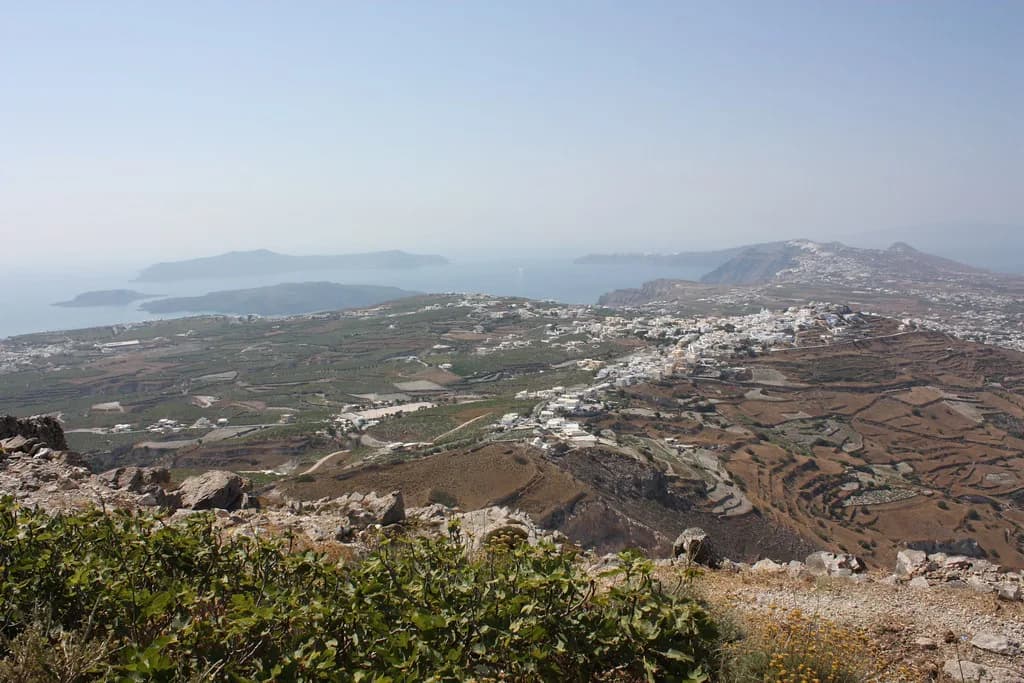
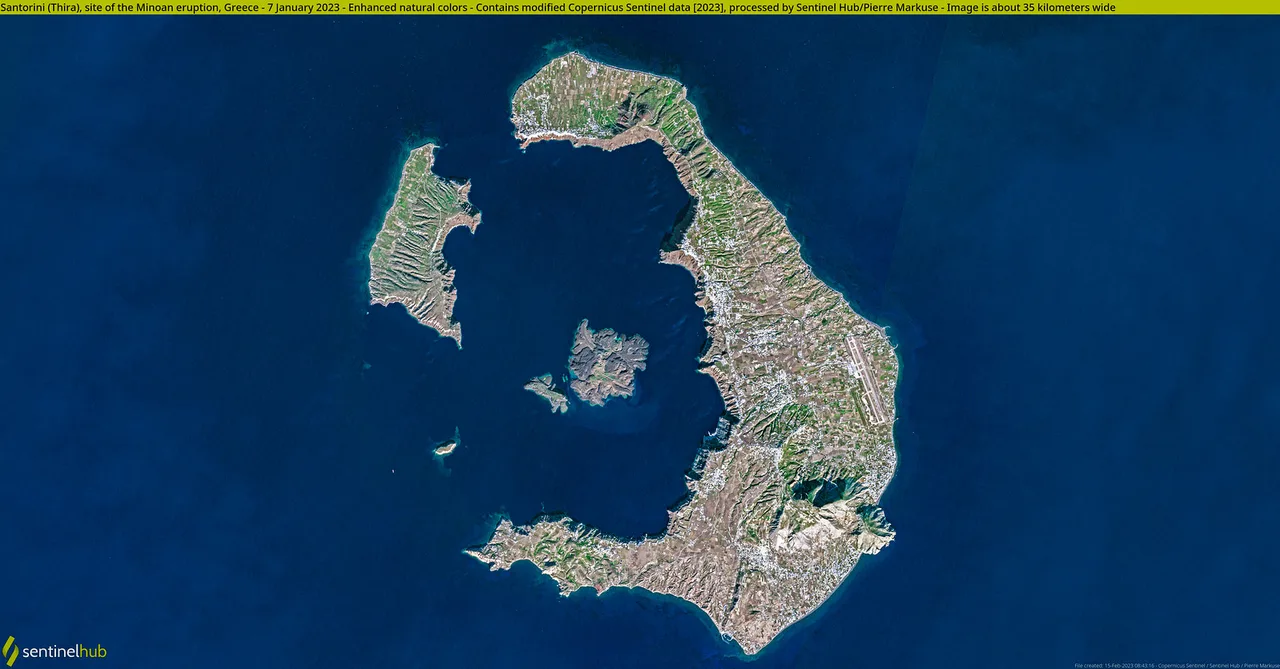
Santorini's landscape is the reason its history looks the way it does. The island is the rim of a flooded volcanic caldera, so settlements hug the cliff edge or sit on high ground inland, while the beaches and harbours lie below. Knowing that explains why a drive between two sites that look close on a map can take far longer than expected, and why so many viewpoints involve stairs.
What is Santorini best known for historically? It is best known for the Bronze Age eruption and the settlement buried at Akrotiri, and secondarily for the classical city on Mesa Vouno at Ancient Thera. Later medieval fortifications and the 1956 earthquake make up the more recent layers.
Where can you see Santorini's history in person? Akrotiri in the southwest is the main excavated Bronze Age site, and Ancient Thera on the Mesa Vouno ridge above Kamari and Perissa preserves the classical city. Medieval walls and post-earthquake rebuilding are visible inside villages rather than at a single ticketed monument.
What happened at Akrotiri? A Bronze Age town was buried under volcanic material from a major eruption and has since been excavated, revealing multi-storey buildings, streets and storerooms. Much of the portable material is held in museums, so the site itself shows architecture and town planning.
For a wider frame, compare Santorini with other archaeological destinations before you commit days to it; our guide to ancient sites in greece sets out how Greek sites differ in scale, setting and access. That context helps you decide whether Akrotiri and Ancient Thera deserve a full day each or a half day combined.
Start With the Island's Shape: Caldera and Volcanic Ground
The caldera is not scenery bolted onto the history; it is the history. Volcanic activity, earthquakes and erosion produced the steep cliffs and the broken outline that later determined where towns, castles and harbours could be built. As you move around the island, notice that the densely built caldera-edge villages face inward, while the long sandy beaches on the east side sit at sea level.
A practical consequence: plan by side of the island, not by straight-line distance. Group Fira and the caldera villages together, and treat Akrotiri in the southwest and Ancient Thera above Kamari and Perissa as separate outings. Trying to tick all three in one afternoon usually means rushing the site you came for.
The Minoan Eruption: What Happened and What It Buried
The Bronze Age eruption is the anchor of Santorini's story: a major volcanic event that buried a settlement in ash and left deep layers that archaeologists now read like a timeline. The date is usually given as roughly the middle of the second millennium BC, but the precise year is still argued over, so treat any confident single date you see advertised as an approximation under debate.
Two popular claims deserve caution. The idea that Santorini is the lost city of Atlantis is speculation, not an archaeological finding, and the suggestion that the eruption single-handedly ended Minoan Crete is contested rather than proven. Visit the sites for what they physically preserve, and hold the big theories loosely.
Akrotiri: The Bronze Age Town Under the Ash
Akrotiri, in the southwest of the island, is the reason many travellers come: a Bronze Age settlement preserved under volcanic material, with multi-storey buildings, paved passages and storerooms. What you see is the excavated architecture, not furnished rooms; much of the portable material went to museums, so the visit is about urban layout, construction and drainage as much as objects.
Read the buildings as a town rather than a monument. Look for the street plan, the way houses share walls, and the upper floors that survived because they were sealed. The site is covered, which makes it a sensible choice in strong midday sun and a reasonable fallback when coastal activities are blown out.
Ancient Thera: The Classical City on Mesa Vouno
Ancient Thera sits on the ridge of Mesa Vouno between Kamari and Perissa, high above the coast. The position is the point: a defensible site with wide views and cooling exposure, connected to the sea by steep routes rather than by a harbour at its door. Remains include streets, terraces, cisterns and civic structures that reward slow walking rather than a quick photo stop.
Expect exposed ground, uneven stone and little shade, so sturdy shoes and water matter more than at a covered site. Because the ridge road climbs from the coast, the drive itself takes time; pairing Ancient Thera with a beach morning in Kamari or Perissa works better than squeezing it in before a caldera sunset booking.
Medieval and Venetian Layers: Castles and Fortified Villages
Later centuries left a different kind of site: fortifications, watchpoints and compact settlements built for defence during periods of Aegean piracy and rivalry. These layers are less packaged for visitors than Akrotiri, often appearing as fragments inside villages rather than as ticketed monuments, so the reward comes from noticing walls, gates and the tight, inward-looking street patterns.
Island place-names carry part of this memory, and similar medieval layers survive elsewhere in Greece. Our Rhodes History for Visitors covers a far more monumental version of the same era, including the walled Rhodes Old Town, and is useful for understanding what a fortified Aegean settlement looks like when it is largely intact.
The 1956 Earthquake and Its Legacy
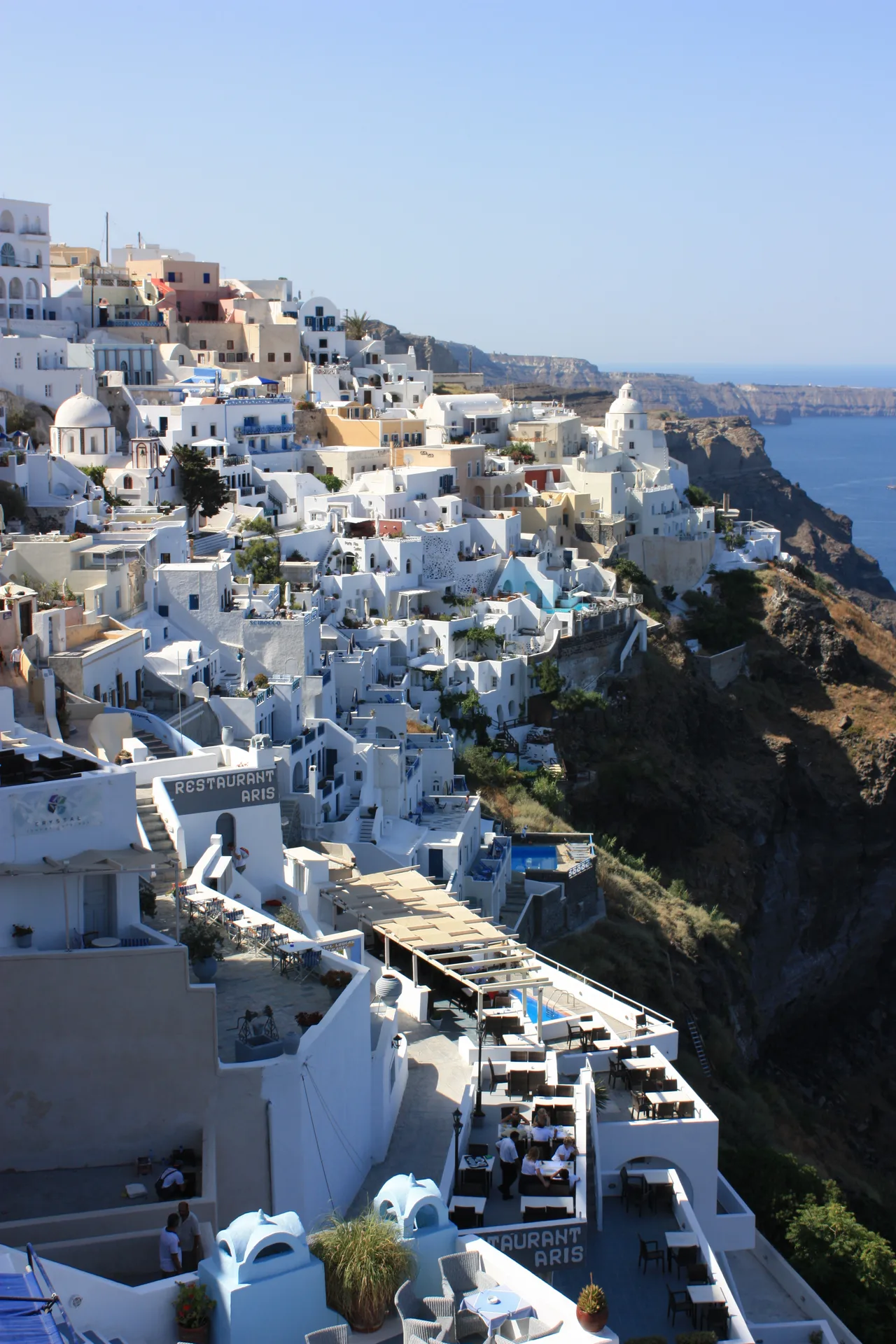
The 1956 earthquake is the modern rupture in Santorini's story: it damaged and destroyed buildings, prompted rebuilding, and led to the abandonment of some structures that remain as ruins today. When you see newer concrete construction next to older vaulted buildings, or empty shells inside busy villages, that contrast is partly a twentieth-century story rather than a Venetian one.
This layer is harder to visit deliberately, because it is woven into ordinary streets. Ask locally or read municipal and museum panels about the reconstruction; a site's age is rarely obvious from the outside, and many rebuilt ruins sit flush against older walls.
Quick Orientation: A Short Timeline at a Glance
Bronze Age settlement and the volcanic burial of Akrotiri come first, followed by the classical city on Mesa Vouno and the later Aegean and medieval centuries. The modern period, including the earthquake and the growth of caldera-edge tourism, sits on top of all of it. The order matters because it explains why different sites sit in completely different parts of the island.
Use the timeline as a routing tool. Akrotiri belongs to the southwest, Ancient Thera to the ridge above Kamari and Perissa, and caldera villages to the western rim. If you only have one full day, pick one archaeological site properly rather than two badly.
Sequencing the Sites: Two Realistic Day Shapes
Day one, archaeology-focused: Akrotiri in the southwest in the morning, then a slow lunch in the Akrotiri area before returning along the caldera rim. Day two, hill and coast: Ancient Thera on Mesa Vouno in the morning, then a beach afternoon at Kamari or Perissa. This split keeps driving short and puts each exposed site in the cooler half of the day.
Trade-offs are real. Chasing a caldera sunset the same evening as Ancient Thera means leaving the ridge early, and crossing the island at peak time is slow. If a view table is the priority, build the day around it; if the site is the priority, stay on the east side and eat there. Whichever way you lean, our guide to things to do in Santorini sets out the island's highlights so you can slot the view stops around your ruins.
Tickets, Opening and What to Verify
Opening days, seasonal closures and ticket arrangements for Akrotiri and Ancient Thera are set by the Greek archaeological authorities and change between seasons. Neither the sites' current hours nor their admission rules are fixed facts to carry in your head; check before you go, ideally the day before.
Book accommodation and any caldera-view dining ahead in high season, and confirm directly with the venue rather than relying on a photo. Where a source has not published a schedule, treat absence of information as a reason to ask, not as evidence of anything.
What to Wear and How to Pace Exposed Sites
Sun and wind are the practical issues. On the Mesa Vouno ridge there is little shelter, and stone surfaces get hot; on the caldera edge, stairs and polished paths demand grip. Closed shoes, a hat and a layer for wind cover most visits, and a light rain jacket is worth packing in shoulder season.
Pace by heat, not by ambition. Start early, take a long midday break when the sun is strongest, and save shaded or indoor visits for the middle of the day. Carry water; tap-water safety is a separate question from the ruins, and bottled water is easy to buy in the villages.
Where to Eat Near the History Sites
Taverna geography follows the sites. The Akrotiri area and the southwest coast serve visitors coming from the excavation, while Kamari and Perissa, below Mesa Vouno, have beachfront strips that suit a post-Ancient Thera lunch. Fira and the caldera villages lean toward view dining, where the setting is the product and prices reflect it. If you are still planning your budget for meals and entrance fees, it helps to know the currency in Greece before you arrive.
At lunch, order a few shared plates rather than a large individual main: tzatziki (yogurt with cucumber and garlic), fava (a purée of yellow split peas) and a Greek salad are standard openers, with grilled fish or souvlaki to follow. For a fuller glossary of dish names before you order, see what to eat in Greece and the dish-by-dish Traditional Greek Food guide.
Fish is often sold by weight, so ask the price per kilo and the weight before it is cooked; a quoted price per kilo is not a total. Bread is commonly brought to the table and charged, so decline it at the start if you do not want it.
Common Mistakes at Santorini's Historical Sites
The most common error is treating Akrotiri as a museum of treasures: it is an excavated town, and the objects are largely elsewhere. The second is underestimating transfer times between the caldera rim, the southwest and the eastern beaches. The third is believing dramatic claims about Atlantis or a single-year eruption date without checking what is actually evidenced.
A fourth is dressing for the photograph rather than the ground. Ruins mean uneven stone, dust and wind, and a scenic outfit is a poor trade for a turned ankle. Bring proper footwear and leave the sunset styling for the evening.
What Is Still Debated
Archaeologists continue to argue about the precise dating of the eruption, the scale of its regional impact, and how far Santorini's Bronze Age town connected to Crete and the wider Aegean. Presenting any of these as closed questions overstates the evidence. Read site panels critically and notice where wording shifts from fact to interpretation.
The Atlantis association belongs in the realm of speculation. It is a story people enjoy, not a conclusion supported by excavation, and it should not shape which sites you choose to visit.
Plan Your Visit
Build the trip around two anchors, Akrotiri and Ancient Thera, and let the medieval and earthquake layers fill the gaps as you walk through villages. Keep each day on one side of the island, eat near the site you have just seen, and reserve your view dining for an evening when the schedule allows it.
Before travelling, confirm opening arrangements for both archaeological sites and check with any restaurant you have set your heart on, especially outside high season. Then the history is simply there in front of you: ash, stone, cliff and street plan.
Explore more Greece sauna guides
Frequently Asked Questions
What is Santorini best known for historically?
It is best known for the Bronze Age eruption and the settlement buried at Akrotiri, and secondarily for the classical city on Mesa Vouno at Ancient Thera. Later medieval fortifications and the 1956 earthquake make up the more recent layers.
Where can you see Santorini's history in person?
Akrotiri in the southwest is the main excavated Bronze Age site, and Ancient Thera on the Mesa Vouno ridge above Kamari and Perissa preserves the classical city. Medieval walls and post-earthquake rebuilding are visible inside villages rather than at a single ticketed monument.
What happened at Akrotiri?
A Bronze Age town was buried under volcanic material from a major eruption and has since been excavated, revealing multi-storey buildings, streets and storerooms. Much of the portable material is held in museums, so the site itself shows architecture and town planning.
Why is Ancient Thera on a mountain?
The city occupied a defensible ridge with wide views and better exposure than the coast, reached by steep routes from the sea. That position shapes the visit today: exposed ground, uneven stone and little shade.
Was Santorini Atlantis?
That is speculation rather than an archaeological conclusion. The eruption and the buried town are well attested, but linking them to the Atlantis story is not supported by excavation evidence.
Do you need to book Santorini's archaeological sites in advance?
Opening arrangements and ticketing for Santorini's archaeological sites are set by the Greek archaeological authorities and vary by season, so check current details before you travel. Caldera-view restaurants are the bookings worth making ahead in high season.
What should you wear to Akrotiri and Ancient Thera?
Sturdy closed shoes, a hat and a wind layer. Ancient Thera is especially exposed with little shade, so start early, carry water, and take a long midday break.
Sources
Notes for eating well in Greece
Optional updates to our guides.
You might also like

Continue reading
More guides you'll find useful