Rhodes History for Visitors: Colossus, Knights, Lindos & Old Town
A visitor's guide to Rhodes history: the Colossus, the Knights of St John in the Old Town, Lindos, and Ottoman and Italian rule, with where to see each.
On this page
Rhodes rewards travellers who read the island in layers rather than as one lump of "old." The walled Old Town is the densest concentration of the medieval and Ottoman past, while Lindos holds an ancient acropolis above a whitewashed village, and Rhodes Town itself spreads into a modern municipality with a history that runs through several ruling powers. Deciding which layer you care about most is the single most useful planning step, because it settles whether you base yourself in Rhodes Town or give Lindos a full day.
Use this as a period-by-period map: what each era left behind, which neighbourhood to walk for it, and roughly how to pair sightseeing with a meal. Historical detail here stays at the level the island's own tourism and municipal sources describe; for exact dates, closed rooms or ticket arrangements, check the official site for the specific monument before you travel.
Why Rhodes history is easy to see on foot
The medieval city of Rhodes is enclosed by fortifications, which means a large share of the island's headline history sits inside a walkable circuit. You can move from a gate to a paved street of stone houses to a mosque courtyard without a bus, and that compactness is why a single morning in the Old Town covers more ground than a day of scattered ruins elsewhere. Wear shoes that handle polished, uneven paving, since the lanes were not laid out for modern comfort.
What is Rhodes best known for historically? Rhodes is best known for the Colossus, one of the Seven Wonders of the ancient world, and for the medieval fortifications of the Old Town built under the Knights of St John. The island also has an ancient acropolis at Lindos and a layered townscape that includes Ottoman and Italian-era building phases, all within a compact area you can explore on foot.
Where did the Colossus of Rhodes stand? No surviving ancient bronze figure remains, and the sources available to visitors do not settle the exact location or appearance of the Colossus. Treat it as a story to carry around Rhodes harbour rather than a monument with a viewing point, and be sceptical of tours that claim to show the precise spot where it stood.
What did the Knights of St John build on Rhodes? The Knights are responsible for the fortifications that enclose Rhodes Old Town, along with the streets and buildings inside them, most famously the Street of the Knights and the Palace of the Grand Master. When you visit, read the on-site information panels to distinguish original medieval fabric from later restoration and rebuilding.
Orientation matters more than a checklist. The Old Town has distinct quarters, and the character shifts as you move between the Knight-built streets, the Ottoman-era corners with their places of worship and baths, and the modern Greek town outside the walls with its harbour and market streets. Pick two quarters per visit rather than trying to circle the whole walled area, and you will actually remember what you saw.
The three ancient cities: Lindos, Ialysos and Kameiros
Before the city of Rhodes existed, the island was organised around three powerful settlements, and the municipality's own tourist pages still describe Ialysos as one of the three great ancient cities that, with Lindos and Kamiros, formed the island's earlier political core.
Ialysos, also called Trianta, sits on the coast northwest of Rhodes Town and keeps two clearly separate draws: the busy modern resort strip and the green Hill of Filerimos, where the municipality lists a monastery of the Virgin Mary and the remains of an ancient acropolis. Treating Filerimos as a short climb with a view makes it a natural half-day, and it pairs neatly with the beach rather than competing with it.
Lindos is the third of that trio and the one most visitors already know, but many arrive only for the bay and never climb to the acropolis. The village below is a compact hillside of whitewashed houses and a medieval-walled hilltop, and the municipality describes its streets as paved with black and white pebble mosaics, lined with houses built by wealthy sea captains and ship owners in the 17th and 18th centuries. Walking up through those lanes is part of the sight, not just the approach to it.
The Colossus of Rhodes: what to expect on the ground
The Colossus is the island's most famous historical claim, and it is also the one most likely to disappoint if you expect a standing monument. No ancient bronze figure remains to visit, so treat the Colossus as a story you carry around the harbour rather than a sight with a ticket booth. Resist any tour that promises the exact spot where it stood, because the sources available to a casual visitor do not settle its precise location or appearance.
The practical move is to fold the Colossus into a harbour-side walk during your first hour in Rhodes Town and let the medieval city do the heavy lifting afterwards. That keeps expectations honest and frees time for the fortifications that genuinely survive.
Hellenistic and Roman Rhodes: the planned city as a walking frame
Rhodes is unusual among Greek destinations in that its ancient street logic is still legible beneath the later city. The island's historical summaries describe a planned foundation laid out on a Hippodamian grid, the system of straight intersecting streets attributed to the ancient urban planner Hippodamos, and knowing this changes how you read the modern town: the regularity is not an accident of tourism development but a very old habit.
For a walk, use that grid idea as your frame outside the walls and the medieval lanes as your frame inside them. If you want to compare Rhodes with planned ancient cities elsewhere in Greece, keep a broader list of ancient sites in Greece as background reading before you go, so the terminology is familiar when you arrive.
Byzantine and early Christian layers before the Knights
Rhodes did not jump from antiquity to the Knights. Between them lies a long Byzantine and early Christian period that left churches, defensive works and settlement patterns which later builders reused, extended or built over. Because so much was absorbed into the medieval city, the Byzantine layer is less a separate sight than a set of fragments you notice inside buildings and along the walls.
Practically, this means you should not hunt for a "Byzantine quarter." Instead, read the medieval city as a palimpsest, a surface written over several times, where each generation adapted what stood before. That framing makes an ordinary stone doorway or an oddly shaped chapel worth a second look.
The Knights of St John: walls, gates and the medieval city
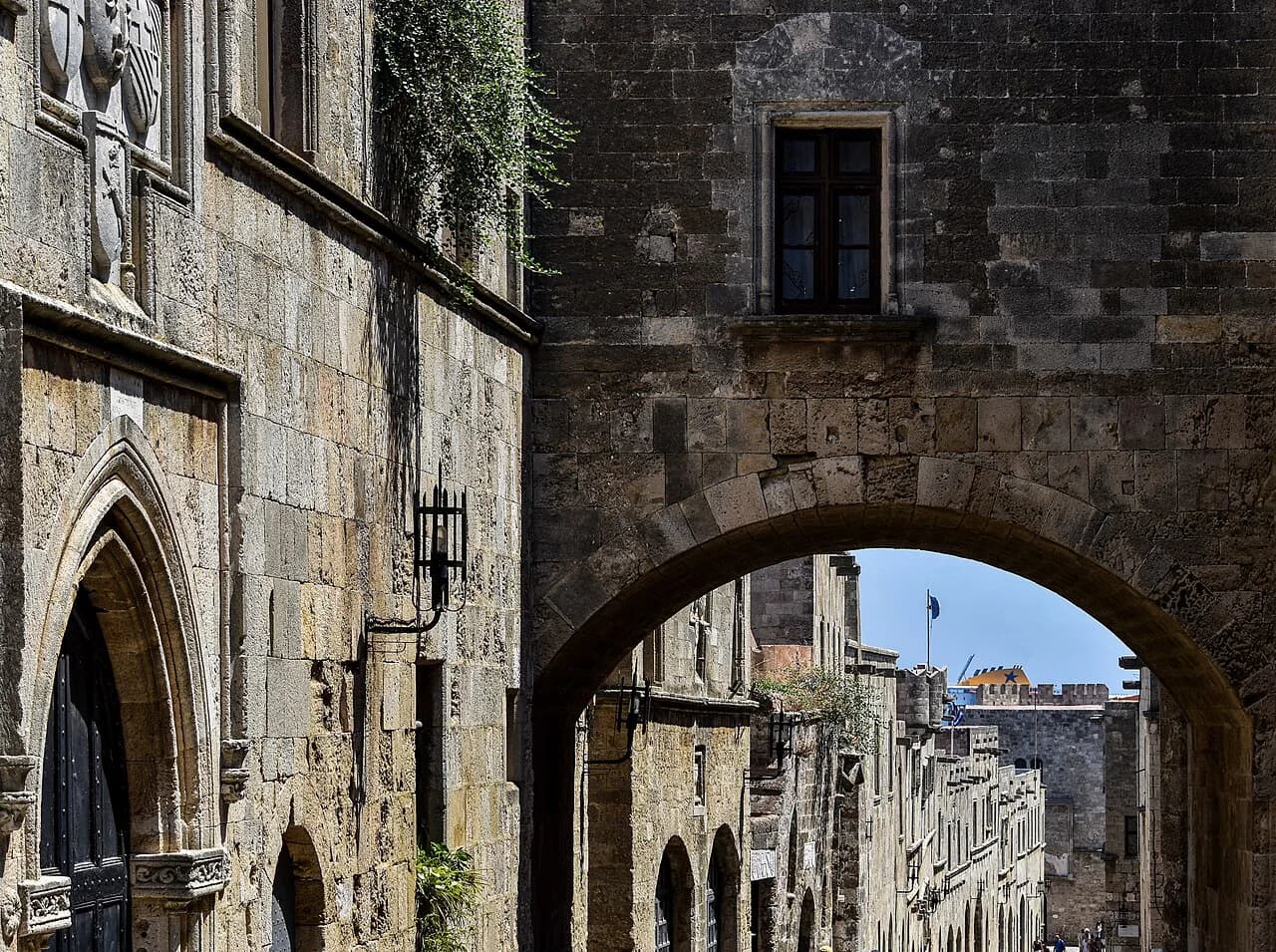
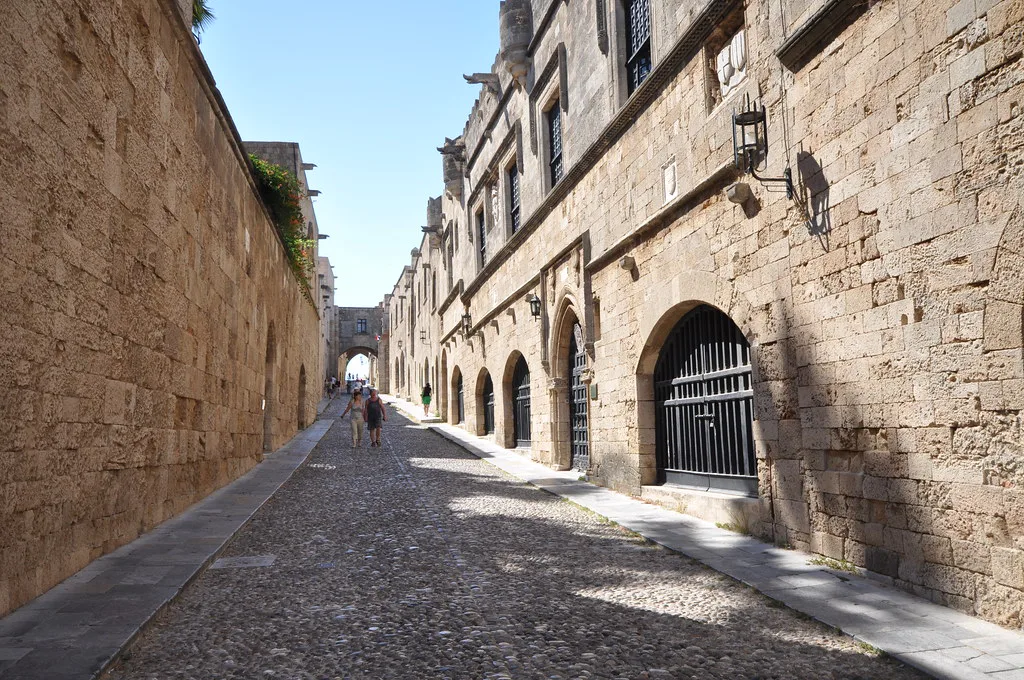
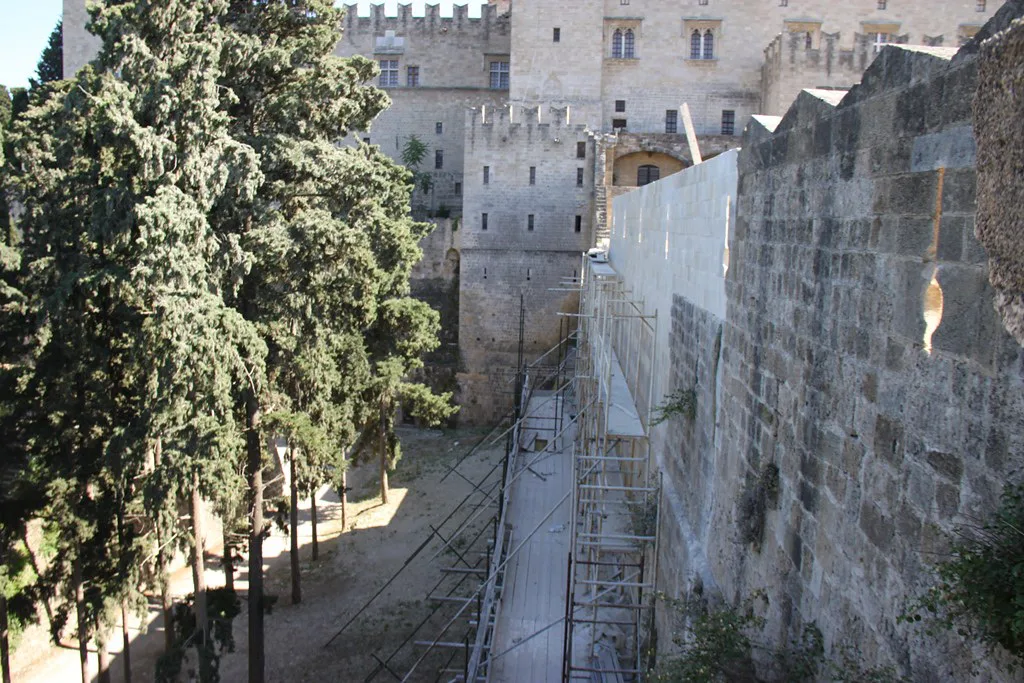
The Knights of St John are the reason Rhodes Old Town looks the way it does, and the fortifications are the clearest thing to study. Rather than trying to see every gate, walk one stretch of wall from outside and one street from inside on the same morning; the contrast between the defensive face and the sheltered streets behind it is the whole point of a fortified city. Allow at least a couple of hours for this rather than treating the walls as a photo stop.
The Street of the Knights and the Palace of the Grand Master are the two names most travellers arrive with, and both are best approached with an eye for what has been restored. Distinguishing original medieval fabric from later rebuilding is difficult on site and the island's public sources do not give a room-by-room breakdown, so read the information panels at each monument and let them tell you what you are looking at.
Ottoman Rhodes: mosques, baths and street life inside the walls
After the medieval period, the walled town continued as a living Ottoman city, and that layer is visible in places of worship, bathhouses and the shape of the streets rather than in a single monument. Because it sits inside the same walls as the Knight-built city, the two periods are often a few steps apart, which is exactly why the Old Town resists being labelled with one date.
This is also where the question of whether Rhodes is more Greek or Turkish becomes unhelpful. The island is Greek today, and its built fabric carries medieval, Ottoman, Italian and modern Greek layers in sequence; walking the lanes with that in mind is more rewarding than trying to assign each building to one identity.
Italian rule and the remade Old Town
Rhodes passed through Italian administration in the early twentieth century before reuniting with Greece after the Second World War, and the colonial-era townscape around the modern centre dates largely from that interval. The most visible legacy for visitors is the way parts of the Old Town and the Palace of the Grand Master were restored or rebuilt in that period, which is why some surfaces look newer than the medieval masonry around them.
For a traveller, the useful takeaway is not to memorise a chronology but to notice the joins: a crisp facade next to worn stone, a broad avenue outside the walls running beside a lane built for donkeys. If you enjoy this kind of architectural comparison, the old towns of Crete make a good follow-on, and the Rethymno old town guide covers a comparable mix of Venetian and Ottoman fabric.
Modern Rhodes: how the island is laid out today
Modern Rhodes is one of the larger municipalities in the Greek islands and functions as an administrative, financial and cultural centre for the south-eastern Aegean, which is why Rhodes Town feels like a working city rather than a resort strip. That matters practically: you will find year-round services, transport and civic buildings in town, while the coastal resorts and inland villages have their own rhythms.
The municipality's own listings give a sense of how far the island's settlements spread: Ialysos and its town hall to the northwest, Kallithea along the Faliraki coast, Lindos in the southeast, and smaller communities inland towards Attaviros and the south. Reading that map before you book accommodation tells you more about your holiday than any single hotel review.
Lindos: acropolis, village and St Paul's Bay
Lindos deserves its own slot in the plan. The municipality describes a rare combination: a compact whitewashed village beneath a medieval-walled hilltop acropolis that contains an ancient Greek temple, overlooking a deep circular bay of aquamarine sea rimmed by a beach. That is three separate experiences in one place, and each takes time.
Below the village, St Paul's Chapel is described by the municipality as a tiny chapel perched under a cliff in the shadow of the acropolis, beside the turquoise water of St Paul's Bay, and it appears on the municipal list of ceremony venues. Expect this bay to be at its most crowded in the middle of the day, and plan to climb to the acropolis earlier or later if you want cooler air and clearer views.
For eats, Lindos village is packed with places aimed squarely at day visitors, which is a trade-off: convenience and views against higher prices and less local character than inland villages. If you want a wider frame for choosing dishes rather than a specific restaurant, our dish-by-dish guide to what to eat in Greece explains the names you will meet on the menu.
Practical pairings: meals near the history
Rhodes Town is the easiest place to combine a long walk with a proper meal, because the Old Town and the modern centre give you a genuine choice between eating inside the walls and stepping outside them. As a rule, the lanes immediately around the main monuments carry the highest prices; a few minutes' walk towards the modern town usually buys a calmer table for the same cooking. If you want a broader shortlist beyond the walls, our guide to things to do in Rhodes pairs the town's sights with its beaches and villages.
Ialysos works well after Filerimos, since the resort strip along the coast has the density of places that a hungry walker needs, and the beach gives you somewhere to sit afterwards. Lindos is the weakest of the three for value and the strongest for setting; budget for that rather than being surprised by it.
When you order, a few names cover most of what a taverna serves. Mezedes are small plates meant to be shared and ordered together rather than in courses, and dishes such as tzatziki, a yogurt dip with cucumber and garlic, or fava, a purée of yellow split peas with olive oil and lemon, appear almost everywhere. With fish, prices swing enormously by species and by whether it was farmed or freshly caught, so ask before ordering anything sold by weight. Because taverna bills are quoted in euros, it is also worth reading up on currency in greece and how cards and cash are handled before you sit down.
Common mistakes when sightseeing Rhodes history
The first mistake is treating the Old Town as a single period and photographing it as one backdrop. It is a medieval city that absorbed Byzantine fragments, an Ottoman town and an Italian-era restoration programme, and the differences are the interesting part. Slow down at the transitions.
The second is rushing Lindos at midday, arriving hot, climbing fast and leaving without seeing the village itself. The third is skipping the small museums inside the walls, which is where the explanation behind the masonry usually lives. Give the acropolis and its approach a generous half-day and you will not need a second visit.
If you are building a wider Greek itinerary around historical sights, it helps to see how other islands handle their own layers; a comparative read of Santorini history, covering the Bronze Age site of Ancient Thera and the island's later volcanic and Venetian story, is a useful contrast to Rhodes' medieval walls and Ottoman streets.
Verifying dates and details before you go
Dates and attributions in Rhodes' long history are contested in the details, and this guide deliberately avoids pinning specific years to events. Before you travel, consult the municipality's official pages and the information provided at each monument, which will give you the site-specific version of the story along with any current notices.
Note that the municipality's own venue list flags the Rodian Mansion as temporarily unavailable due to renovation, which shows why checking current notices is worth two minutes before you walk across town for something specific. Treat municipal listings as the live source and older guidebooks as background reading only.
Plan Your Visit
Build your Rhodes days around one layer at a time: the walled city of the Knights and Ottomans on foot, the acropolis and village at Lindos as a full half-day, and Filerimos above Ialysos as a shorter pairing with the beach. That structure keeps you out of the trap of treating a 2,400-year-old island as a single photo opportunity.
Eat where the walking takes you, favouring streets a few minutes from the headline monuments for better value, and ask about fish sold by weight before you commit. Check the official municipal pages for current notices about specific sights before you set out, since renovation work and closures change from season to season.
Explore more Greece sauna guides
Frequently Asked Questions
What is Rhodes best known for historically?
Rhodes is best known for the Colossus, one of the Seven Wonders of the ancient world, and for the medieval fortifications of the Old Town built under the Knights of St John. The island also has an ancient acropolis at Lindos and a layered townscape that includes Ottoman and Italian-era building phases, all within a compact area you can explore on foot.
Where did the Colossus of Rhodes stand?
No surviving ancient bronze figure remains, and the sources available to visitors do not settle the exact location or appearance of the Colossus. Treat it as a story to carry around Rhodes harbour rather than a monument with a viewing point, and be sceptical of tours that claim to show the precise spot where it stood.
What did the Knights of St John build on Rhodes?
The Knights are responsible for the fortifications that enclose Rhodes Old Town, along with the streets and buildings inside them, most famously the Street of the Knights and the Palace of the Grand Master. When you visit, read the on-site information panels to distinguish original medieval fabric from later restoration and rebuilding.
Was Rhodes part of Italy or Greece?
Rhodes came under Italian administration in the early twentieth century before reuniting with Greece after the Second World War. That interval left a colonial-era townscape around the modern centre and influenced how parts of the Old Town and the Palace of the Grand Master were restored, which is why some surfaces look newer than the medieval masonry beside them.
Is Lindos worth visiting for the history alone?
Yes, if you give it time. Lindos combines a whitewashed hillside village with a medieval-walled acropolis containing an ancient Greek temple, overlooking a circular bay with a beach. It was one of the island's three great ancient cities, so arriving only for the beach and skipping the climb up through the pebble-mosaic lanes misses the main point.
How should I split my time between Rhodes Town and Lindos?
Give Rhodes Town at least a full day for the walled city, its gates, mosques and Palace of the Grand Master, and Lindos a generous half-day including the village and the climb to the acropolis. Pair Filerimos above Ialysos with a beach afternoon if you have a third day, and start the Lindos climb early or late to avoid the hottest and busiest hours.
Sources
Notes for eating well in Greece
Optional updates to our guides.
You might also like

Continue reading
More guides you'll find useful