Santorini Churches: Blue Domes, Fira Cathedrals & Village Chapels
Plan a church-focused day in Santorini: the blue domes of Oia and Firostefani, Fira's cathedrals, hilltop monasteries, and how to visit respectfully.
On this page
Santorini's skyline is punctuated by dozens of churches and chapels, many of them whitewashed with bright blue domes that have become the island's signature image. The density reflects centuries of Orthodox and Catholic worship, and the buildings range from tiny rock-cut chapels to large cathedrals with bell towers and frescoes. For a visitor, the practical challenge is not finding churches but choosing which ones fit a realistic day and understanding what each stop actually involves.
This guide organizes the main churches by village cluster: the caldera rim walk through Fira, Firostefani, and Imerovigli, and the interior drive to Pyrgos, Mesa Gonia, Exo Gonia, Emporio, and Vothonas. It explains what a blue dome is architecturally, distinguishes the Orthodox and Catholic cathedrals in Fira, and covers etiquette for entering active places of worship. For broader context on the island's museums and archaeological sites, see the guide to museums in greece.
Quick orientation: why Santorini has so many churches and chapels
Santorini is a rather small island that is nonetheless crowded with spiritual monuments, including chapels, churches, and monasteries scattered across its villages. Both Orthodox and Catholic traditions are represented, and the buildings run from plain whitewashed chapels to grand cathedrals and abbeys. A short walk or drive can pass several of them, so it pays to know which are architecturally or historically distinctive instead of trying to tick off every door.
Why are there so many churches in Santorini? Santorini has a dense concentration of chapels, churches, and monasteries because both Orthodox and Catholic communities have built and maintained places of worship across its villages over centuries. The buildings range from simple whitewashed chapels to large cathedrals and fortified monasteries.
What are the blue domes in Santorini and which churches have them? The blue dome is the painted hemispherical roof of a church in the Cycladic style. Well-known examples include St.
Which Santorini churches are in Oia and which are in Fira? Oia is home to Panagia Platsani, which was rebuilt in the village centre after an earthquake. Fira has the Orthodox Metropolitan Cathedral and the Catholic Cathedral of St.
In a single day you can reasonably cover the caldera-rim churches on foot between Fira and Imerovigli, or drive to a handful of interior villages such as Pyrgos, Mesa Gonia, and Emporio. Doing both in one day means a lot of walking plus driving, so most travellers choose either a rim walk or an interior circuit. The sections below group the churches so you can pick the route that matches your energy and transport.
Cycladic style explained: whitewashed walls, blue domes, and vaulted roofs
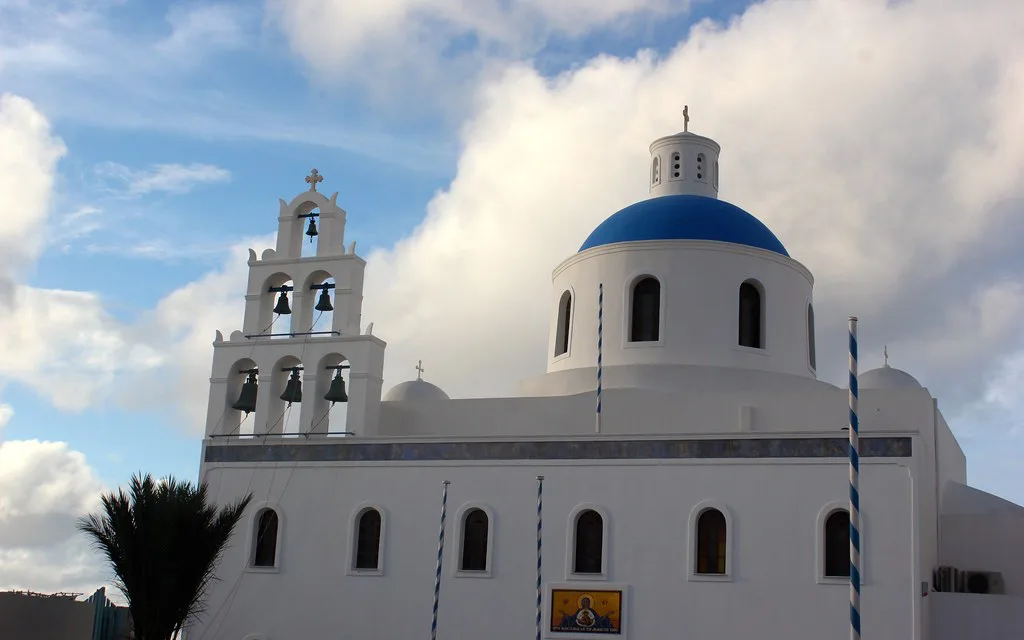
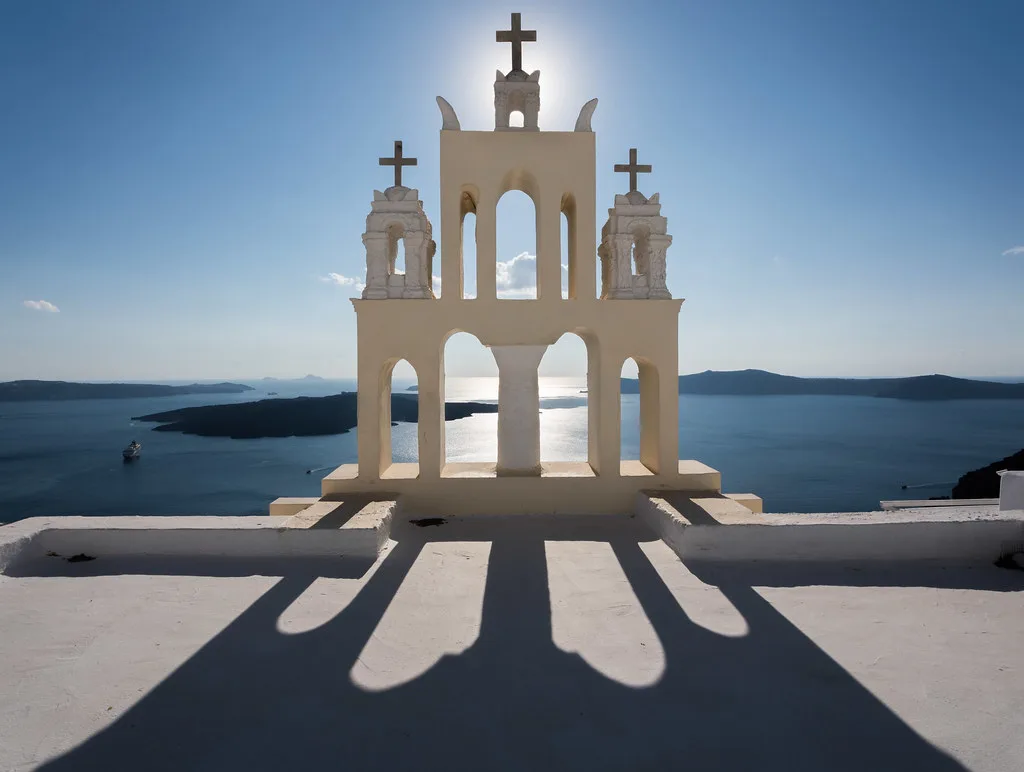
The blue dome that appears on so many postcards is the hemispherical roof of a church, painted deep blue against whitewashed walls in the Cycladic architectural style found across the island. The contrast is deliberate and has become one of the most photographed features of the Aegean. Not every church has a blue dome; some are tiled, some are flat, and some show Baroque or other European influences, as with the Catholic Cathedral in Fira.
Vaulted roofs, arched bell towers, and small courtyards belong to the same vocabulary. Knowing these elements helps you read the buildings rather than treat them only as backdrops, and it makes the interior-village churches more interesting when they diverge from the caldera-rim icons. The blue dome is a roof form, not a single church, and several villages have their own examples.
The blue domes worth planning around: Oia, Firostefani, and Fira
Three blue-domed churches are commonly singled out. St. Gerasimos in Fira is known for its sharp colour contrast and is one of the most photographed churches in the Aegean. Panagia of Agioi Theodoroi, also called the church with the three bells, sits on the caldera rim at Firostefani. Panagia Platsani in Oia was once part of Castle Oia and was rebuilt in the centre of the village after an earthquake destroyed the original structure, and several celebrations are held there each year. For more detail on the Oia church and its surroundings, see the guide to Oia churches.
The trade-off on the caldera rim is view versus crowds. The Firostefani and Oia churches offer caldera vistas and are easy to reach on foot from the main villages, but they draw the most photographers. Going early in the morning or outside peak sunset hours improves the experience. No reliable source lists opening hours for these churches, so ask locally or at your accommodation before planning to go inside.
Panagia Theoskepasti near Imerovigli and the Skaros Rock climb
Panagia Theoskepasti, dedicated to the Virgin Mary, is one of the island's symbols and is reached via the Skaros Rock climb at Imerovigli. The route means climbing to the top of Skaros Rock and then descending to the chapel, and many walkers save the church for the end of the Skaros trip to take in the panoramic views. The detour adds significant steps and uneven ground, so it suits those with time and proper footwear rather than a quick photo stop.
The effort is rewarded with views that stretch along the caldera, but the climb is exposed and can be hot at midday. Slotting it into a morning or late afternoon makes more sense than attempting it in the strongest sun. Because the chapel is a place of worship rather than a viewpoint alone, keep noise down and dress considerately.
Fira's two cathedrals: Orthodox Metropolitan and Catholic St. John the Baptist
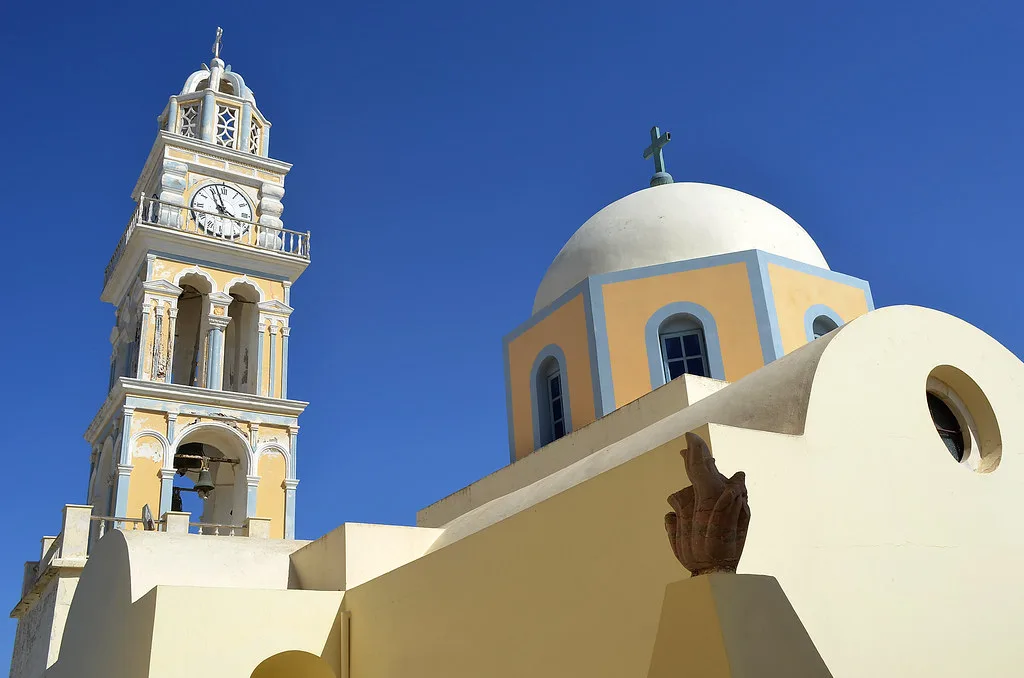
Fira has two cathedrals that represent the island's Orthodox and Catholic communities. The Orthodox Metropolitan Cathedral was built in 1827 and rebuilt after the 1956 earthquake; it has a wide dome, rolling arches, whitewashed walls, frescoes by a local artist, and views over the caldera and volcano. The Catholic Cathedral of St. John the Baptist, in the Catholic quarter of Fira, was built in 1823 and restored after 1956; it is Baroque in style with pale colouring, blue moulding, and a clock tower that sets it apart from the whitewashed churches.
The pair makes a compact walking loop in Fira and is useful for understanding the island's mixed religious history. The Orthodox cathedral is the larger and busier of the two, while the Catholic cathedral's Baroque details and clock tower are a contrast worth seeking out. Neither cathedral has published service times in the available sources, so if you want to attend Mass or a service, ask at the Catholic Cathedral of St. John the Baptist or the Orthodox Metropolitan Cathedral in Fira for their schedules.
Beyond the caldera rim: Mesa Gonia, Exo Gonia, and Emporio
Inland villages hold churches that see far fewer visitors. Panagia Episkopi in Mesa Gonia is described as an 11th-century Byzantine monument with a tiled roof unlike the white-domed churches, and it has survived invasions, earthquakes, and fires. Agios Charalambos in Exo Gonia was founded in 1705, is one of the largest churches on the island, and has a tiled roof and a position that offers views. Agios Nikolaos Marmaritis at the entrance of Emporio is a small chapel built entirely of grey marble, which gives it its name. If Byzantine and ancient masonry appeal to you, the guide to ancient sites in greece shows where similar stonework survives elsewhere.
These stops reward a car or organized transport because they are spread across the interior and not on the caldera rim. The trade-off is fewer caldera views in exchange for quieter courtyards and architectural variety. Pairing Mesa Gonia with a winery visit in nearby Pyrgos or Megalochori is a common way to structure the day, and the village tavernas make a natural lunch stop.
Profitis Ilias Monastery above Pyrgos: fortress profile and collections
The monastery of Profitis Ilias, or Prophet Elias, sits at the crest of Prophet Elias Hill above Pyrgos and was founded at the beginning of the 18th century. It has a square, flat, fortress-like profile with a tall steeple and offers panoramic views across the island. It suffered serious damage in the 1956 earthquake but remains a striking structure, and it once served as a Greek school in the 18th century.
The monastery holds the Icons and Memorabilia Collection of Pyrgos, with manuscripts, old publications, ethnographic items, and displays on printing, candle making, shoe making, wine making, and local food. It also has a wood-carved iconostasis. The source places the Profitis Ilias monastery about 6km from the airport in Kamari, which is a useful reference if you are arriving or departing rather than staying in Oia or Fira. Access to the collection may depend on monastery hours, so ask at the monastery before making it the focus of a trip.
Rock-cut and hidden churches: Panagia Sergena above Vothonas
Panagia Sergena, also known as Panagia tis Trypas or the church of the hole, is carved into volcanic rock about 20 meters above ground outside Vothonas. It was hidden to serve as a refuge from pirates, and its name Sergena means the patroller because lookouts were posted there in the Middle Ages. Access today is via a gravel walkway and steps, and the perch gives a tranquil view of the surrounding landscape.
The approach is rougher than the caldera-rim churches, so wear shoes with grip and allow more time than the map suggests. The reward is one of the island's more unusual sacred spaces, cut into the rock rather than built on it. It suits travellers who have already seen the main villages and want a quieter, more rugged stop.
Agios Nikolaos Monastery: the island's only Greek Orthodox convent
Agios Nikolaos Monastery sits between Firostefani and Imerovigli and is the only Greek Orthodox convent on Santorini. It was originally founded on Skaros in 1651 and moved to its current location in 1820, and it is dedicated to three saints: Agios Nikolaos, Agios Panteleimon, and Zoodohos Pigi. It holds a distinctive Byzantine icon of Saint Nicholas and a carved iconostasis.
Because it is an active convent, visitors should treat it as a place of worship first. Dress modestly, keep voices low, and ask before photographing inside. It fits naturally into a walk between Firostefani and Imerovigli, and it pairs well with the Panagia of Agioi Theodoroi church nearby.
Visiting etiquette: dress, silence, photography, and candles
Santorini's churches are active places of worship, not only sights. Cover shoulders and knees, remove hats inside, and keep conversation quiet, especially if a service is in progress. If a sign or a person indicates that photography is not allowed inside, respect it; flash and tripods are rarely welcome during worship. Lighting a candle is a common gesture, and candles are usually available near the entrance.
If you arrive during a service, wait at the back or return later rather than walking through the congregation. Many village churches are unlocked only around services or festivals, so a closed door is normal rather than a sign that you have the wrong information. Asking at your accommodation about local feast days can help you time a visit for when a church is open and active.
Festival days and village life: October 20 in Finikia and August 6 in Pyrgos
Panagia Matrona in Finikia holds an annual festival on 20 October with live music and food and drink, and the church has a tranquil courtyard with a palm tree and a venerated icon screen. In Pyrgos, the celebration of the Transfiguration of the Savior on August 6 includes a custom in which young people take pots of basil from girls' yards on the eve of the feast and decorate the church dome with them. These are living traditions rather than performances, so visitors should watch respectfully and follow local guidance.
Feast days are among the best chances to see a village church in use, but they also mean crowds and changed transport. If your trip overlaps with a festival, plan around it rather than expecting a quiet visit. The exact programme varies by year, so check locally for times and processions.
Practical routing: a caldera-rim walk versus an interior drive
The caldera-rim churches cluster along the walk from Fira through Firostefani to Imerovigli, including the Orthodox and Catholic cathedrals in Fira, St. Gerasimos, Panagia of Agioi Theodoroi, Agios Nikolaos Monastery, and Panagia Theoskepasti via the Skaros climb. This route needs no car and can be done in a morning or split across two days if you want to linger. The interior churches, by contrast, are spread out and best reached by car or organised tour.
For the interior, a loop through Pyrgos, Mesa Gonia, Exo Gonia, and Emporio covers Profitis Ilias Monastery, Panagia Episkopi, Agios Charalambos, and Agios Nikolaos Marmaritis, with Vothonas adding Panagia Sergena. Distances are short by car but the roads are winding, so allow more time than a straight-line map suggests. If you are also interested in archaeological sites, the guide to ancient sites in greece can help you combine a church day with a visit to the Akrotiri Archaeological Site or Ancient Thera.
Where churches fit around a meal: pairing village visits with taverna stops
Village church visits pair naturally with a taverna lunch. After Mesa Gonia or Exo Gonia, head to Pyrgos or Megalochori for a sit-down meal, and in Emporio the village lanes offer shade and a break from the sun. If you are new to Greek menus, the guide to what to eat in Greece explains dish names such as moussaka, souvlaki, and horiatiki, the village salad.
Timing matters: many churches are best visited in the cooler morning or late afternoon, with the hottest hours reserved for a long lunch. Restaurant opening hours and seasonal closures vary, and the available sources do not list them, so check current times with your accommodation or locally. If you are also considering museums, the guide to museums in santorini can help you fill a hot midday slot.
Plan Your Church Day
Santorini's churches reward a little planning. Choose either the caldera-rim walk through Fira, Firostefani, and Imerovigli or the interior drive through Pyrgos, Mesa Gonia, Exo Gonia, Emporio, and Vothonas, and build in time for the climbs and the courtyards. Dress modestly, keep noise down, and treat festival days as community events rather than photo opportunities.
Opening hours, service times, and festival programmes are not consistently published, so confirm locally before making a church the centrepiece of a day. For more on the island's cultural sights, the museums in Greece guide covers related collections and archaeological sites across the country.
Explore more Greece sauna guides
Frequently Asked Questions
Why are there so many churches in Santorini?
Santorini has a dense concentration of chapels, churches, and monasteries because both Orthodox and Catholic communities have built and maintained places of worship across its villages over centuries. The buildings range from simple whitewashed chapels to large cathedrals and fortified monasteries.
What are the blue domes in Santorini and which churches have them?
The blue dome is the painted hemispherical roof of a church in the Cycladic style. Well-known examples include St. Gerasimos in Fira, Panagia of Agioi Theodoroi at Firostefani, and Panagia Platsani in Oia. Not every church has one; some are tiled or flat-roofed.
Which Santorini churches are in Oia and which are in Fira?
Oia is home to Panagia Platsani, which was rebuilt in the village centre after an earthquake. Fira has the Orthodox Metropolitan Cathedral and the Catholic Cathedral of St. John the Baptist, as well as St. Gerasimos. Firostefani, between Fira and Imerovigli, has Panagia of Agioi Theodoroi.
What is the difference between the Orthodox and Catholic cathedrals in Fira?
The Orthodox Metropolitan Cathedral is a whitewashed building with a wide dome, frescoes, and caldera views, built in 1827 and rebuilt after the 1956 earthquake. The Catholic Cathedral of St. John the Baptist is Baroque in style with pale colouring, blue moulding, and a clock tower, built in 1823 and restored after 1956.
Can you go inside Santorini's churches?
Many churches are active places of worship and are open around services and festivals rather than all day. A closed door is common. If you find one open, enter quietly and follow any signs about photography or dress. The available sources do not list opening hours for individual churches.
What should you wear when visiting churches in Santorini?
Cover shoulders and knees, remove hats inside, and wear comfortable shoes for the steps and uneven ground around the caldera-rim and rock-cut churches. Modest dress shows respect for worshippers and is expected in active churches.
Which Santorini churches are easiest to reach on foot from the caldera rim?
The churches between Fira, Firostefani, and Imerovigli are the easiest on foot, including the two cathedrals in Fira, St. Gerasimos, Panagia of Agioi Theodoroi, and Agios Nikolaos Monastery. Panagia Theoskepasti requires a climb on Skaros Rock. The interior churches need a car or organised transport.
Are there church festivals in Santorini worth planning around?
Panagia Matrona in Finikia holds a festival on 20 October, and Pyrgos marks the Transfiguration of the Savior on August 6 with a basil-decorating custom. These are community events, so check locally for times and join respectfully.
Sources
Notes for eating well in Greece
Optional updates to our guides.
You might also like

Continue reading
More guides you'll find useful