Oia Churches: Blue Domes, Panagia Platsani & Visiting Tips
A practical guide to the churches of Oia, Santorini: Panagia Platsani on the main square, the famous blue domes, what you are looking at, and photo etiquette.
On this page
Almost every image of Oia, Santorini, is built around a blue dome and a white bell tower, yet the village's churches are not a single sight with one entrance. One is a parish church on the main square; the others are small chapels scattered through the lanes. Knowing which is which changes how you plan the stop and what you can reasonably expect to see inside.
This guide separates Panagia Platsani, Oia's central church, from the blue-domed chapels photographers queue for, then covers the walk through the village, timing around crowds and sunset, and photo etiquette. It also explains the Greek church vocabulary and the food names you will meet afterwards. For churches beyond Oia, from the villages of Mesa Gonia and Exo Gonia to the island's Catholic and Orthodox parishes, see the wider guide to Santorini churches.
What 'Oia churches' Usually Means
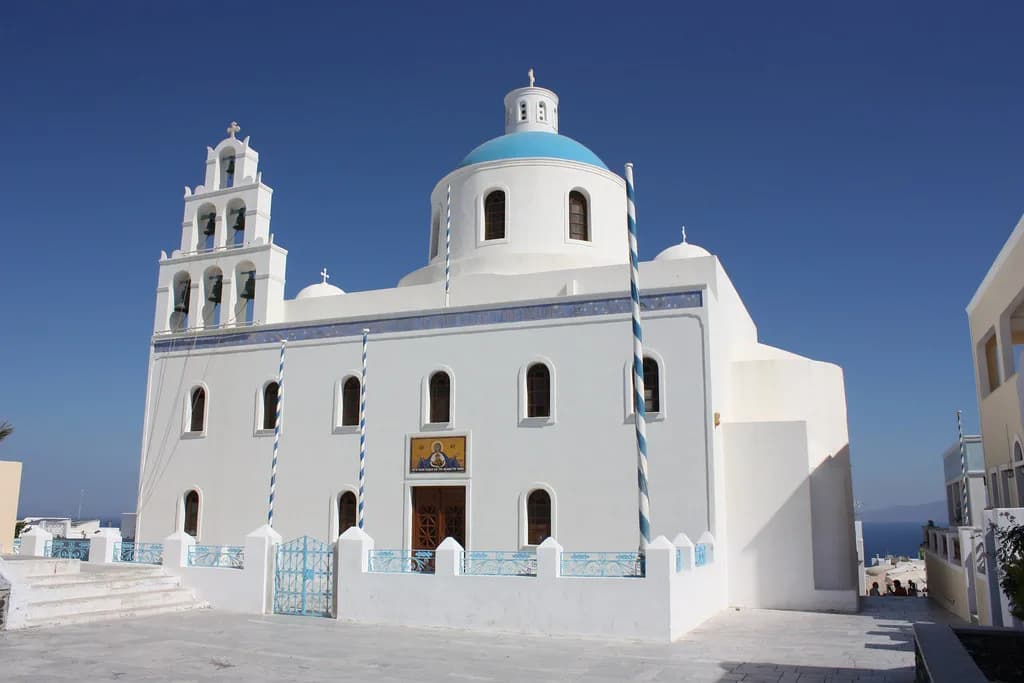
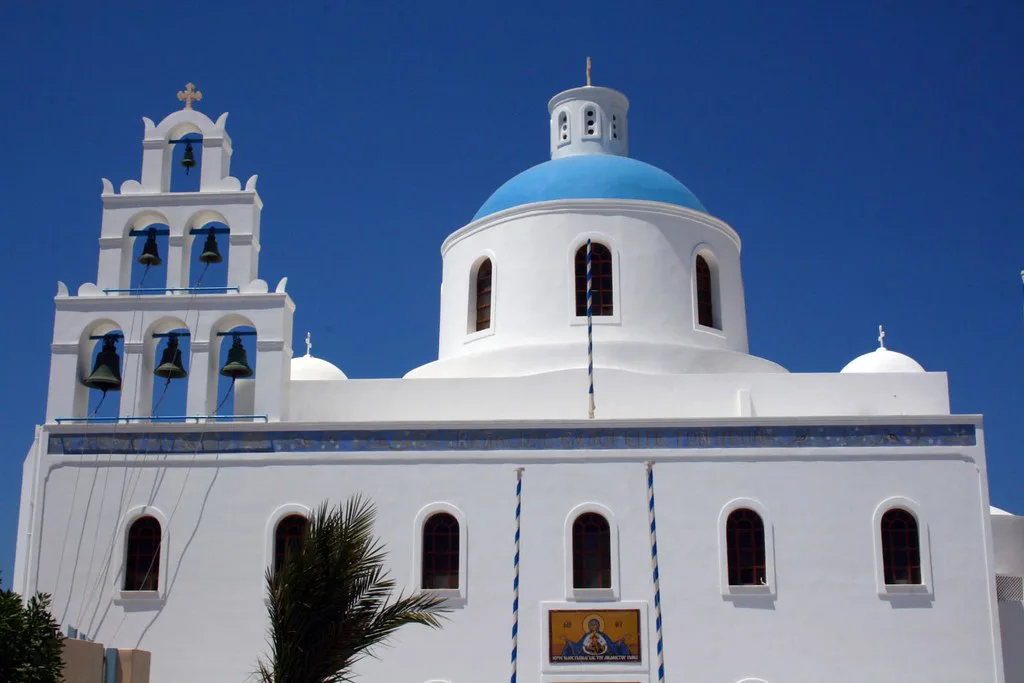
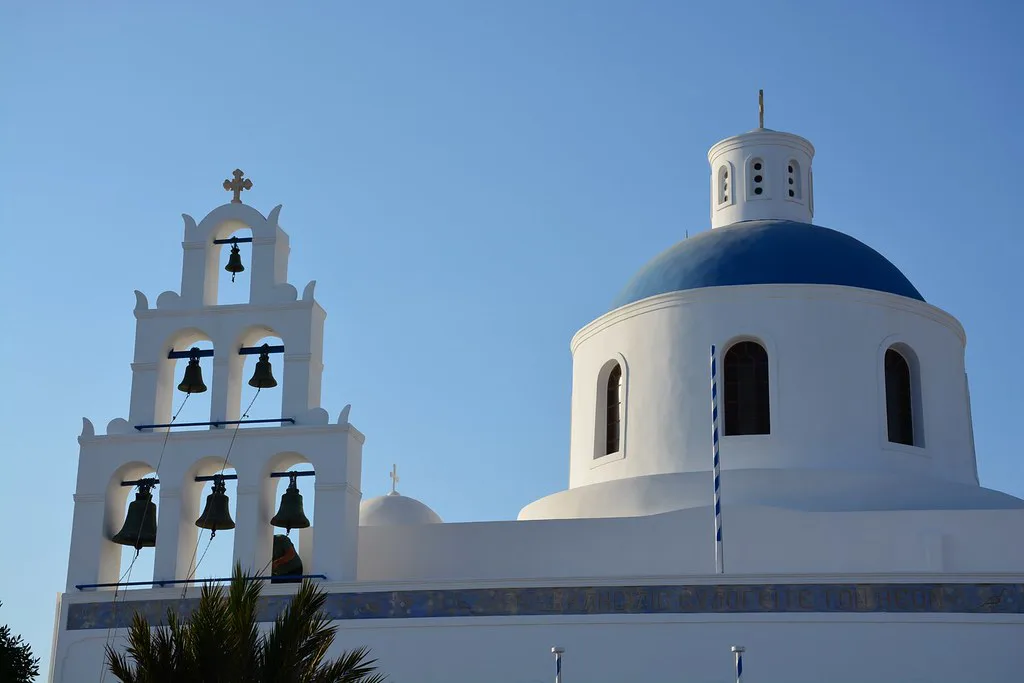
The phrase covers two different things. The first is Panagia Platsani, the church on Oia's main square, listed as the village's most popular church and described with five blue domes, colourful arched windows, a bell tower with six bells and a carved facade. The second is the cluster of small blue-domed chapels that appear on postcards, led by the chapel commonly called the Three Bells Church.
Where is the Church of Panagia Platsani in Oia? Panagia Platsani stands on Oia's main square in the pedestrian centre of the village, which makes it the easiest church to reach on foot. It is the natural orientation point for a walk along the main street towards the windmills and the castle.
Are Oia's churches free to visit? Panagia Platsani is listed as free to enter and open at all hours, though access can change for services or restoration, so confirm before relying on it. The small blue-domed chapels are not visitor attractions in the same way and are often closed.
How do you find the famous three blue domes in Santorini? The Three Bells Church and the neighbouring blue-domed chapels sit in Oia's caldera-side lanes, reached by stepped footpaths rather than roads. The classic photograph is taken from a higher path looking down at the domes and the sea.
That distinction matters practically. Panagia Platsani sits on flat main-square ground and is listed as free to enter and open around the clock, so it is the reliable stop. The chapels are mostly tiny buildings wedged into the caldera-side lanes; many are not regularly open, so a photo stop is not the same as a visit. Treat any open door as a bonus, not a schedule item.
Santorini's church landscape is broader than Oia. The island's church listings group the Oia blue-dome chapels with houses of worship across the island, which is worth knowing if you want to combine a village walk with a stop in Pyrgos, Mesa Gonia or Fira. Our Santorini churches guide maps those options so you can decide whether Oia alone is enough for your trip.
Panagia Platsani in Detail
Panagia Platsani stands on Oia's main square, at the heart of the pedestrian village, which makes it the easiest church to reach and the natural orientation point for a walk. Its five blue domes, arched windows, six-bell tower and carved main door are the features to look for as you approach from the main street. The name Panagia refers to the Virgin Mary, and the church is dedicated to her.
Inside, according to the same listing, pictures on the walls depict stories about the Virgin Mary. If the door is shut, the square outside still gives you the clearest close-up of the architecture.
The church also functions as a viewpoint: the listing recommends taking in village and sunset views from it. The trade-off is that main-square ground is also where much of Oia's foot traffic funnels, so the calmest look at the facade is usually early in the day rather than at sunset, when the square fills.
The Blue Domes and the Three Bells
The Three Bells Church and the neighbouring blue-domed chapels are the icons of Oia, framed against the caldera and the Aegean. Tour listings for Oia's churches name the blue-dome church overlooking the caldera and the Three Bells Church among the village's best-known religious buildings, which is why the same few viewpoints draw the longest queues.
On the ground, these chapels sit in the caldera-side lanes, reached by stepped paths rather than roads, so the walk itself decides how many you see. The photograph you have in mind is usually taken from a slightly higher path looking down at the domes; finding that angle takes patience rather than a map, since the lanes are narrow and one-way in practice.
One honest limitation: many of these chapels are small, privately maintained and not regularly open to visitors. Plan the blue domes as an architectural walk with photo stops, and treat Panagia Platsani as the place where you actually go inside.
Greek Orthodox Basics for Visitors
A Greek Orthodox church is built around the liturgy, and the building's layout reflects that: a screen of icons, called the iconostasis, separates the altar area from the nave where people stand. You will usually see icons rather than pews, and worshippers may come and go during a service. A chapel is a smaller consecrated building, often tied to a family, a monastery or a neighbourhood, which is why Oia has so many small ones.
That private, local character explains why small chapels may be locked and why opening is not a visitor service. Panagia Platsani, by contrast, is the village's main church and the one most likely to be accessible. If you want to see interiors across the island rather than just facades, the broader Santorini churches guide helps you plan a route beyond Oia.
If you are building a wider sightseeing list, the island's archaeological sites make a natural counterweight to church-hopping. Our guide to museums in Santorini covers the Akrotiri Archaeological Site and Ancient Thera, both of which need more time than a photo stop.
Reading Cycladic Church Architecture
Cycladic churches are whitewashed for practical reasons as much as style: lime wash reflects heat and is cheap to renew. The blue dome is a later convention rather than a rule, which is why you also see white, terracotta and unpainted domes around the island. The bell tower, often with several bells, is the vertical marker that tells you a church is a parish building rather than a storeroom.
Panagia Platsani shows the full set: five blue domes, arched windows and a six-bell tower. Smaller chapels compress the same elements into one dome and a single bell, which is why they read so well in photographs. Learning to spot the difference makes a walk through the lanes more interesting than simply counting blue roofs.
Getting Around Oia on Foot
Oia is a pedestrian village built on a slope, and the approach matters. The church listing describes arriving on foot, by cable car or by donkey ride, with a cable car or donkey ride priced at EUR 5 one way. Cruise arrivals and tour groups concentrate on the main street and the castle end, so walking against the flow, towards the quieter caldera lanes, usually buys you space.
Steps are the real constraint. Many lanes are staircases with no handrail and uneven surfaces, so sturdy shoes matter more than any route plan, and anyone with mobility limits should treat the caldera-side chapels as viewpoints from above rather than destinations. Panagia Platsani on the main square is the flattest and most forgiving church stop.
Timing Around Crowds and Sunset
Oia's day has two peaks: late morning, when cruise excursions arrive, and sunset, when the castle and caldera viewpoints fill. Panagia Platsani's square sits in the middle of that flow, so visit the church in the early morning or early afternoon if you want the facade without a crowd in front of it. The listing notes sunset views from the church, but the square is also exposed and busy at that hour.
If a caldera-view table for sunset is part of the plan, book it ahead and expect to pay for the view; restaurants along the caldera rim charge for position, while back-street places a few lanes inland generally cost less and are easier to book. Decide which you want before you arrive, because turning up at sunset hoping for a rim table is a poor strategy in high season.
Restaurants on the island follow seasonal patterns, with many closing for the winter months; the exact dates vary by business and are usually posted locally, so check directly if you are travelling in the shoulder months. For a wider frame, our guide to what to eat in Greece explains the dishes you will meet on Oia menus, from meze (small shared plates) to grilled fish priced by weight.
Etiquette Inside Oia's Churches
Dress modestly: shoulders and knees covered is the safe standard for a Greek Orthodox church, and a light scarf or shirt in your bag solves it. Keep your voice low, avoid flash, and do not walk in front of someone praying or lighting a candle to get a clearer shot. If a service is under way, stand at the back or wait outside rather than moving through the nave.
Photography inside varies by church and by who is present. Panagia Platsani is described as having pictures on its walls and being free to enter, but no source sets out an interior photo policy, so look for posted signs and ask if you are unsure. A short question at the door is accepted practice; assuming permission is not.
Photographing the Blue Domes Respectfully
The famous three-dome view is a composition, not a single address: you are looking down onto rooftops from a public path, and the path is narrow. The practical rules are simple: do not block doorways, staircases or the lane itself, do not climb onto roofs or walls for a better angle, and move on after a short set of shots so the next person gets a turn.
Drones are the most common friction point. Rather than assume any national rule, read local signage and ask your accommodation what is permitted in the village; Oia is densely built and a drone over the caldera lanes disturbs residents. On the ground, a modest telephoto framing from a higher path often gives the compressed dome-and-sea shot without standing in anyone's way.
Greek Easter and Festival Days
Greek Easter is the biggest event in the Orthodox calendar, and the church listing notes that Panagia Platsani is lit with lanterns and bells at Easter. Dates follow the Orthodox calculation and shift each year, so look up the year's date, which often differs from Western Easter. If you are in the village then, expect crowds and processions and plan around them rather than through them.
If you come across a service or procession, behave as you would in any working place of worship: stand to the side, keep phones down, and let the congregation pass. Candles, incense and chanting are part of the liturgy, not a performance, and a few minutes of quiet observation is more welcome than a narrated video.
Pairing the Churches With the Rest of Oia
A sensible half-day links Panagia Platsani on the main square with Oia's Main Street, the Windmills of Oia and Oia Castle, all of which sit within the village's walkable core. The castle end is the classic sunset viewpoint, so doing the churches first and ending there avoids backtracking up the steps twice.
From the castle area, the path down to Ammoudi Bay is a steep descent to the water, where the fish tavernas sit below the village. The trade-off is simple: the walk down is easy and the walk back up is not, so many visitors take a taxi back or time the climb for cooler hours.
If you want more church architecture after Oia, Santorini's villages reward a short drive, and island-hoppers can compare styles in the Ionian and Dodecanese. Our guides to Corfu churches and Rhodes churches cover Saint Spyridon Church in Corfu Town and the churches around the Hospital of the Knights respectively. For the bigger picture on religious and archaeological sightseeing across the country, start with museums in Greece.
Eating After the Churches: View or Value
Oia's restaurants split into two clear groups. Caldera-rim tables sell the sunset and the drop below; back-street tavernas sell cheaper plates and a quieter room. The view table is worth it once, booked ahead for the hour you want; the back street is where you eat on the other nights, and where walk-ins are more realistic.
Menus across the village share the same vocabulary, so learn a few words before you sit down. Meze are small shared plates, tzatziki is yoghurt with cucumber and garlic, horiatiki is the Greek salad of tomato, cucumber, onion, olives and feta, and grilled fish is usually sold by weight, so ask for the price before it is cooked. The dish-by-dish guide to traditional Greek food explains these in more detail, and it is the better place to start if you want the full picture of what to eat in Greece beyond Oia's menus.
Prices in Oia vary widely by position and season, and restaurants do not always publish them in advance, so the practical step is to read the menu board at the entrance before committing and to ask whether a caldera table carries a minimum spend. Confirm winter closures and booking policies directly with the restaurant.
Plan Your Oia Church Visit
The short version: go to Panagia Platsani on the main square for the interior and the architecture, then walk the caldera lanes for the blue domes and Three Bells with your camera, expecting facades rather than open doors. Start early, wear shoes that handle steps, and keep the sunset hour for one booked table or one castle viewpoint rather than both. If church-hopping sharpens your appetite for ruins, our guide to ancient sites in greece covers the Acropolis of Athens and Mount Parnassus in the same practical, dish-by-dish spirit.
Before you travel, verify access at Panagia Platsani and any restoration work in the village, since church opening is not guaranteed. For everything around the churches, from island archaeology to the food names on the menu, the museums in Greece hub links the rest of the guides.
Frequently Asked Questions
Where is the Church of Panagia Platsani in Oia?
Panagia Platsani stands on Oia's main square in the pedestrian centre of the village, which makes it the easiest church to reach on foot. It is the natural orientation point for a walk along the main street towards the windmills and the castle.
Are Oia's churches free to visit?
Panagia Platsani is listed as free to enter and open at all hours, though access can change for services or restoration, so confirm before relying on it. The small blue-domed chapels are not visitor attractions in the same way and are often closed.
How do you find the famous three blue domes in Santorini?
The Three Bells Church and the neighbouring blue-domed chapels sit in Oia's caldera-side lanes, reached by stepped footpaths rather than roads. The classic photograph is taken from a higher path looking down at the domes and the sea.
Why are there so many churches in Santorini?
Small chapels are typically tied to families, monasteries or neighbourhoods, which is why so many dot the villages. They are working religious buildings, not a single sight with one entrance, and many are not regularly open.
What should you wear when visiting a church in Oia?
Cover shoulders and knees as a safe standard for a Greek Orthodox church, and carry a light layer or scarf in case you want to step inside. Comfortable shoes matter too, since Oia's lanes are staircases.
Can you take photos inside Oia's churches?
There is no published blanket policy: look for posted signs and ask at the door if the church is open. Outside, avoid blocking doorways or steps and do not climb onto roofs for a shot.
Is Panagia Platsani open every day?
It is listed as open around the clock with free entry, but churches close for services, maintenance and restoration. Check locally before making it the centrepiece of a day.
When is Greek Easter in Oia?
Greek Easter follows the Orthodox calendar and falls on a different date each year; check the year's date, as it rarely matches Western Easter. Panagia Platsani is described as lit with lanterns and bells for the occasion.
Sources
Notes for eating well in Greece
Optional updates to our guides.
You might also like

Continue reading
More guides you'll find useful