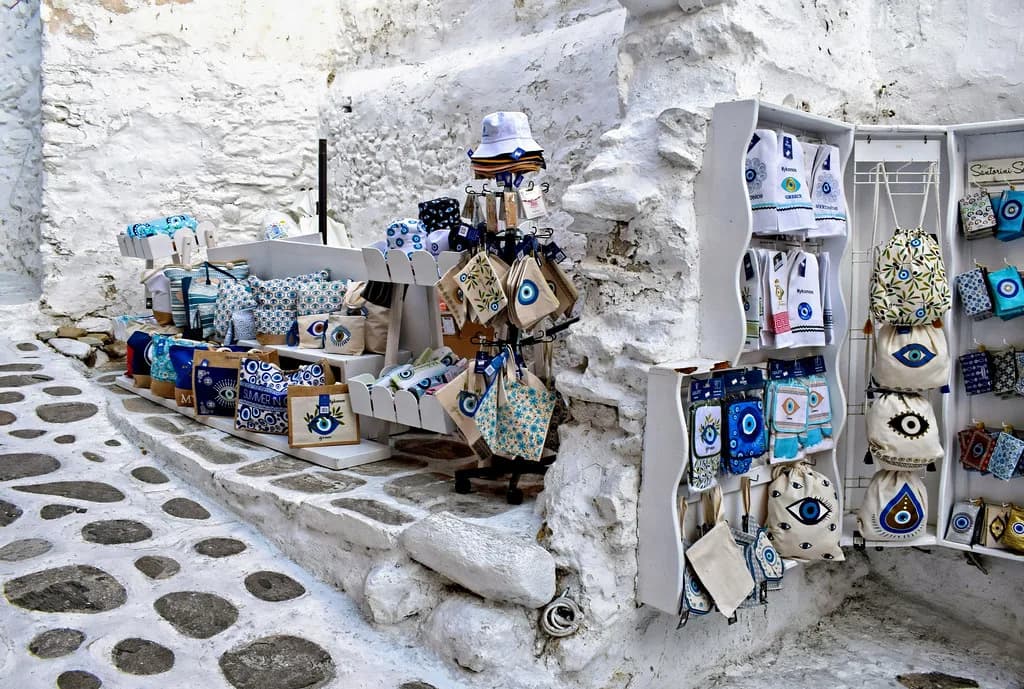
Greek Evil Eye (Mati): Meaning, Charms and What to Buy
The Greek evil eye, or mati, is a blue glass charm meant to deflect envy. Learn what it means, what forms it takes, and how to choose one as a souvenir.
On this page
Walk through almost any Greek shopping street and you will meet the same object: a disc of blue glass with a dark centre, hung from a cord, strung on a bracelet or glued to a fridge magnet. Greeks call it a mati, which simply means "eye", and it is bought, given and worn as protection against envy rather than as decoration alone. This guide explains the vocabulary, the belief behind the object and the practical choices a buyer faces.
It is a shopping guide as much as a culture note. You will find the differences between a pendant, a wall hanging and a car charm, the overlap with Turkish and South Asian eye charms, and the questions worth asking before you pay. Prices, shop names and opening hours are not fixed in this article because they vary by island, season and seller, so the last section explains how to check them on the spot.
What the Greek Evil Eye Is: Mati, Kalo Mati and Kako Mati
The core word is mati (μάτι), Greek for "eye". The phrase kako mati (κακό μάτι) means the evil eye itself, the harmful or envious gaze that the belief warns about, and it is the term you will see used when Greeks describe misfortune as the work of someone else's jealousy. The charm is the countermeasure rather than the curse, so it is often called kalo mati, the good eye.
What is the Greek word for the evil eye? The Greek word for the eye is mati (μάτι). The evil eye itself is kako mati, literally bad eye, while the blue charm worn or hung to deflect it is often called kalo mati, good eye, or mataki, little eye.
Is the evil eye Greek or Turkish? The blue eye amulet appears in both traditions, so you are unlikely to find a single country of origin. Greek versions are usually labelled with Greek words such as mati or mataki, while Turkish pieces are commonly called nazar.
What does the blue eye symbol mean? It is a protective symbol meant to deflect an envious or malevolent gaze, which is why the charm is worn close to the body or hung where visitors will see it. In Greece it is also associated with drawing love, happiness and success.
Labels in shops mix these terms freely, and small pieces are usually described with the diminutive mataki (ματάκι), literally a little eye. Knowing the three words lets you read a tag and understand whether the seller is naming the charm, the belief or the protective power it is supposed to carry. If a label just says "evil eye", it is a translation convenience, not a Greek term.
The same Greek word stretches into ordinary kitchen and family language, which is a useful reminder that mati is not a mystical term reserved for amulets. It is the everyday word for an eye, so a Greek speaker hearing it will think first of the body part and only then of the charm.
Why the Charm Is Blue
The classic mati is cobalt or deep azure glass with a white ring, a dark pupil and often a smaller inner circle. The colour is the most recognisable feature, and it is what most travelers picture when they think of the Greek evil eye, even though the sources describe the symbol's protective role more than a single fixed colour rule.
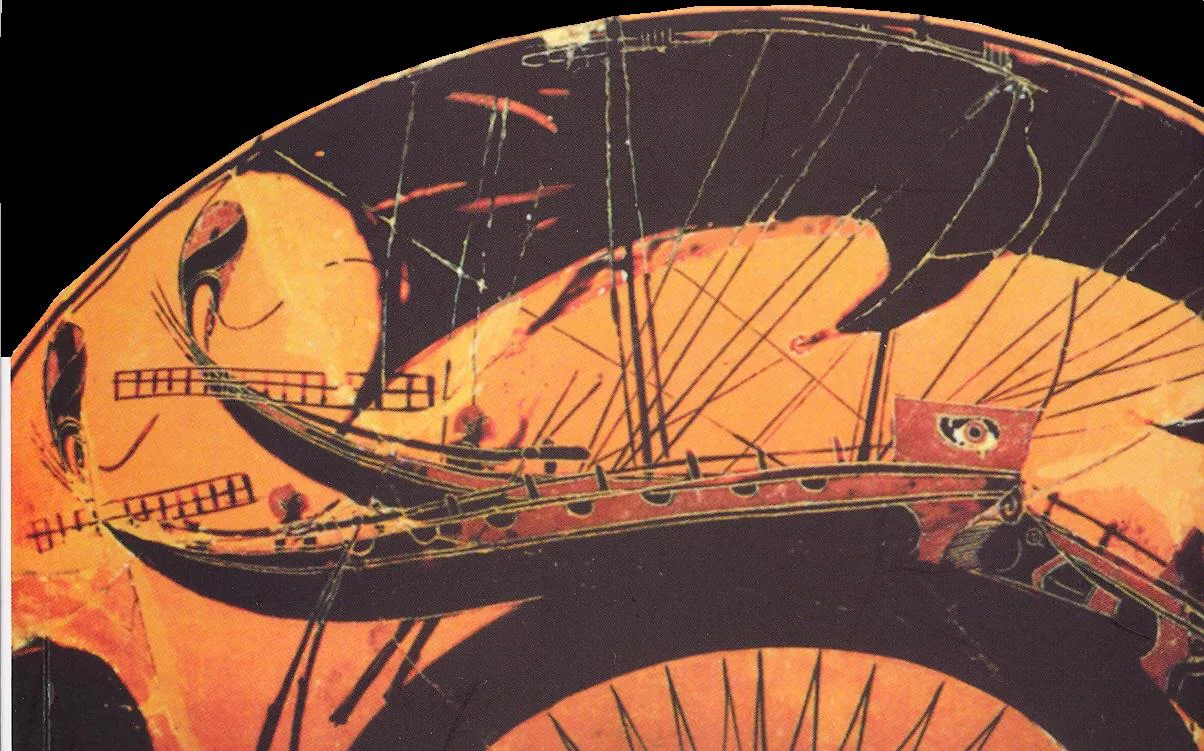
The eye as a protective symbol is far older and far wider than modern Greece, and it has been adopted by Christian, Muslim, Buddhist and Hindu societies, each with its own name for it. In Greece the glass eye is worn or hung to deflect envy, and it is also treated as a way to attract love, happiness and success, so the object carries both defensive and hopeful meanings depending on who is giving it.
Because the form is so widespread, blue glass eyes are photographed and sold far beyond Greece, including in Turkish and broader Mediterranean contexts. Treat the colour as a shared visual language rather than a Greek patent, and look at the labelling and the maker's description to understand what you are actually buying.
The Belief in Practice: Compliments and Envy
In everyday Greek usage, the evil eye is the explanation offered when things go persistently wrong, from illness to accidents to a run of bad luck. The belief holds that a malevolent or envious gaze, sometimes prompted by praise or attention, can cause harm, which is why the charm is worn close to the body and hung where guests and strangers will see it.
This has a practical social consequence for visitors. A Greek host or shopkeeper may respond to extravagant praise with a small ritual phrase or gesture intended to deflect envy, and the safest reading is that this is customary politeness rather than a comment on you. If you are complimenting a meal or a home, keep the praise warm but not excessive, and let your host decide whether any protective gesture is needed.
The sources describe the belief and its social expressions, but they do not provide a verifiable method for removing an evil eye, so no ritual should be treated as instruction. If someone offers to perform a removal for you, that is a personal or folk practice, not a standardised procedure you can look up and follow.
Jewelry, Wall Charms and Car Mirrors: What Each Form Is For
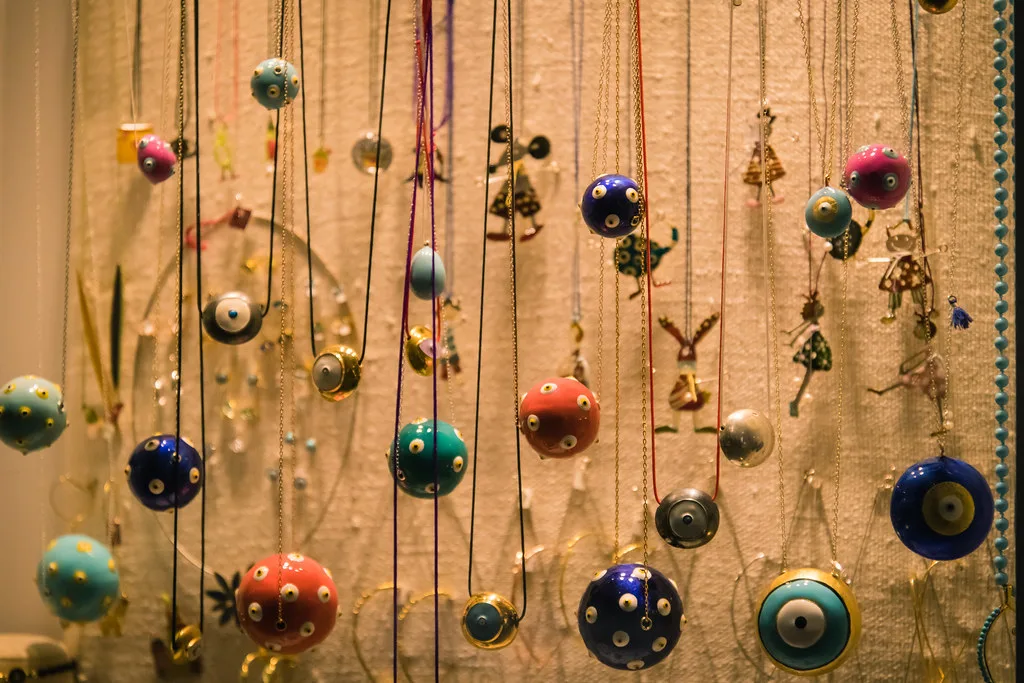
The smallest form is the bracelet, a thin cord or chain with a single glass eye or a row of them. It is the easiest version to wear daily and the easiest to break, which is why many buyers treat it as a light, replaceable souvenir rather than an heirloom. Pendants follow the same logic in a larger size, and they are usually sold with a cord rather than a precious-metal chain.
Household versions scale up. A wall hanging, often a cluster of glass eyes on a cord or a small ceramic plaque, is meant for a doorway or a living-room wall where visitors pass it. Car charms are a distinct category: a small eye or a tasselled hanging for the rear-view mirror, sold at roadside stops, kiosks and petrol stations as much as in souvenir shops.
What you choose should follow where the object will live. A bracelet or pendant suits a traveler who wants something to wear; a wall or door charm suits someone decorating a home and willing to pack something fragile; a car charm is a gift with a clear destination. None of these forms carries a guaranteed protective effect, so buy for the look, the material and the meaning you want to keep.
Where Travelers Encounter the Mati in Greece
The mati appears at every level of the market. Island souvenir shops stack trays of inexpensive glass eyes beside magnets and postcards, urban jewelers set smaller versions in silver or gold, and church-adjacent stalls and monastery shops often carry them alongside religious items. Museum shops sometimes sell well-made versions with a printed explanation, which is useful if you want the context written down.
On Santorini the split between view-driven shopping streets and quieter back lanes is easy to see. The main caldera-side lanes in Fira and Oia carry the polished, higher-rent version of the souvenir trade, while the inland and harbour areas tend to have plainer, cheaper stock. For a wider picture of the island's shopping geography, the guide to shopping in Santorini is worth reading before you go.
Oia concentrates the same trade into a smaller area, with the main pedestrian spine carrying most of the traffic and the side lanes holding smaller workshops and boutiques. If you are staying in the north of the island, shopping in oia is the natural place to compare pieces, and the street known as Nik. Nomikou is the busiest stretch for it.
Athens and other mainland cities spread the trade more widely, with jewelers in central commercial streets, museum shops near the major ancient sites, and market stalls in the same districts. If your trip includes the Acropolis of Athens, the shops around its approaches are convenient but rarely the cheapest; the same applies at popular ancient sites elsewhere, where convenience pricing is built into the location.
Greek, Turkish and Hindu Eyes: Telling Them Apart
The blue eye is not exclusively Greek. Turkish culture uses the nazar, a closely related blue glass amulet, and South Asian and Middle Eastern traditions have their own eye charms with different shapes and colours. The visual overlap is why a market stall in one country can sell objects that look at home in another.
For a buyer, the distinction is usually in the labelling and the form rather than the colour. Greek pieces are often sold with Greek words such as mati or mataki, sometimes with a printed card explaining the belief. Turkish nazar pieces often carry their own name, and Hindu and Buddhist versions may use different materials, tassels or colour schemes.
None of this makes one version more authentic than another, but it does affect what you are bringing home. If the story matters to you, ask the seller where the piece was made and what it is called in the local language; if the look is what matters, buy the one you like and describe it accurately when you give it away.
Glass, Ceramic or Enamel: Choosing a Souvenir Mati
Most cheap matia are pressed or blown glass, which gives the deep translucent blue but chips and cracks easily. Ceramic versions are heavier and often painted rather than translucent, and enamel or metal versions are the most durable for everyday wear but lose the glassy look. Each material sets a different expectation for how long the object will last.
Handmade pieces usually sit in jewelers and craft shops rather than on souvenir trays, and the price difference reflects the work as much as the material. Two objects can look similar at a glance while one is a mass-produced casting and the other is assembled by hand, so ask directly how it was made if that distinction matters to you.
Inspect the piece before paying. Run a finger around the rim for chips, check that the hanging loop or cord is firmly attached, and look for cracks where the glass meets the setting. A damaged charm is not a bargain, especially if it has to survive a flight home.
Buying Etiquette and Avoiding the First-Stall Trap
Expect tourist-grade and handmade versions to sit side by side, sometimes in the same shop. The tray by the door is usually the cheaper stock; the case behind the counter is where the better pieces live. Asking to see both is normal and does not commit you to buying.
The common mistake is paying at the first stall you pass, especially at a port or a cable-car exit where foot traffic is captive. Walk one street further and compare two or three sellers before deciding, and remember that a small mati is a light, low-risk purchase that does not need a long negotiation. Fixed-price shops will not haggle, and that is fine.
If you are also shopping for other Greek food gifts, keep the mati separate from anything edible and pack it on its own. Spoon sweets, small fruit preserves served by the spoonful, and Greek mountain tea are better companion purchases than another glass object, and they travel with fewer breakage worries. If you are weighing which edible gifts are worth the luggage space, the guide to what to eat in Greece pairs well with this one, and it is the same decision you would make at any ancient sites in greece where shop-bought gifts compete for room in your bag. The same balancing of decorative and edible souvenirs applies when you plan Things to Do in Mykonos: Town, Beaches and Delos.
Other traditional small souvenirs follow the same logic of material and maker. A komboloi, the string of beads Greeks use as worry beads, is often made in olive wood or amber-coloured resin and is sold in the same kinds of shops, so the questions about provenance and workmanship carry over.
Packing and Practical Handling
The charm is usually glass, so pack it padded and keep it in hand luggage if it is fragile or has sentimental value. A small rigid box or a rolled item of clothing around the piece is enough for most pendants; wall hangings with several glass elements need more care and are better wrapped flat than folded.
Check the airline's rules for liquids and sharp objects only if you are also carrying food or drink souvenirs, since the mati itself raises no security issue. For anything you buy that involves food, look at what to eat in Greece for the names of the products worth bringing home, then pack them separately from the glass.
If the piece is a gift, keep the seller's card or ask for a printed description so the recipient knows what the object is called. A short note explaining mati and kako mati turns a small glass eye into something the recipient can actually understand.
Plan Your Visit
The mati is one of the easiest Greek souvenirs to buy and one of the easiest to misunderstand. Knowing that mati means eye, that kako mati names the envy the charm is meant to deflect, and that the blue glass form is shared across several cultures will make you a better shopper in any island street or city market.
Decide before you go whether you want a wearable piece, a wall charm or a small gift, then compare sellers rather than buying at the first stall. Leave room in your bag for something fragile, and if you are still choosing between edible and decorative souvenirs, the wider greek souvenirs guide covers the food side.
Shop opening hours and seasonal closures vary by island and by month, so check current details with your accommodation or the shop itself before making a special trip. That is the only variable worth confirming in advance; the meaning of the charm you can read before you arrive.
Frequently Asked Questions
What is the Greek word for the evil eye?
The Greek word for the eye is mati (μάτι). The evil eye itself is kako mati, literally bad eye, while the blue charm worn or hung to deflect it is often called kalo mati, good eye, or mataki, little eye.
Is the evil eye Greek or Turkish?
The blue eye amulet appears in both traditions, so you are unlikely to find a single country of origin. Greek versions are usually labelled with Greek words such as mati or mataki, while Turkish pieces are commonly called nazar. Ask the seller where a specific piece was made.
What does the blue eye symbol mean?
It is a protective symbol meant to deflect an envious or malevolent gaze, which is why the charm is worn close to the body or hung where visitors will see it. In Greece it is also associated with drawing love, happiness and success.
Is it okay to wear evil eye jewelry?
Travelers can wear it simply as a souvenir of Greece. The charm carries no guaranteed protective effect, so choose a piece you like and treat it as a decorative reminder of the belief rather than as a substitute for anything else.
Sources
Notes for eating well in Greece
Optional updates to our guides.
You might also like



Continue reading
More guides you'll find useful