Komboloi: What Greek Worry Beads Are and How to Use Them
Learn what a komboloi is, how many beads it usually has, how Greeks use worry beads, and how it differs from prayer beads and begleri before buying one.
On this page
A komboloi is a loop of beads, usually threaded on a cord and finished with a decorative tail, that Greeks carry in a pocket or bag and move through the fingers while talking, waiting or walking. It is often translated as Greek worry beads, but the item is a habit and a fidget rather than a religious object. This guide explains the parts, the bead count, the grip and the trade-offs between cheap and expensive versions, so you can recognise a well-made piece before you spend money.
Quick answer: what a komboloi is in plain English
A komboloi is a string of beads joined into a loop, with a shield and a tassel or knot at the join, held in one hand and passed bead by bead through the fingers. Greeks use it the way other people use a pen, a coin or a set of keys: something to occupy the hands during conversation or waiting. It is not a tool for prayer, and it carries no required ritual, blessing or set of words.
What is a komboloi? A komboloi is a loop of beads Greeks carry and move through the fingers as an idle habit, often translated as worry beads. It has no prayers attached and no required count, and it is used in ordinary conversation, waiting or walking rather than in religious practice.
How many beads are in a komboloi? Counts vary by maker and style, and there is no single fixed number. Odd numbers are the convention most often quoted, with strands in the low twenties being common, but shorter and longer loops are sold in the same shops.
What is the difference between a komboloi and prayer beads? Prayer beads, including the Orthodox komvoskini, are tied to recitation and carry a fixed number of knots or beads for specific prayers. A komboloi is a secular hand habit with no prayers, no required count and no blessing, and prayer ropes are usually plain knotted cord while komboloi are strung beads with a shield and tassel.
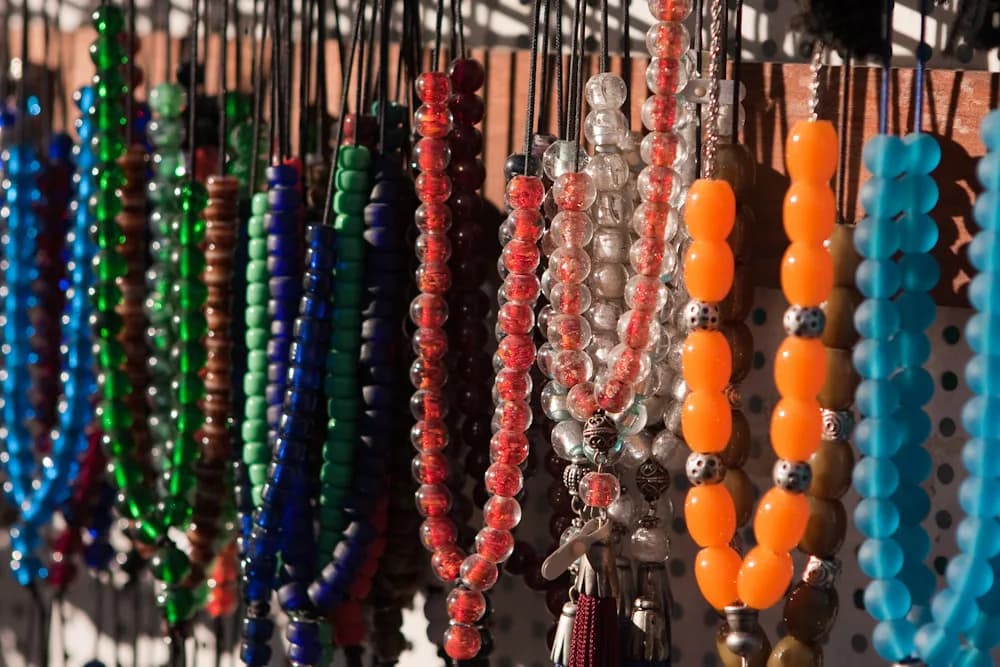
The word is usually rendered in English as worry beads, and visitors most often meet komboloi in souvenir shops, jewellers and craft stalls rather than in churches or museums. English-language accounts describe the beads as a way to keep the hands busy when someone is restless or has time to fill, which is a fair description of how they are used. If you want one as a working everyday object rather than a display piece, buy for feel and durability first and decoration second.
Komboloi, worry beads and the Greek name: meaning and pronunciation
The Greek word is komboloi, and English-language sources commonly gloss it as worry beads because the beads are something to occupy the fingers when a person is restless or waiting. Treat the English term as a description of use, not a medical claim: the beads are a habit and a social prop, not a treatment. The association with soothing the hands is the reason the nickname stuck, and that is as far as the label should be pushed.
For pronunciation, stress the last syllable and keep the vowels short: kom-bo-LOI, with a clear o in the middle. Greeks will understand the English phrase worry beads, but asking for a komboloi in a shop is more precise and avoids confusion with necklaces and rosaries. Spelling varies in transliteration, so try komboloi and koboloi if a search returns little, and show a photo if you are asking in person.
What a komboloi is made of: beads, string, shield and tassel explained
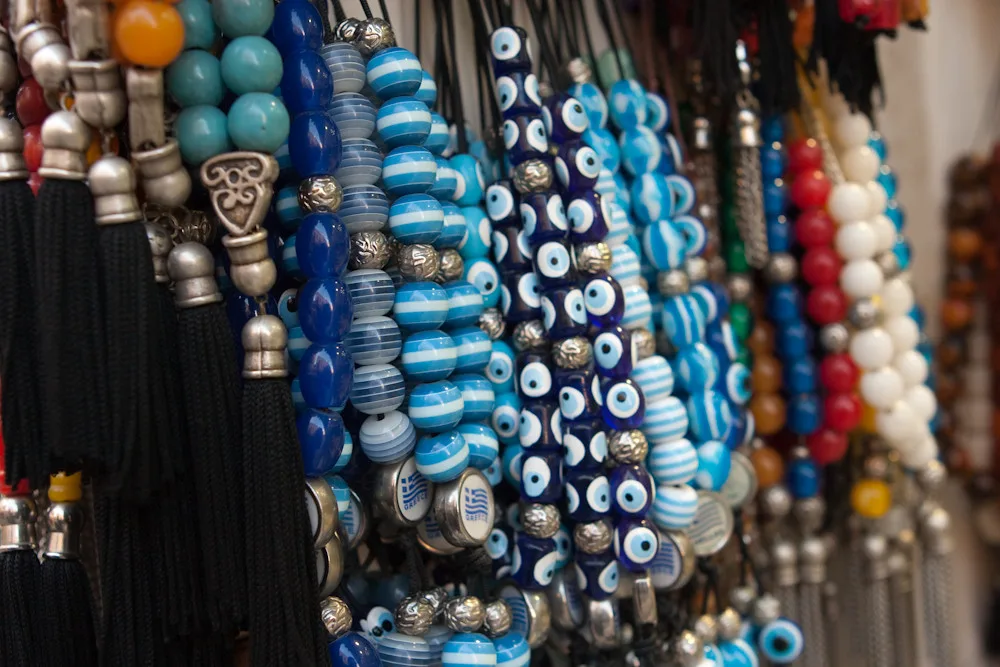
Four parts matter: the beads, the cord that runs through them, a small shield or cover where the ends meet, and the tassel or decorative knot that hangs below. The shield hides the join and protects the cord from rubbing, so a solid one is a sign of care in assembly. The tassel is cosmetic but also gives the fingers something to catch when the loop swings.
Bead materials change weight, sound and price. Amber and faturan, a resin composite often made to imitate amber, give a warm, light click and are the classic premium look; bone and olive wood are heavier and quieter; glass and plastic are the cheapest and loudest. Hard beads in a quiet room are audible, which is worth remembering on a ferry or in a small taverna. Ask what the beads are made of rather than guessing from colour, since imitations are common and honest sellers will say.
String tension decides how the komboloi behaves. A cord that is too loose lets the beads clump and tangles the tassel; one that is too tight makes the loop stiff and awkward to pass from hand to hand. Test by holding the shield and letting the loop hang: beads should sit in a clean curve with a little slack. Check the knot at the shield, because that is where a cheap strand fails first. Once you have a strand you trust, the same habit of testing an object by feel pays off when you handle food and crafts elsewhere, much as what to eat in Greece rewards choosing by sense over labels.
How many beads a komboloi has and why the count varies
There is no single fixed number, and counts vary by maker, style and the size of the beads. Odd numbers are the convention most often quoted, with strands in the low twenties being common, but you will see shorter and longer ones in the same shop. Ask the seller how many beads a specific strand has if the count matters to you, and remember a shorter loop with large beads feels very different in the hand from a long loop of small ones.
Bead size and count work together to set the rhythm. Large beads suit a slow, deliberate pass; small beads allow faster movement and a longer loop that swings more. If you plan to carry it in a trouser pocket, a shorter strand with beads around a centimetre across is easier to pocket than a long, heavy piece. Try both in the shop rather than ordering by bead count alone.
How to use a komboloi: grip, rhythm and moving the beads hand to hand
Hold the shield or the join between thumb and forefinger and let the loop hang, then use the thumb to push one bead at a time over the fingers so the strand travels around. The motion is small, quiet and continuous, and the aim is a steady rhythm rather than speed or tricks. Most people settle into a one-handed pass and only occasionally move the loop to the other hand. Those who keep a komboloi describe the pull of a regular, repetitive movement while the mind is elsewhere.
Start with a slow pass and a light grip. Gripping hard makes the fingers tired and produces a louder click, and flicking the tassel around is a flourish rather than the basic action. If beads tangle, stop and let the loop hang straight before continuing; forcing it strains the cord. Practise at home before using it in public, since a smooth rhythm reads as natural and a fumbled one attracts attention.
Komboloi vs begleri: weighted skill toy or idle fidget
A begleri is a short string with a weight at each end, flipped and caught between the fingers, and it belongs to the world of skill toys and tricks. A komboloi is a closed loop of many beads passed steadily through the hand with no flipping. The two are sometimes sold side by side in the same shops and online stores, so check what you are buying: a begleri will not give you the slow bead-by-bead pass, and a long komboloi is not built for tricks.
If you want something to occupy your hands while walking or talking, choose the komboloi. If you want a challenge and a physical skill to learn, the begleri is the closer match, and the trade-off is noise and dropped weights. Neither is a prayer item, and neither requires instruction beyond a few minutes of practice.
Komboloi vs prayer beads: what separates them
Prayer beads, including the Greek komvoskini used in Orthodox practice, are tied to recitation and carry a fixed number of knots or beads that corresponds to specific prayers. A komboloi has no prayers attached, no required count and no blessing, and it is used in ordinary conversation. The visual difference is usually clear: prayer ropes are knotted cord, often dark and plain, while komboloi are strung beads with a decorative shield and tassel.
The confusion matters when buying a gift. If the recipient wants a religious object, a komboloi is the wrong purchase; if they want a Greek hand habit, a prayer rope is not what they expect. Say plainly what you are looking for in the shop, and ask whether the piece is a komboloi or a komvoskini before paying.
What to check before buying: string tension, bead material, spare parts
Run through a short checklist in the shop. Hang the loop and look for an even curve; roll a bead between finger and thumb to feel for cracks or rough edges; tug gently at the shield to check the knot; and ask whether spare cord or a replacement tassel is available. A seller who can name the bead material and offer a restringing service is usually selling a piece built to last.
Decide between light and heavy before you look at colour. Amber-style resin and glass feel light and click brightly; bone and wood feel denser and quieter; metal beads are heaviest and loudest and are best kept for display. For daily carry, a mid-weight strand in the low twenties is a sensible default, but the right answer is the one that feels balanced in your own hand. Avoid beads with sharp mould seams if you plan to use it often.
If you are shopping for gifts, buy in person rather than from a photo. Komboloi vary enough in weight and finish that two strands with the same bead count can feel completely different, and colour in photographs is unreliable. Ask to handle several, and check the return policy before committing to a pricier piece.
Buying in Greece: souvenir shops, jewellers and craft stalls, and what the price difference reflects
Komboloi turn up at three kinds of seller: general souvenir shops, jewellers and craft stalls at markets or festivals. Souvenir-shop strands are usually inexpensive, mass-produced and dependable enough for a first komboloi. Jewellers stock silver shields, amber-style resin and worked beads at higher prices, and craft sellers may make to order. The price gap reflects bead material, hand-finishing, the shield and how the piece was assembled, not a difference in how the object is used.
Prices are not published in a consistent way across shops, so check the tag or ask before you commit and expect the range to be wide between a plastic strand and a silver-mounted one. If a seller cannot explain bead material or restringing, treat a high price with caution. Greek souvenir shops are covered in more detail in the wider greek souvenirs guide, alongside food gifts and other small keepsakes such as spoon sweets and Greek mountain tea, which travel differently from beads.
Where you shop also shapes what you find. Island souvenir strips lean toward light, cheap strands for tourists, while city jewellers and craft stalls carry heavier pieces with silver fittings. If you are browsing in Santorini, shopping in santorini covers the main retail areas in Fira and beyond, including the Fabrica Shopping Centre, and is a useful starting point before you set out to compare strands. The same approach works on the mainland, where things to do in Nafplio points you to the old-town lanes worth wandering.
Etiquette: is a komboloi loud, and when not to use one
Clicking beads is normal in a Greek cafe, on a ferry deck or in a taverna, and nobody will look up. The etiquette question is noise and setting: hard beads in a quiet church, museum gallery or formal meeting are distracting, and the same strand that is pleasant in a noisy square can be audible across a small room. Keep the movement small and the grip light when you are unsure, or leave the komboloi in your pocket.
On archaeological visits, a komboloi is fine to carry but not something to swing near sculptures or display cases. If your day mixes ruins and shopping, plan the order so you are not juggling a heavy strand: ancient sites in Greece reward hands-free walking, and a loop of beads is easy to tuck away. If you are visiting the Acropolis of Athens or other crowded sites, keep the komboloi in your bag on the climb.
Care and repair: restringing, bead wear and tassel replacement
Cord is the part that wears out first. A strand that starts to sag, tangle or show fraying at the shield needs restringing before a bead drops off, and a jeweller or craft seller can usually do it or sell you cord. Keep the komboloi dry and out of direct sun when stored, since resin, wood and bone can discolour, and wipe beads with a soft cloth rather than solvents.
Tassels fray with daily use. A replacement tassel or a simple knot keeps the piece functional, and a loose shield can be tightened with thread before it rubs through the cord. If the beads themselves are chipped, the strand can still be used, but sharp edges will catch on clothing and skin. Restringing is cheaper than replacing a good bead set, so ask about it before discarding a piece.
Where komboloi sit among Greek souvenirs alongside worry-bead alternatives
Komboloi are among the most portable Greek souvenirs: light, unbreakable in most versions and useful after the holiday ends. They sit naturally beside other small keepsakes such as evil-eye charms, olive-wood kitchen items and food gifts. The evil eye is a different tradition altogether, a protective amulet rather than a hand habit, and Greek Evil Eye (Mati) explains the distinction if you are buying both.
Food gifts and beads rarely overlap, but the same shopping streets sell both. If you are looking for edible souvenirs to pair with a komboloi, what to eat in Greece covers what to buy and how to choose it, and the wider greek souvenirs guide sets out which food gifts travel well.
If you are shopping in Oia on Santorini, the main pedestrian lanes are lined with boutiques and souvenir shops where a light komboloi is easy to find alongside other small gifts. shopping in oia covers the main walking route, and Nik. Nomikou street is the spine of the village's retail area, so allow time to compare strands rather than buying at the first stall.
Plan Your Visit
Choose a komboloi by feel rather than by bead count. Hang the loop, check the shield knot, ask what the beads are made of, and handle a light and a heavy strand side by side before deciding. A mid-weight piece with a secure cord and a replaceable tassel will outlast a cheaper strand that only looks good in the window.
Buy where you can ask questions: a jeweller for silver and amber-style pieces, a craft stall for something made to order, a souvenir shop for a first cheap strand. If you are touring multiple islands, buy later in the trip so you are not carrying a heavy strand through ferry ports and archaeological sites. Check opening hours and stock directly with the shop, since these change by season.
Frequently Asked Questions
What is a komboloi?
A komboloi is a loop of beads Greeks carry and move through the fingers as an idle habit, often translated as worry beads. It has no prayers attached and no required count, and it is used in ordinary conversation, waiting or walking rather than in religious practice.
How many beads are in a komboloi?
Counts vary by maker and style, and there is no single fixed number. Odd numbers are the convention most often quoted, with strands in the low twenties being common, but shorter and longer loops are sold in the same shops. Ask the seller for the count on a specific strand, since bead size changes the feel as much as the number does.
What is the difference between a komboloi and prayer beads?
Prayer beads, including the Orthodox komvoskini, are tied to recitation and carry a fixed number of knots or beads for specific prayers. A komboloi is a secular hand habit with no prayers, no required count and no blessing, and prayer ropes are usually plain knotted cord while komboloi are strung beads with a shield and tassel.
What is the difference between a komboloi and a begleri?
A begleri is a short string with a weight at each end, flipped and caught between the fingers as a skill toy. A komboloi is a closed loop of many beads passed steadily through the hand without tricks. If you want a slow rhythm, choose the komboloi; if you want a physical challenge, the begleri is the closer match.
How do you use a komboloi?
Hold the shield between thumb and forefinger, let the loop hang, and push one bead at a time over the fingers so the strand travels around in a steady rhythm. Keep the grip light to avoid tiring the hand, and let the loop hang straight if beads tangle rather than forcing them.
Is a komboloi loud?
Hard beads such as glass or metal click audibly, which is normal in a noisy cafe or on a ferry but distracting in a quiet church, museum or meeting. Lighter and smaller movements reduce the sound, and keeping the komboloi in your pocket is the simplest choice when you are unsure about the setting.
Can you wear a komboloi as a bracelet?
Most strands are built to hang from the hand rather than wrap around the wrist, and a long loop will not sit neatly as a bracelet. Shorter strands or bracelets made in a similar style are the practical option if you want to wear one. Ask the seller whether a specific piece is intended for the wrist before buying.
Where can you buy a komboloi in Greece?
Souvenir shops, jewellers and craft stalls at markets or festivals all sell komboloi, and island shopping streets stock light tourist versions. Jewellers carry heavier pieces with silver fittings, and craft sellers may make to order. Ask about bead material and restringing before paying, since prices vary widely between plastic and silver-mounted strands.
Sources
Notes for eating well in Greece
Optional updates to our guides.
You might also like


Continue reading
More guides you'll find useful