Is Rhodes Expensive? Real Costs for Food, Buses and Sights
Rhodes costs more in the resorts and Old Town than in back streets and villages. See what drives the bill, from taverna meals to buses and site tickets.
On this page
Rhodes sits in the middle of the Greek island price range, but the range itself is wide. A meal in a walled Old Town square, a sunbed in Faliraki and a caldera-style table at Lindos pull the bill in different directions, and each needs a different plan.
This guide looks at what actually moves costs on Rhodes: resort zones, the medieval Old Town, seasonal demand and the way Greek menus price fish by weight. It also maps the everyday items, coffee, ouzo, buses and site tickets, so you can build a daily figure that matches how you travel.
Prices change from season to season and from one establishment to the next, so treat any figure here as a range rather than a fixed rate. Start with a broader picture of what a trip to Greece costs, then narrow it to Rhodes, and check current prices before you travel.
Is Rhodes expensive compared with other Greek islands?
Rhodes is a large, developed island with a long tourist season, so it tends to sit above the cheapest Cyclades and Dodecanese options and below the most image-driven destinations. The comparison that matters is not island against island but zone against zone: a back-street taverna in Rhodes Town and a view table in Lindos can belong to two different price worlds.
Is Rhodes expensive compared with other Greek islands? Rhodes generally sits in the middle of the Greek island price range. It is more developed and more year-round than the smallest Cyclades, so it has more mid-range and premium options, but its size also means more competition and more cheaper back-street places away from the resort belt and the Old Town.
How much should I budget per day in Rhodes? No single figure holds across the Old Town, the resort belt and Lindos, and prices change seasonally. Build your own total from food, transport and accommodation, and compare each line against what a careful, mid-range or comfortable trip would spend on those items rather than relying on an island-wide average.
Is it cheaper to eat in the Old Town or outside the walls? Meals outside the walls in modern Rhodes City tend to be cheaper, because they serve residents and office workers as well as visitors. Inside the walls you pay partly for the medieval setting, so a common approach is one atmospheric evening in the Old Town and the rest of the meals outside it.
For a like-for-like sense of where Rhodes fits in the national picture, read the full breakdown of is greece expensive, which separates transport, food and accommodation by island type. Rhodes usually lands in the mid-range band, with the resort belt and the Old Town pushing toward the upper end of that band.
What actually sets prices on Rhodes: resort zones, the walled Old Town and seasonal demand
The island has a handful of recognizable price zones. Rhodes City, the modern capital, includes the walled Old Town, the harbour and the commercial streets around Rhodes Town Hall; Ialysos, also called Trianta, runs into the resort strip of Ixia; Kallithea stretches along Faliraki beach and includes Koskinou and Kalithies; and Lindos combines a whitewashed hillside village with a medieval-walled acropolis above a circular bay.
Demand concentrates in the resort belt between Rhodes City and Faliraki, where hotel units in Ixia and Trianta receive guests year-round, including conference and business visitors. That year-round base makes Ixia and Trianta less seasonal than the smaller beach villages, which changes how much of the season a restaurant has to earn its living in.
The municipality itself publishes lists of ceremony locations across regions including Rhodes City, Ialysos, Kallithea, Lindos, Afandou, Archagelos and Petaloudes. That administrative map is a useful reminder of how big Rhodes is: Petaloudes, the Valley of the Butterflies, and the hill of Filerimos above Ialysos sit in separate areas with their own local economies, and transport between them is a real line in the budget.
Old Town Rhodes: eating inside the walls versus the streets outside them
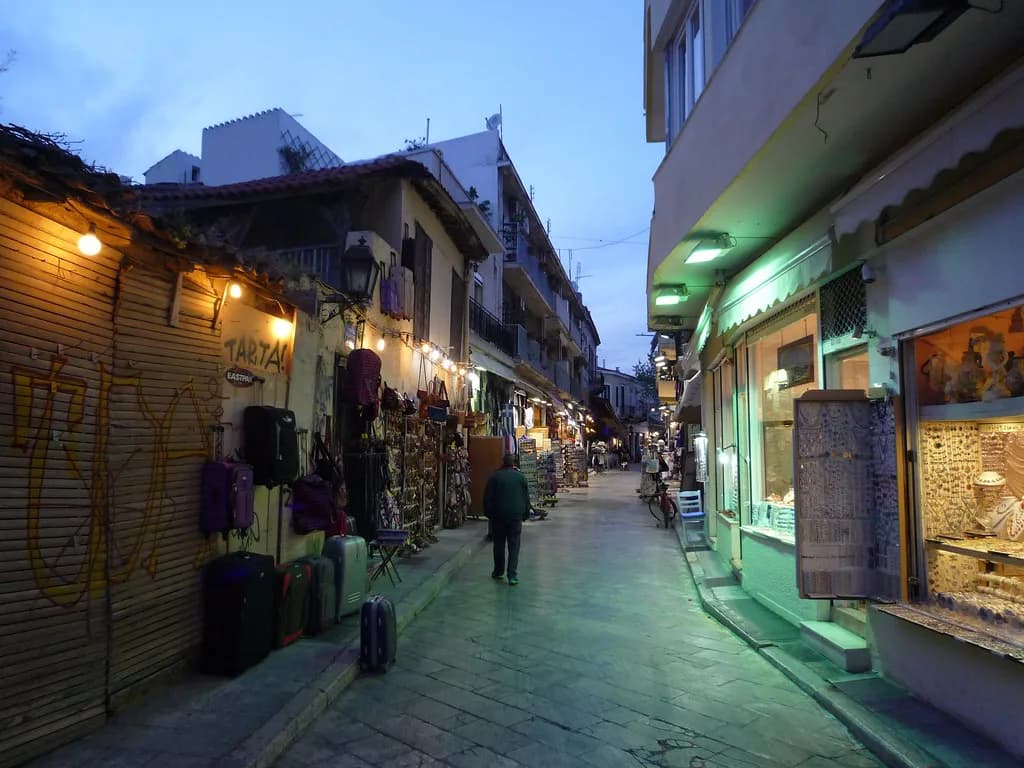
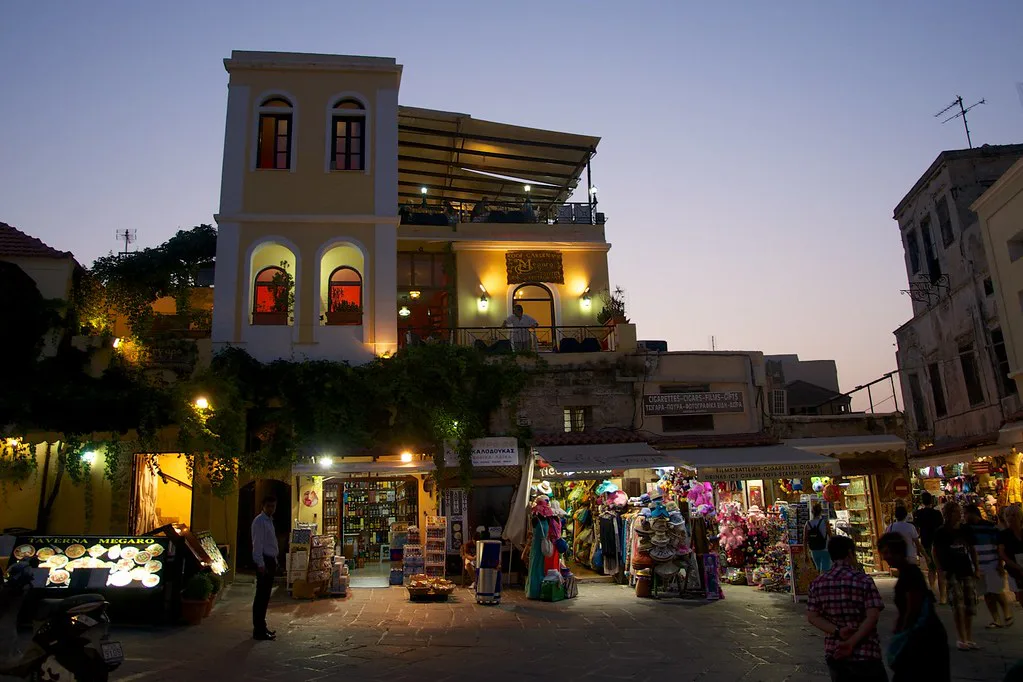
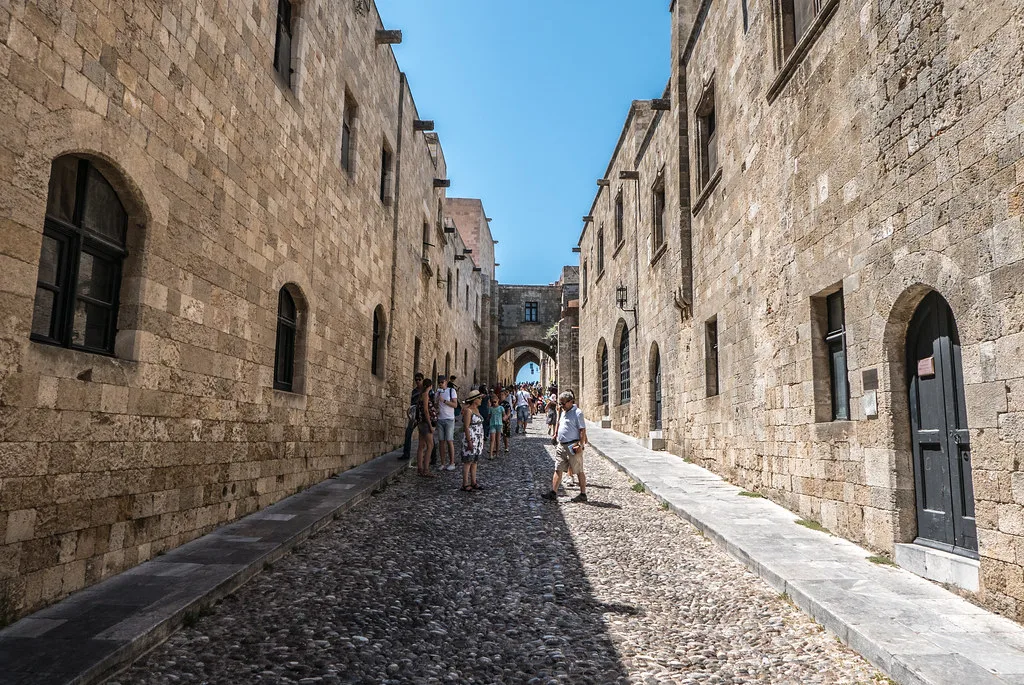
Inside the medieval walls, the Old Town trades on atmosphere: pebble-paved lanes, stone courtyards and proximity to the Palace and the harbour gates. Tables here are often priced for the setting, and the busiest lanes between the main squares can carry a noticeable premium.
Outside the walls, the modern city spreads toward Rhodes Town Hall and the commercial streets. Meals here are aimed at residents and office workers as much as visitors, so the same dishes tend to be gentler on the wallet, at the cost of the medieval backdrop.
The honest trade-off is that the Old Town is not the place to economize on the setting you came for, but it is also not the place to economize on the food. A practical approach is to spend one evening inside the walls for the atmosphere and eat your other meals outside them.
Resort comparisons: Faliraki, Ixia and Trianta, Kallithea and Lindos
Faliraki is the loudest and most commercial stretch, with a five-kilometer sandy beach and hotels of every class, so the price spread is wide and choice is the main defense. Kallithea, which also covers Koskinou and Kalithies, combines the Italian springs and diving bay with residential villages just inland, where eating tends to be more ordinary and cheaper.
Ixia and Trianta sit between Rhodes City and the airport side, with a year-round hotel base that keeps a steady supply of restaurants open beyond the summer. Lindos, by contrast, is the premium day out: its compact village, acropolis and deep bay make it the most photographed corner of the island, and the view tables around St Paul's Bay and the beachfront earn their premium at sunset.
To see how far these zones sit from each other and from the airport, read the municipality's own list, which places Lindos, Faliraki, Ialysos, Archagelos and Petaloudes in their regions.
Island pattern to plan around: seasonal restaurants closing roughly November to April
Many Greek island restaurants, especially the smaller family places, close for the winter, roughly November to April, and Rhodes follows that general pattern outside its year-round urban and resort cores. Ixia and Trianta are explicitly described as receiving guests all year round, which means the winter map of open kitchens on Rhodes is concentrated rather than evenly spread.
If you are traveling between November and April, build your eating plan around the year-round zones and confirm the specific place before you commit an evening to it. A quick direct message or a look at recent reviews will tell you more than an outdated listing.
Taverna costs and how to read a Greek menu
Greek eating is built around mezedes, the small dishes meant to be shared, ordered together and eaten as a spread rather than in courses. A meze is that same idea in the singular or as a set, so the number of dishes, not the number of diners, is what drives a taverna bill.
Learn a few names and the menu stops being a lottery. Tzatziki is yogurt with cucumber and garlic; skordalia is a potato-and-garlic cream; fava is a purée of yellow split peas; taramosalata is a fish-roe spread; and tirokafteri is a spicy feta-and-yogurt dip. A choriatiki is the familiar village salad of tomato, cucumber, pepper, onion, feta and olives; saganaki is fried cheese; dolmades are stuffed vine leaves; gemista are vegetables stuffed with rice; and gigantes are giant beans baked in tomato sauce.
Pita gyros is the cheap staple, a wrapped flatbread with meat, salad and sauce, sold from counters rather than as a sit-down meal. It is worth knowing that the vertical rotisserie version became established in Greece only in the late 1960s, which explains why the take-away wrap is the modern convenience dish rather than an old taverna classic.
Bread is typically brought to the table and charged without being asked. If you do not want it, say ochi psomi parakalo (no bread, please) when you sit down, and the cover drops from the final bill.
For a dish-by-dish guide to what to eat in Greece, from moussaka to pastitsio, use a food guide that explains each plate before you order. Knowing the names makes the Rhodes taverna prices easier to read too, since, as with ancient sites in greece, the cost sits in the specific thing you choose.
Ordering fish and seafood by the kilo, and why the price can climb fast
Fish is the biggest single variable on a Greek taverna bill, because it is usually sold by weight rather than as a fixed portion. The custom is for one person to follow the waiter to the kitchen and choose from what is actually available that day, so the price of the meal is decided before it is cooked, not after.
Fish can be very expensive, though cheaper species such as sardines, anchovies, mackerel and smelt are widely available and cost far less than the premium bream and bass family. Farmed sea bream and sea bass are increasingly common, so if provenance matters, ask before you choose.
Greek menus are required to indicate whether fish is fresh or frozen, with a frozen item often marked accordingly. Look for that mark, and ask the price per kilo before confirming a whole fish.
For a lower-risk fish meal, order the small fried species as mezedes and share a single fresh fish among two or three people. Octopus and squid work the same way: a grilled octopus tentacle or a plate of fried squid is a shareable starter rather than a main.
Drinks: Greek coffee, freddo espresso, ouzo, house wine and beer
Drinks are where a budget quietly leaks. Greek coffee, ellinikos kafes, is strong, served in a small cup with a glass of water, and traditionally ordered sketos (no sugar), metrios (medium) or glykos (sweet). Freddo espresso is iced, frothed and now the everyday summer coffee; a freddo cappuccino adds cold milk foam and often comes with a still-warm bougatsa, a phyllo pastry.
House wine is usually available by the carafe, often drawn straight from the barrel, and is the cheapest way to drink wine with a meal. Ouzo is the aniseed spirit that pairs with mezedes, and the cheapest way to drink it is by the small glass alongside a shared plate of octopus or sardines. Bottled beer is priced per bottle, so it adds up faster than a carafe.
For a broader set of strategies that apply across the country, from coffee to transport, the Greece on a budget guide covers the everyday habits that keep a daily total down.
Getting around: buses versus rental car versus taxis
Rhodes is a big island, and the distances between the Old Town, Faliraki, Lindos and the western villages are real. Buses are the cheapest way to cover those distances, but they tie you to fixed routes and timetables, so check the schedule for the specific line you need on the day rather than relying on memory.
A rental car makes sense if you want to combine distant places in one day, such as the hill of Filerimos above Ialysos with the Valley of the Butterflies at Petaloudes. The trade-off is parking in Rhodes City and the Old Town, where space is limited and a car becomes a liability rather than a convenience.
Taxis are best kept for airport transfers and late evenings, when a bus timetable no longer suits. For families or groups of three or four, splitting a taxi can be cheaper than buying separate bus tickets and faster than waiting.
If you want to compare the cost of getting around with the cost of everything else, the wider budget breakdown for what a trip to Greece costs puts transport in context.
Sights and ticketed attractions, and how entry fees add up over a week
Most of Rhodes's sightseeing is free at the edges and ticketed at the center. The Old Town streets, the harbour and the beaches cost nothing to walk; the acropolis at Lindos, the Palace of the Grand Master and the archaeological museum carry individual entry fees. A week of single tickets adds up quickly, so check whether a combined ticket or a free day applies before you buy.
Some of the best-value stops are places the municipality itself lists as landmarks rather than ticketed sites: the hill of Filerimos with its monastery and ancient acropolis ruins, the Italian springs at Kallithea, and the Valley of the Butterflies at Petaloudes, reached via the village of Theologos. These are outdoor or low-cost half-days that balance a week of paid museums.
Plan sightseeing geographically so that one day's transport serves several stops. Pairing ancient sites in greece with a single base, for example the Acropolis of Athens with sites elsewhere, is a habit that works just as well on Rhodes.
Accommodation trade-offs: view versus value, harbour versus back street
On Rhodes, the view is usually the single largest line in an accommodation bill. A room facing the Lindos bay or a terrace above the Old Town harbour commands a premium that often runs to two or three times the price of a simple room in the same village, and it is worth asking whether you will actually be in the room at the hour the view pays off.
A back-street room a few minutes from the waterfront gives you the same beaches and restaurants for less, at the cost of a short walk. In Ixia and Trianta, the year-round hotel base means off-season rates are more stable than in the beach villages, which close with the season.
Honest direct booking with a small hotel often matches or beats the big platforms, and it lets you ask the questions that matter: whether the kitchen is open in April, whether the bus stops nearby, and how far the walk to the beach actually is.
A sample daily spend for a careful, mid-range and comfortable traveler
The municipality's own pages cover ceremony venues and registration procedures rather than restaurant or transport tariffs. Figures circulating in forums, including claims that Rhodes is the most expensive place a traveler has visited, reflect individual itineraries rather than a rate you can budget from.
Build your own figure from three lines instead. Food: a careful day of bakery breakfast, pita gyros lunch and a shared meze dinner costs far less than a restaurant dinner with a whole fish. Transport: a bus pass day versus a rental car with fuel and parking. Accommodation: a back-street room versus a view room, booked direct.
For a broader framework to slot those three lines into, the cheapest Greek islands comparison shows what a genuinely low-cost island looks like, which makes Rhodes's mid-range position easier to judge.
Common money mistakes on Rhodes and how to avoid them
The first mistake is choosing a table for the view before checking the menu for anything besides the view. The second is ordering a whole fish by weight without asking the per-kilo price first. The third is assuming that the Old Town is uniformly expensive or uniformly cheap, when the lane and the courtyard matter.
Bread and cover charges quietly inflate a bill, and a polite no at the start settles it. Ordering bottled water at every meal, when tap water is safe and free, is another small leak. Finally, a single return taxi from Rhodes City to Lindos can cost more than a day of buses for two people.
The single most effective habit is to decide before you sit down whether this meal is about the setting or the food. A view table at St Paul's Bay and a back-street taverna outside the Old Town walls are both valid choices; the mistake is ordering the view and the food as if they were one purchase.
Practical booking advice for sunset and caldera-style view tables in Lindos
Lindos has the closest thing on Rhodes to a caldera setting: a deep circular bay below a walled acropolis, with St Paul's Chapel and bay below the cliff and the beachfront at Vliha in front of the Lindian Jewel hotel. The tiny chapel of St Paul is perched next to the turquoise water and is one of the most photographed settings on the island, so tables with that line of sight are the ones to reserve.
Book view tables at least a day ahead in high season and confirm the sunset time when you book, since the hour shifts through the season. Ask whether the table is outside and facing the bay, and whether the kitchen stays open until sunset; a table that stops serving before the light goes is not the table you booked for.
The municipality lists Lindos Town Hall, St Paul's Chapel and platform, and Vliha Beach as ceremony locations, which tells you the bay and chapel area is both a public landmark and an event space. On a wedding day, the most photogenic stretch of bay can be partly reserved, so check the local schedule if a specific table matters.
For a comparable view-versus-value exercise, the is santorini expensive guide breaks down how caldera tables are priced, and the lessons transfer directly to Lindos.
Plan Your Visit
Rhodes is neither the bargain island nor the trap the internet makes it out to be. It is a mid-range destination whose bill is set by three choices you control: which zone you sleep in, whether you order the view or the food, and how much of the island you cover by bus versus car.
Start with the zone, then the menu, then the transport plan. If you are comparing islands, weigh Rhodes against the cheaper options honestly, and check opening days and prices with the specific place before you build an evening around it.
Explore more Greece sauna guides
Frequently Asked Questions
Is Rhodes expensive compared with other Greek islands?
Rhodes generally sits in the middle of the Greek island price range. It is more developed and more year-round than the smallest Cyclades, so it has more mid-range and premium options, but its size also means more competition and more cheaper back-street places away from the resort belt and the Old Town.
How much should I budget per day in Rhodes?
No single figure holds across the Old Town, the resort belt and Lindos, and prices change seasonally. Build your own total from food, transport and accommodation, and compare each line against what a careful, mid-range or comfortable trip would spend on those items rather than relying on an island-wide average.
Is it cheaper to eat in the Old Town or outside the walls?
Meals outside the walls in modern Rhodes City tend to be cheaper, because they serve residents and office workers as well as visitors. Inside the walls you pay partly for the medieval setting, so a common approach is one atmospheric evening in the Old Town and the rest of the meals outside it.
Do restaurants in Rhodes close in winter?
Many Greek island restaurants close for the winter, roughly November to April, and Rhodes follows that pattern outside its year-round cores. Ixia and Trianta have a year-round hotel base including business and conference guests, so they remain the safest bet in the colder months. Confirm the specific place before traveling for it.
Is Lindos more expensive than Rhodes Town?
Lindos is the premium day out on Rhodes, because of its acropolis, its compact village and the bay around St Paul's Chapel. Tables with a view of the bay carry a premium, especially at sunset, while inland villages such as Koskinou and Kalithies offer cheaper everyday eating.
How much does a pita gyros cost in Rhodes?
Pita gyros is the cheapest sit-down-or-takeaway staple in Greece, and it is priced per wrap at the counter rather than by weight. Prices vary by zone and season, so read the board before ordering; the resort belt is generally higher than a back street in Rhodes City.
Is it cheaper to rent a car or take buses on Rhodes?
For one or two people covering the main routes, buses are usually cheaper; for three or four people combining distant places in a single day, a rental car can work out cheaper once fuel and parking are counted. Parking in Rhodes City and the Old Town is the main practical constraint.
Do I need to book a table for sunset in Rhodes?
For view tables in Lindos, especially around St Paul's Bay, book at least a day ahead in high season and confirm both the sunset hour and that the kitchen stays open through it. For back-street tables outside the Old Town walls, booking is rarely necessary.
Sources
Notes for eating well in Greece
Optional updates to our guides.
You might also like

Continue reading
More guides you'll find useful