
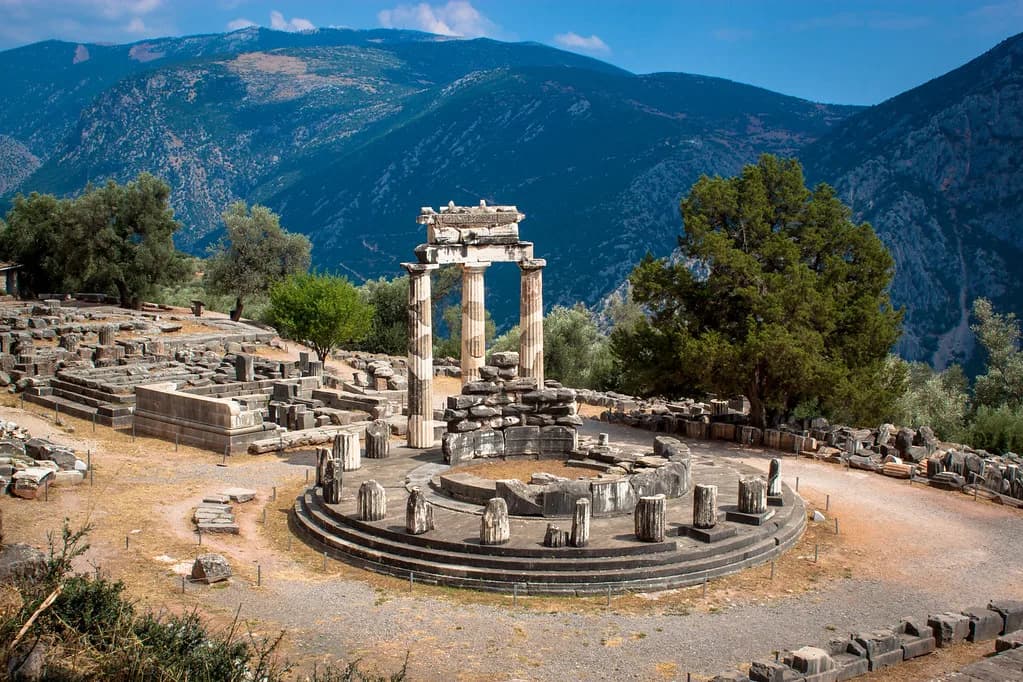
The Tholos of Delphi: Visiting the Round Temple at Athena Pronaia
Most visitors to Delphi walk up from the road, through the Sanctuary of Apollo, and never look down at the circular ruin below the highway. That ruin is the Tholos, the most photographed monument of the sanctuary of Athena Pronaia and one of the structures included in the Delphi UNESCO World Heritage Site. It is small, it is unexplained, and it rewards ten minutes of attention rather than a passing glance.
This guide stays with the Tholos itself: where it stands within its sanctuary, how to reach it on foot, what the columns and floor actually tell you about the original design, and the competing theories about its function. Hours and tickets change by season, so check the official archaeological site pages for the day you plan to go rather than relying on a figure quoted anywhere else.
What the Tholos of Delphi Is
The Tholos is a circular building erected between 380 and 370 BC inside the sanctuary of Athena Pronaia, a short distance from the main sanctuary of Apollo at Delphi. Its ancient name and use are not settled, which is why the monument's own site describes its function as unidentified. What is certain is the date range, the circular plan, and its place among the monuments of the Delphi archaeological site.
Architecturally it is a rare thing: a fully round building with a circular colonnade and a circular inner room, the cella. The official description notes that it combines almost all the styles of Classical architectural design, which is why architectural historians treat it as a reference point rather than a footnote.
Where It Sits Within the Delphi Site
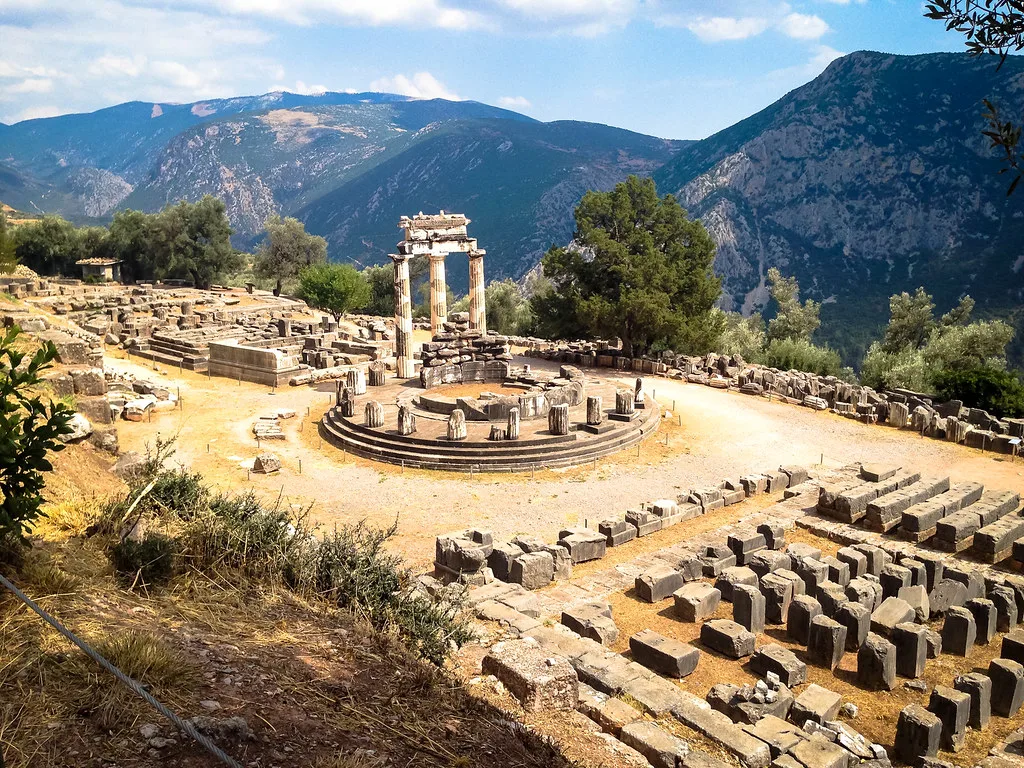
The Tholos stands in the sanctuary of Athena Pronaia, positioned between the 4th-century temple of Athena and the treasury of the Massaliots. That location matters practically: it is not up among the treasuries on the Apollo slope but down in a separate precinct, and the official page notes that the round building is visible from the road. If you only see it from the bus window, you have seen the silhouette and nothing else.
The sanctuary of Athena Pronaia is the area most often skipped, because it lies below the modern road and has no grand processional approach. Treat it as its own stop rather than a detour: the temple of Athena and the Massaliot treasury sit in the same precinct and are seen in the same twenty minutes.
How to Get There on Foot
From the main archaeological site, the route to Athena Pronaia runs downhill and east along the road toward Arachova, and the return is uphill. That geometry is the single biggest factor in how much time to budget: the walk down takes minutes, the climb back up takes longer, and the midday sun makes it feel longer still. Sturdy shoes and a bottle of water are the practical answer, not a guided shortcut.
If you are arriving by car or coach, the sanctuary is easier to visit on the way in or out, since roadside stopping is limited and signage is modest. Whichever direction you come from, confirm the current access arrangements and opening hours with the official Delphi site before setting out, as these are seasonal.
What You Actually See Today
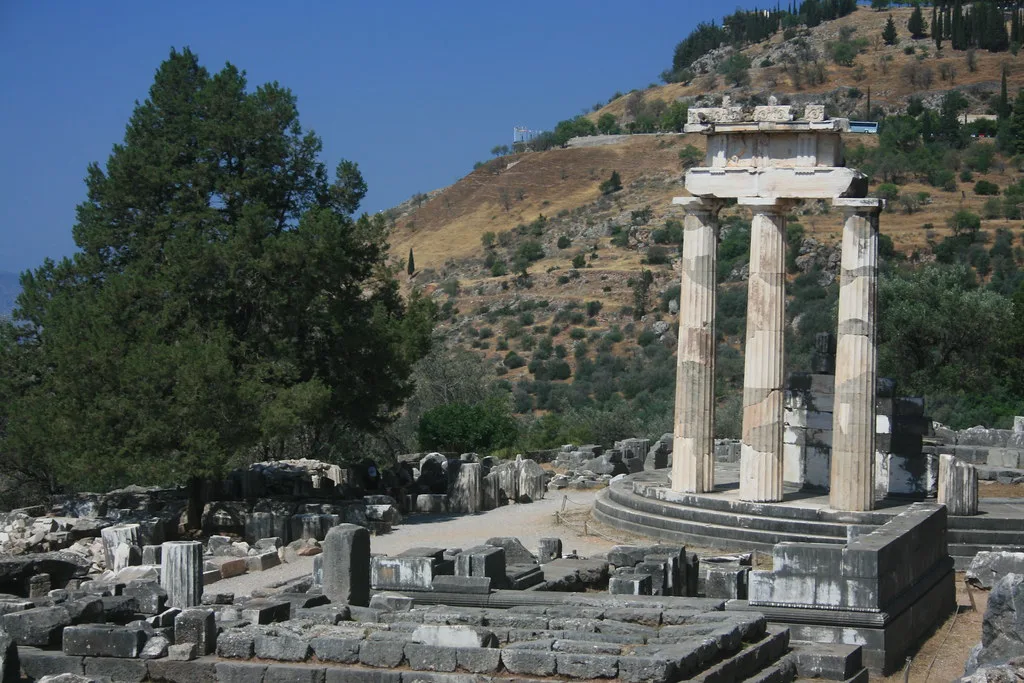
What survives is partial: a section of the circular colonnade re-erected in the 1938 restoration, standing on the lower courses of the structure, with the rest of the plan legible in the stone foundations. The building was destroyed by fire in the 1st century BC, so there is no roof, no cella interior in elevation, and no sculpted frieze in place. Reading the monument means reading a footprint with three or so columns rising from it.
Visitors should not expect to walk into the cella or climb onto the platform; the monument is viewed from outside, from ground level. The payoff is proportional: the Tholos is a short stop, and the interest lies in the shape, the surviving order, and the view back up toward the sanctuary of Apollo.
Reading the Architecture
The original building had twenty tall, slender Doric columns around the outside, each 5.93 metres high, supporting an architrave and a frieze of forty sculpted metopes showing battles of Amazons and Centaurs. The outer colonnade, the pteron, was deliberately narrow, which the site's description suggests was done to emphasise the circular form. Those reliefs were carved exceptionally deep, closer to freestanding sculpture than to flat panel work.
Inside, the cella was also round, entered from the south, and its walls carried a bench of bluish marble with ten or thirteen Corinthian semi-columns on the lower level. A recent reconstruction proposes a second, upper colonnade of Ionian semi-columns above them, so the interior mixed orders rather than repeating the Doric exterior. The floor combined white marble at the centre with dark Eleusinian limestone toward the edge.
The scale is modest and worth holding in mind: 13.5 metres across the outside, 8.41 metres inside the cella. That is a room, not a cathedral, and knowing the dimensions makes the surviving columns easier to judge when you are standing beside them.
The Unresolved Question of Function
No source establishes what the Tholos was for, and the official page is explicit that its use remains undefined. Older scholarship linked it to a cult of Artemis, based partly on the sanctuary setting. More recent proposals read it as an arsenal, a use attested in inscriptions at the site, where armour and other dedications to Athena were kept, or as a place for performing hymns.
A further theory connects the building to the citizens of Sicilian Thurioi, who are said to have dedicated it to Boreas, the north wind, after their enemies the Syracusans were scattered in a naval battle in 379 BC. These are scholarly proposals, not settled fact, and a good guide or site panel will present them as such. Visitors who want a single answer will not find one, and that uncertainty is itself the most interesting thing about the monument.
Pausanias, the ancient traveller who described Delphi in detail, does not name the Tholos specifically; he refers to four temples in the sanctuary of Athena Pronaia. That silence is part of why the identification is still argued over, and it is a useful reminder that even a well-documented ancient site has gaps.
The Architect and the Design Mix
Vitruvius names Theodore the Phocaean, from Phocis or from Phocaea in Asia Minor, as the architect, and notes that he wrote a book about this building. The design is a deliberate combination: Doric outside, Corinthian semi-columns within, and according to the reconstruction an Ionian upper order, with a marble roof and akroteria figures of winged victories. The materials were equally mixed, poros stone foundations, local limestone, marble and dark Eleusinian stone, producing what the site calls a sense of polychromy.
How Long to Allow
The Tholos itself takes a few minutes to look at, but the sanctuary stop as a whole, including the temple of Athena and the Massaliot treasury, is realistically a twenty to thirty minute visit. Add the walk down and the climb back up and the block becomes closer to forty-five minutes. That is the trade-off against the main site: the sanctuary costs you time and effort, and gives you a quieter, more legible set of ruins.
The most comfortable sequencing is to see the Tholos before the museum, while your legs are fresh for the slope, then finish indoors. The Delphi Archaeological Museum holds the sculpture and finds from the site, and seeing the Tholos first makes the architectural pieces in the collection easier to place.
Tickets, Hours and What to Confirm
The Delphi site's own pages publish museum hours but do not, on the Tholos page, state a separate ticket or a separate opening schedule for the Athena Pronaia sanctuary. Do not assume the sanctuary keeps the same hours as the main site or the museum; confirm the current combined ticket and opening times through the official culture ministry and Delphi archaeological site pages before your visit.
Because the Tholos is an open-air monument viewed from outside, weather and daylight are the real variables rather than queue times. Early morning and late afternoon give softer light on the columns and cooler air for the climb back up to the road.
Photography and Viewing Angles
The two useful viewpoints are from the road above, where the round colonnade reads clearly as a circle against the slope, and from inside the sanctuary at ground level, where the height of the Doric columns is apparent. The road view flattens the building into its silhouette; the ground view explains the engineering. Take both, and keep off the ancient stones.
The sanctuary faces a valley, and the light changes quickly through the day, so a shot that looks flat at noon may look entirely different an hour later. There is no need to plan a special trip for photography; just do not skip the ground-level angle because the roadside view was convenient.
Nearby Within the Same Visit
Within the sanctuary of Athena Pronaia, the 4th-century temple of Athena and the treasury of the Massaliots stand close to the Tholos and are seen on the same short circuit. Further along the road toward the main site, the Castalian Spring is the other natural stop on this lower stretch, and it is worth ten minutes if you are already walking between the two sanctuaries.
Back up at the main site, the Temple of Apollo, the Treasury of the Athenians, the Polygonal Wall and the stadium are all part of the same ticket and the same uphill walk. The Roman Agora and the Marmaria area fill in the rest of the picture if you are giving Delphi a full day.
If you are comparing Delphi with other sites on your trip, it helps to know how the sanctuaries here are laid out before you arrive, so the two-level geography does not come as a surprise. Delphi Attractions: 9 Visitor Guides covers the individual monuments in more depth than any single page can.
Common Mistakes
The first mistake is skipping the sanctuary because it sits below the road and looks like a roadside fragment from a moving vehicle. The second is assuming the Tholos can be entered or that it is a temple with a known dedication; neither is supported. The third is rushing the sanctuary in order to reach the museum, when in fact the walk down and back up means the stop should be planned as a block, not squeezed into ten minutes.
Plan Your Visit
Treat the Tholos as the anchor of a short, separate stop at Athena Pronaia rather than a bonus on the way to the museum. Budget forty-five minutes for the walk down, the sanctuary circuit and the climb back, wear shoes that handle a slope, and take water.
Before you go, confirm hours, ticket arrangements and any access restrictions through the official Delphi archaeological site pages, since these are exactly the details that change with season. The monument's own page gives the building's history and dimensions in detail, which is the best preparation for understanding what you are looking at.
Frequently Asked Questions
What is the Tholos of Delphi?
It is a circular building erected between 380 and 370 BC in the sanctuary of Athena Pronaia at Delphi. It had twenty outer Doric columns, a circular inner room and a sculpted frieze, and it is included in the Delphi UNESCO World Heritage Site.
Where exactly is the Tholos in Delphi?
It stands in the sanctuary of Athena Pronaia, between the 4th-century temple of Athena and the treasury of the Massaliots, below the modern road and separate from the main sanctuary of Apollo. It is visible from the road.
How do I get to the Tholos of Delphi?
On foot from the main archaeological site, the route runs downhill along the road toward Athena Pronaia; the return is uphill. By car or coach it is easier to stop on the way in or out, though roadside space is limited.
Was the Tholos of Delphi a temple, and who was it for?
Its function is unidentified. Proposals include a cult of Artemis, an arsenal for dedications to Athena, a place for performing hymns, and a monument linked to the citizens of Thurioi and the north wind Boreas. None is settled.
How long does it take to see the Tholos of Delphi?
The Tholos itself takes a few minutes, but the sanctuary circuit including the temple of Athena and the Massaliot treasury takes twenty to thirty minutes, and the walk down and back up adds about fifteen.
What does the Tholos of Delphi look like today?
What survives is the lower structure with a section of the circular colonnade re-erected in the 1938 restoration. There is no roof or standing cella interior, and the monument is viewed from outside at ground level.
When was the Tholos of Delphi built and by whom?
It was built in 380-370 BC; Vitruvius names Theodore the Phocaean as its architect. It was destroyed by fire in the 1st century BC and partly restored in 1938.
Do I need a separate ticket to see the Tholos of Delphi?
The Tholos page does not state a separate ticket or a separate opening schedule for the Athena Pronaia sanctuary. Check current ticket arrangements and hours on the official Delphi archaeological site and culture ministry pages before visiting.