
Marmaria, Delphi: A Visitor's Guide to the Sanctuary of Athena Pronaia

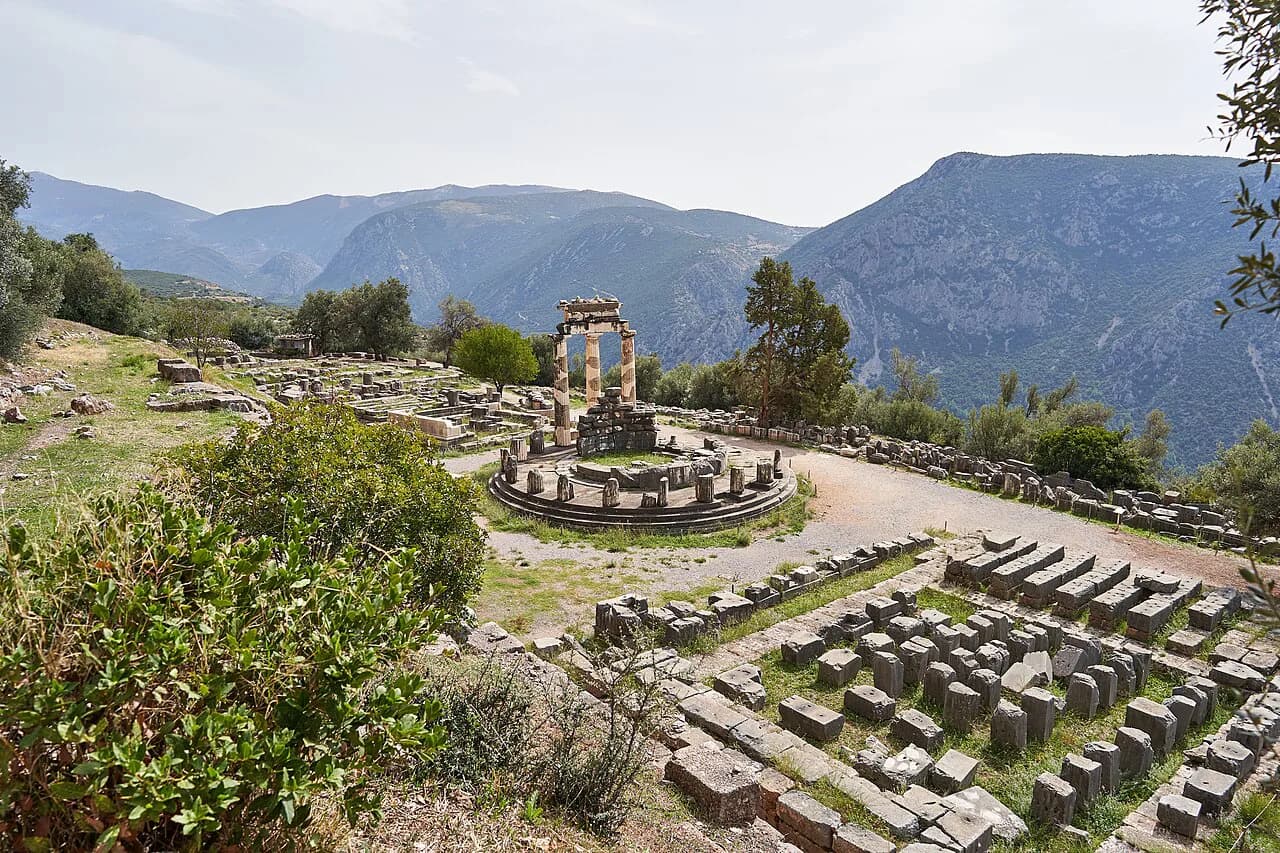
Most visitors climb straight from the Delphi car park to the Temple of Apollo and never make the short detour to the terrace below the road, where the Sanctuary of Athena Pronaia sits among pines. This second sanctuary is smaller and quieter, and its star exhibit, the circular Tholos, is one of the most photographed ruins in Greece. Marmaria rewards a half-hour stop if you plan the walk down and the climb back into your day.
The name needs no saint or village to explain it: marmaro is the Greek word for marble, and the terrace is named for the Parian and Pentelic stone used in its buildings. The sanctuary itself was dedicated to Athena Pronaia, the goddess who stood before the temple of her half-brother Apollo. Getting there means leaving the main site, so it helps to know exactly where the path leaves the road and what you will find at the bottom.
What Marmaria Is: The Marble Terrace and Its Sanctuary
Delphi held two sanctuaries: the great Sanctuary of Apollo on the slope, and this smaller precinct of Athena about a kilometre to the south-east. Pilgrims arriving from the east met Athena's terrace first, which is why she carried the epithet Pronaia, meaning the one before the temple. The precinct is walled off as a temenos, a sacred boundary, and the surviving structures are spread across a modest terrace rather than stacked on a hillside.
Do not expect a second Delphi. There is no long sacred way, no museum and no crowds of guides; the pleasure is in picking out the Tholos, the temple foundations and the two treasuries at your own pace. That compactness is also the trade-off: without a guidebook or an audio guide, much of the terrace reads as anonymous stone.
Where It Is and How to Reach It
Marmaria lies on a terrace below the main temple complex, roughly one kilometre south-east of it, off the road that runs between Arachova and Delphi village. The site address is given as Delphi 330 54. The sanctuary is accessed on foot from the main archaeological area rather than by a separate entrance, so it slots into a normal site visit.
The usual approach is to walk down from the main site, cross or follow the road, and reach the terrace from above. Coming back means climbing, and the return leg is the part people underestimate at the end of a hot morning. Wear shoes with grip for the paths and ancient paving, and carry water in summer, since the terrace is open ground.
The Tholos: Three Columns and an Open Question
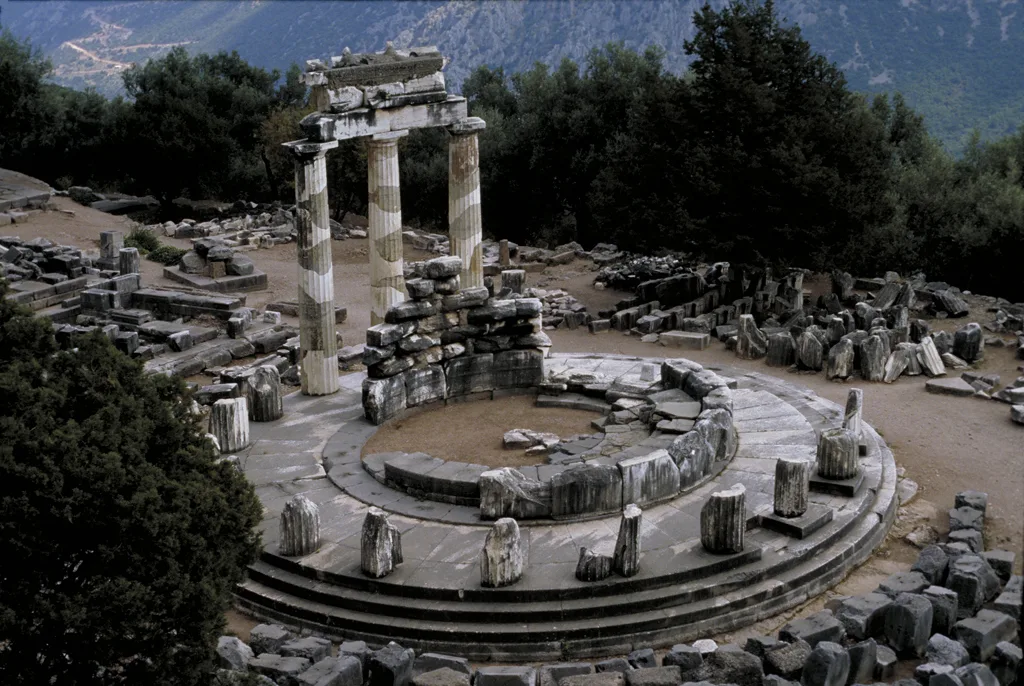
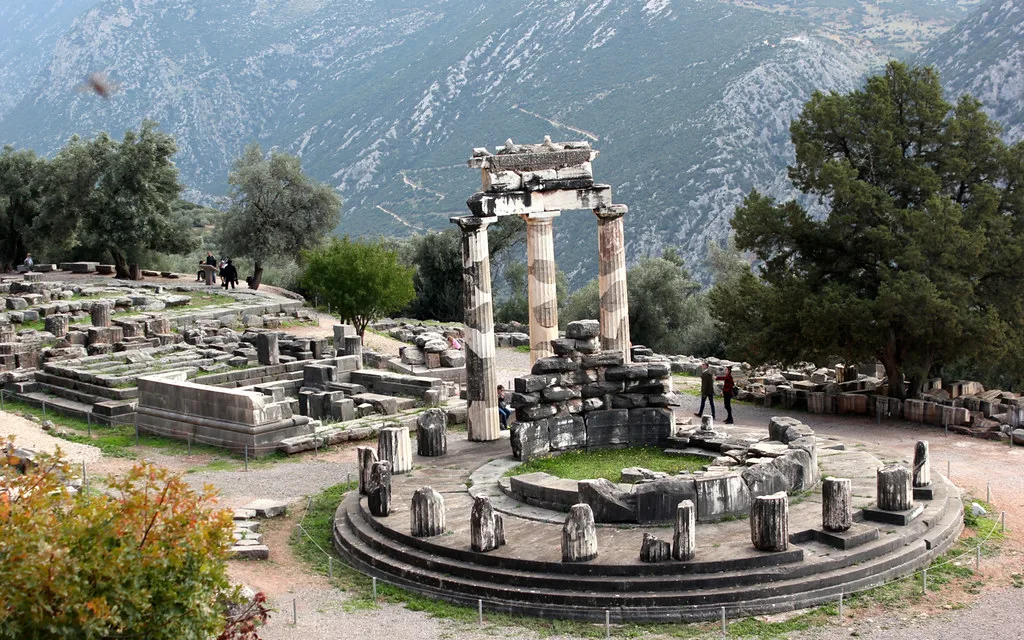
The Tholos is the building that sells postcards: a circular structure of Pentelic marble that once carried a ring of twenty slender Doric columns, with ten Corinthian half-columns decorating the interior. Three columns and part of the entablature were re-erected in 1938, which is why the ruin reads as a recognisable building rather than a scatter of drums.
Construction is dated to the early fourth century BC, with sources varying between roughly 390 and 380 BC, and the architect is named as Theodorus of Phoceus, who reportedly wrote a treatise on his own design. What the building was for remains unknown; suggestions range from a shrine for a statue to a monument of civic display, and Pausanias does not describe it at all. Treat any confident explanation you hear on site as a hypothesis.
If the Tholos catches your interest, the Delphi Archaeological Museum is where its story continues, since decorated elements of the roof are displayed there. Visiting the museum after the terrace, rather than before, keeps the sequence of the two sanctuaries clear in your head.
The Three Temples of Athena
Three temples to Athena were built on the terrace over several centuries, and the name shifted along the way from Pronaia, the one before the temple, to Pronoia, forethought. The earliest temple went up in the Archaic period and was destroyed before the fifth century BC, in an event ancient writers linked to a rockfall that also turned back a Persian attack. Two columns of an early temple still stand among the remains.
A second temple, built around 510 BC, was badly damaged by earthquake, and much of its colonnade survived until a rockfall in 1905 brought down a large number of its columns. The third temple, from around 360 BC, is now only foundations after the sanctuaries were closed in the late fourth century AD. Knowing which stones belong to which temple is exactly where a guide or a good audio commentary earns its cost.
The Treasuries and the Altars
Two treasuries stand on the terrace. The Doric Treasury dates to roughly 490 to 460 BC and its builders are unidentified, while the Treasury of the Massalians was built around 530 BC by the city of Massalia, today's Marseille, to advertise its growing wealth. It was made of Parian marble and carried two columns with palm-carved capitals, a detail worth looking for in the remains and in reconstructions.
Altars stood on the southern side of the precinct, and fifth-century inscriptions record dedications to Athena alongside Zeus, Hygieia and Eileithyia, goddesses associated with healing and childbirth. The inscriptions are a reminder that this was a working sanctuary with sacrifices and votive offerings, not merely an architectural set piece. Most of these altars survive as low structures and cuttings that are easy to walk past.
Nearby: The Gymnasium and the Castalia Spring
Between Marmaria and the Castalia Spring, south of the Arachova to Delphi road, lie the two levels of the Gymnasium. The upper level held the xystos, a long covered colonnade where athletes trained in bad weather, with an open track beside it; the lower level has the peristyle court of the palaestra, the wrestling ground, which is the most legible of the standing remains. A bath complex with a cold plunge and small tubs adjoined it, and a hot bath was added in Roman times.
The Castalia Spring, where pilgrims purified themselves before consulting the oracle, sits close enough to fold into the same loop back up to the main site. Combine Marmaria, the Gymnasium and the spring into one descent instead of making three separate trips down the same road.
How Long to Allow
The sanctuary itself is small, and about half an hour is enough to walk the terrace and read the main structures. Add the descent and, more importantly, the climb back, plus time at the Gymnasium and spring, and the lower site easily absorbs an hour or more of a Delphi visit.
The trade-off is straightforward: the lower terrace is far quieter than the Sacred Way and the Temple of Apollo, and the Tholos is arguably the most photogenic ruin at Delphi. The cost is effort and heat, so schedule the detour before the main site in summer if you want the climb done while it is cooler.
Tickets, Guides and What Carries Over
Access to the Sanctuary of Athena Pronaia is included with Delphi archaeological site tickets, so there is no separate entry to buy for Marmaria. Guided tours of the archaeological site generally cover the sanctuary as well, and self-guided entry tickets may include an audio guide in English. Confirm what your specific ticket includes before booking, since the inclusions vary by product.
Opening hours and prices for the Delphi site, and any seasonal changes, are published by the site authority rather than by ticket resellers; check the official Delphi pages or the Ministry of Culture site on the day you plan to go. If you intend to rely on a guidebook rather than a tour, download or buy it in advance, because signage on the lower terrace is limited and the site is not always staffed at the ruins themselves.
Practical Trade-offs: Quiet Terrace, Uphill Return
This is not a museum visit. The terrace is open ground with uneven ancient paving, low walls and loose stone, so sandals and smooth soles are a poor choice. There is little formal shade and few places to sit, which matters most in midsummer.
Food and drink are not part of the visit; Delphi village and Arachova, a short drive away, are where you will find tavernas afterwards. If Delphi is one stop on a longer trip, it also pairs naturally with other ancient sites in Greece on a driving route north of Athens.
Plan Your Marmaria Visit
Treat Marmaria as a deliberate detour rather than an afterthought: walk down from the main site, spend half an hour on the terrace, continue to the Gymnasium and the spring, then climb back. Build in fifteen minutes for the return and you will enjoy the Tholos far more than if you are rushing to catch a tour bus.
Explore more Delphi sauna guides
Frequently Asked Questions
Where is Marmaria in relation to the main Delphi site?
Marmaria is the terrace of the Sanctuary of Athena Pronaia, below the main temple complex and roughly a kilometre south-east of it, off the road between Arachova and Delphi village. Visitors reach it on foot from the main archaeological area.
How far is the Sanctuary of Athena Pronaia from the Temple of Apollo?
The sanctuary sits about one kilometre south-east of the main Delphi complex. The route is a walk down from the main site and a climb back, so allow extra time for the return leg rather than for the distance alone.
Do I need a separate ticket for Marmaria?
Access to the Sanctuary of Athena Pronaia is described as included with Delphi archaeological site tickets, so there is no separate entry to buy. Check what your particular ticket or tour includes before booking, because inclusions differ between products.
How long does it take to see the Sanctuary of Athena Pronaia?
The terrace is compact and can be explored in about half an hour. Adding the walk down, the Gymnasium, the Castalia Spring and the climb back turns it into an hour or more of your Delphi day.
What was the Tholos of Athena Pronaia used for?
Its purpose is unknown. Sources describe the building and its fourth-century BC construction but do not agree on its function, so explanations offered on site should be treated as interpretations rather than established fact.
Why is it called Marmaria?
The name comes from marmaro, the Greek word for marble, referring to the Parian and Pentelic marble used in the sanctuary's buildings. It is not named after a person or a nearby village.
Is the walk to Marmaria steep?
The outbound route drops down from the main site, and the return involves a climb. Wear shoes with grip, carry water in summer, and consider doing the detour earlier in the day when temperatures are lower.
Can I visit Marmaria with a Delphi guided tour?
Guided tours of the Delphi archaeological site are described as covering the sanctuary, and some self-guided entry tickets include an English audio guide. Check the itinerary and inclusions of your chosen tour.