
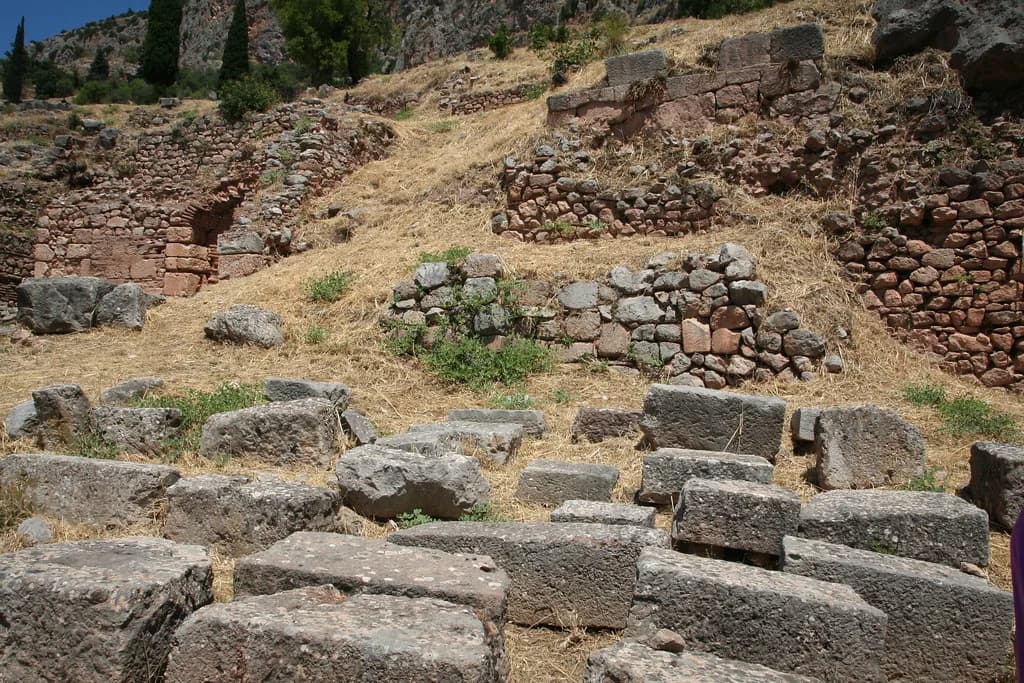
The Polygonal Wall at Delphi: A Visitor's Guide to the Terrace Wall
Most people climbing the Sacred Way at Delphi pass the Polygonal Wall in a few seconds, on the way to something that looks more like a monument. It is the long retaining wall of tightly fitted, multi-sided stone blocks directly below the Temple of Apollo terrace and behind the Treasury of the Athenians, on the southern slope of Mount Parnassus. Knowing what it does and what is carved into it turns a stretch of masonry into one of the more revealing stops on the site.
This guide sticks to the wall itself: where it sits in the sanctuary, how you reach it, how polygonal masonry works, and which inscriptions and cuttings are worth slowing down for. Other Delphi monuments appear only as things you will walk past on the same stretch.
Where the Polygonal Wall Sits in the Sanctuary
The wall stands on the slope of Mount Parnassus in central Greece, inside the Delphi archaeological site, on the terrace below the Temple of Apollo. It runs behind the Treasury of the Athenians, so pilgrims walking up the Sacred Way meet it early, before the temple columns come into full view. The whole sanctuary is laid out in ascending terraces, and the wall is the structure that makes the upper one possible.
If you want the wall placed among the site's other stops before you arrive, the Delphi Attractions: 9 Visitor Guides covers the main monuments in the sanctuary and at Marmaria. The wall itself has no separate entrance or viewing platform; it is simply part of the main site, passed on foot.
How to Reach It and Where It Appears on the Route
You enter through the main entrance of the Delphi archaeological site and follow the Sacred Way uphill. The path bends past the Roman market remains and the Athenian treasury area, and the Polygonal Wall appears on your left as a long face of pale stone holding back the slope. Because it comes so early and looks like plain masonry, it is easy to register as background and keep walking.
The ground is uneven and the route climbs steadily, so footwear with grip matters more than speed. There is no railing along the wall face, and the path narrows where visitors stop to read inscriptions. Plan to step aside rather than halt in the middle of the walkway when you pause.
What Polygonal Masonry Actually Is
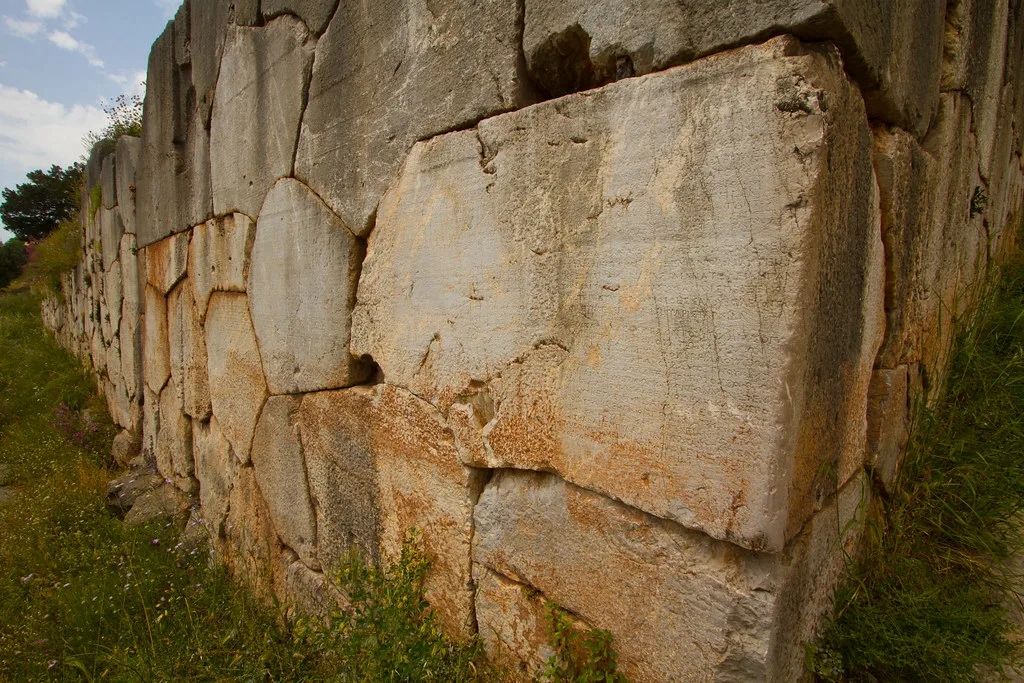
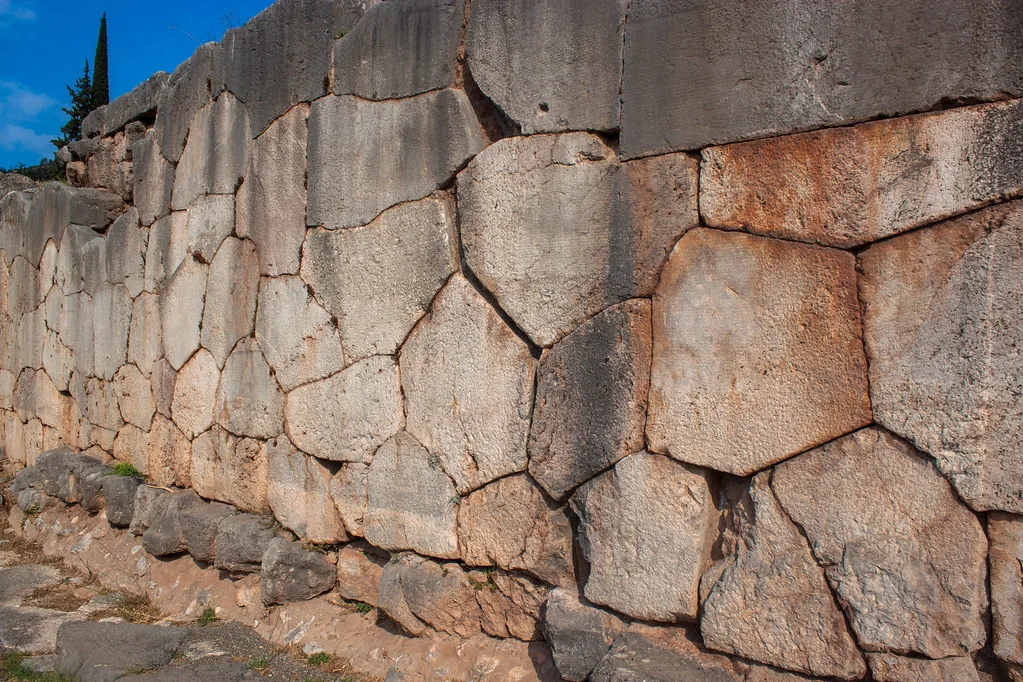
The wall is built from large stone blocks cut with several sides rather than squared into rectangles, then fitted edge to edge without mortar. Each block's edges were trimmed to match its neighbours, so the joints interlock and the face reads as a mosaic of polygons. The style is known as polygonal masonry, and once you recognise the joint pattern you will spot it on other ancient Greek fortification and terrace walls.
The wall was built in the 6th century BC after an earlier temple burned, to support and extend the terrace for the new Temple of Apollo. It originally stood roughly 7 to 8 metres high; what survives today is somewhat lower but still substantial. Reading it as engineering first makes the later inscriptions easier to understand as an addition rather than the wall's purpose.
The temple the wall was built to serve went through several rebuilds. The 4th-century BC Doric temple whose columns you see above the terrace replaced an Archaic predecessor destroyed by earthquake, and its foundations and columns are what remain.
The Inscriptions: A Stone Register of Freed People
Over time the wall stopped being only a retaining structure. In the Hellenistic period its surface was covered with hundreds of inscriptions, most of them manumissions, the formal texts recording the freeing of enslaved people. These carvings turned a piece of engineering into a public record of personal histories, inscribed where every visitor climbing to the oracle would see them.
Look for shallow, closely spaced lettering on the smoother blocks, often in small clusters rather than one continuous panel. The texts are weathered and hard to read in raking light, so early or late sun helps more than midday glare. Binoculars are more useful than a guidebook here if you want to study individual blocks from the path.
The Stoa of the Athenians and the Trophy Marks
A slender colonnade, the Stoa of the Athenians, was built in the 5th century BC directly against the Polygonal Wall. The Athenians hung captured Persian naval spoils there, including shields, figureheads and rigging, turning the stoa into a permanent display of victory. Cuttings and dowel holes in the wall face still show where those offerings were fixed.
This is the most common confusion on the site: the wall and the stoa are two different structures that share one face. The wall is the ancient terrace support; the stoa is the colonnade planted against it later. Knowing which is which makes the dowel marks and the column stubs read as one story rather than two unrelated ruins.
Nearby on the Same Stretch of the Sacred Way
The Treasury of the Athenians stands on the terrace just above the wall, a small marble Doric building reconstructed in the early 1900s with a high proportion of original blocks. It is the only fully restored building in the sanctuary and displays sculpted metopes of Heracles and Theseus. Its walls carry the Delphic Hymns to Apollo with ancient musical notation.
In front of the wall, near the Sacred Way, a rough limestone boulder known as the Sibyl Rock marks where tradition placed the earliest prophetess of Delphi. Beside it and beneath the wall is the Halos, an open level space that served as a sacred ritual court. Both are easy to miss because neither looks like architecture.
Further down the slope, near the road and the ravine, the Castalian Spring was where the Pythia, priests and petitioners purified themselves before entering Apollo's precinct. The rock-cut fountain chamber with its niches and troughs can still be seen.
Time Needed for the Wall and the Full Site
The wall itself rewards ten to fifteen minutes of slow looking: enough to trace the block joints, find the stoa dowel holes and pick out a few inscription clusters. Most visitors give it well under a minute, which is why the detail goes unnoticed. Build the pause into your climb rather than deciding on the spot.
For the whole sanctuary above the wall, allow two to three hours if you continue to the theater and then up to the stadium, which sits at the top of the site. The theater held musical and dramatic competitions of the Pythian Games, and the stadium's running track of roughly 177.5 metres is still visible. Combining the wall with the rest of the site is a half-day rather than a quick stop.
On the far side of the road, a short walk from the main site, the Sanctuary of Athena Pronaia at Marmaria holds the Tholos, a circular temple of about 380 to 360 BC with three columns still standing. It is a separate stop with its own approach, worth adding if you have the afternoon.
Tickets, Hours and What to Check Before You Go
The wall is inside the paid archaeological site, so access follows the site's opening hours and ticket rules rather than any separate arrangement. Check the official Greek Ministry of Culture listing for Delphi, or the ticket office, for current hours, closure days and admission before you travel, since seasonal schedules change through the year.
Do not assume the site is open at any hour or free to enter on a given day; the ministry listing and the ticket office are the authoritative sources. If you are visiting in low season, confirm opening times on the day rather than relying on an old guidebook.
Footing and Photography Along the Wall
The Sacred Way climbs and the surface is worn stone and gravel in places, so watch your step where the path bends past the wall. The wall face is often in shade in the morning and lit later, which changes how easily the inscriptions read in a photograph. Raking light at either end of the day brings the lettering out far better than flat midday sun.
A wide lens captures the whole face of interlocking blocks, but the joints and dowel holes need a closer frame from the path. Stay behind any rope or barrier and avoid leaning on the stones; the blocks are ancient and the joints are what you came to see.
Reading the Wall Again in the Museum
The Delphi Archaeological Museum, a short walk from the site exit, holds the finds that make sense of what you have just walked past, including sculpture from the Temple of Apollo pediments. Looking at the objects after seeing the wall and terrace helps connect the inscriptions and dedications to the sanctuary's daily life. The Delphi Archaeological Museum guide covers what to prioritise if time is short.
If Delphi is one stop on a longer trip through Greece, the wider guide to ancient sites in Greece helps you see how terrace walls, sanctuaries and theaters were laid out elsewhere. It is useful context, not a substitute for the site itself.
Plan Your Visit
Treat the Polygonal Wall as a deliberate stop on the climb, not scenery on the way to the temple. Give it ten to fifteen minutes for the block joints, the stoa dowel holes and the manumission lettering, then continue to the Temple of Apollo and, if you have the legs, the theater and stadium above.
Confirm current opening hours and ticket arrangements at the ticket office or the culture ministry's Delphi listing before setting out, and wear shoes that handle uneven stone. The wall rewards a slow look precisely because almost everyone else walks straight past it.
Explore more Delphi sauna guides
Frequently Asked Questions
What is the Polygonal Wall at Delphi?
It is an ancient retaining wall built from multi-sided stone blocks fitted together without mortar, holding up and extending the terrace below the Temple of Apollo. It stands behind the Treasury of the Athenians on the Sacred Way and later became a surface for hundreds of carved inscriptions.
Where is the Polygonal Wall located within the Delphi site?
Inside the main Delphi archaeological site on the slope of Mount Parnassus, below the Temple of Apollo terrace and behind the Treasury of the Athenians. It appears early on the uphill walk along the Sacred Way, so you reach it before the temple columns come into full view.
Why was the Polygonal Wall built?
It was constructed in the 6th century BC, after an earlier temple burned, to support and extend the terrace for the new Temple of Apollo. Its original height was roughly 7 to 8 metres; the surviving wall is lower but still substantial.
What are the inscriptions on the Polygonal Wall?
Most are manumissions, the formal texts recording the freeing of enslaved people, carved mainly in the Hellenistic period. They cover the wall's face in small clusters rather than one continuous panel, and weathering makes them easier to pick out in low, raking light.
How long does it take to see the Polygonal Wall?
Allow ten to fifteen minutes to trace the block joints, find the dowel holes left by the Stoa of the Athenians and pick out a few inscription clusters. Most visitors pass it in seconds; the full sanctuary above, including theater and stadium, takes two to three hours more.
What else is near the Polygonal Wall at Delphi?
The Treasury of the Athenians sits on the terrace just above it, while the Sibyl Rock and the Halos ritual court lie in front of and beneath the wall along the Sacred Way. The Castalian Spring is further down the slope toward the road.
Do you need a ticket to see the Polygonal Wall?
Yes. The wall is inside the paid Delphi archaeological site, so entry follows the site's ticket and opening rules rather than any separate arrangement. The Greek Ministry of Culture publishes current hours, closure days and admission on its official Delphi page.