
Roman Agora of Delphi: What to See and How to Visit
The Roman Agora of Delphi is the market complex the Romans added inside the Sanctuary of Apollo at Delphi, in Phokis, Central Greece. It is a modest set of remains rather than a standing monument, and it sits within the wider archaeological site that visitors enter from the road through the modern village. Knowing what survives here, and how it differs from the far more celebrated Roman Agora in Athens, keeps expectations realistic and helps you slot this corner into a longer walk through the sanctuary.
What the Roman Agora of Delphi Actually Is
This is the Roman-era commercial quarter of the Delphic sanctuary, built when Rome dominated the Greek world and Delphi's role had shifted from a purely religious centre to a place embedded in a wider imperial network. The Sanctuary of Apollo is the walled archaeological area on the slope above the modern village, and the Roman Agora sits inside it rather than in the village itself. Treat the name as a district within one large site, not as a separate ticketed attraction.
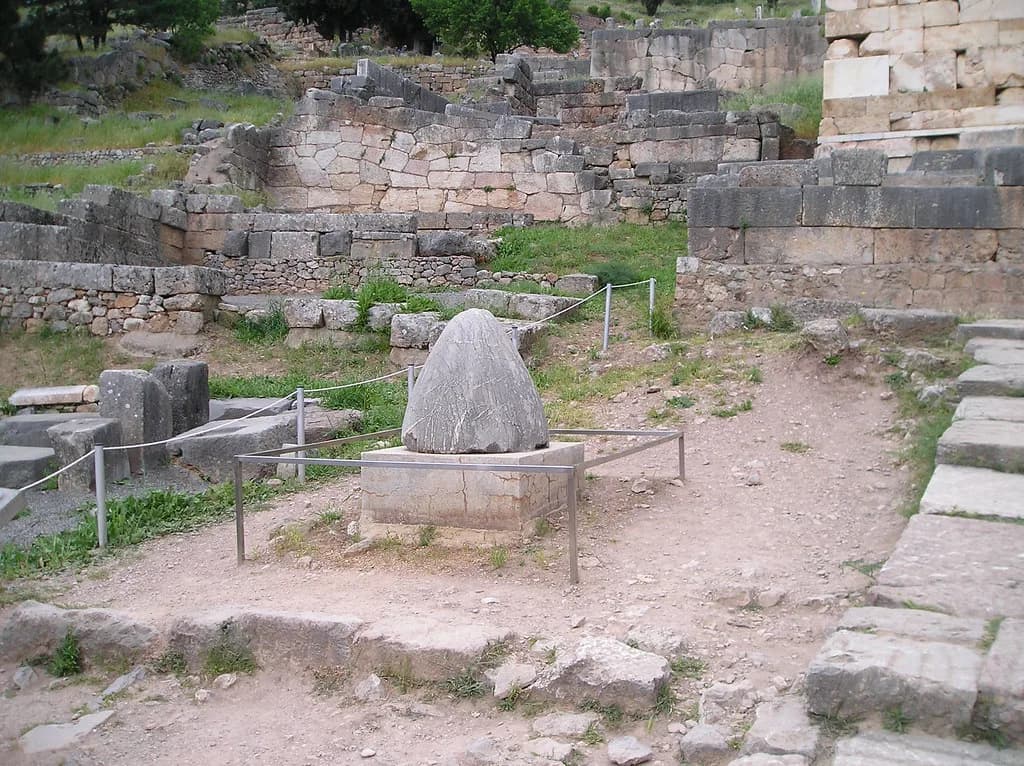
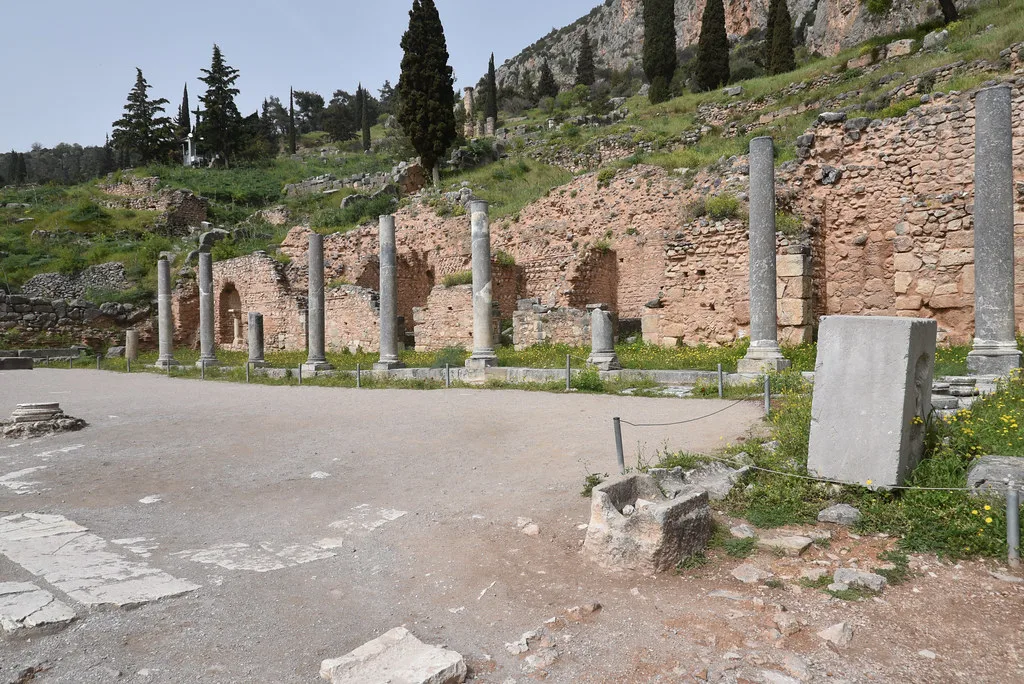
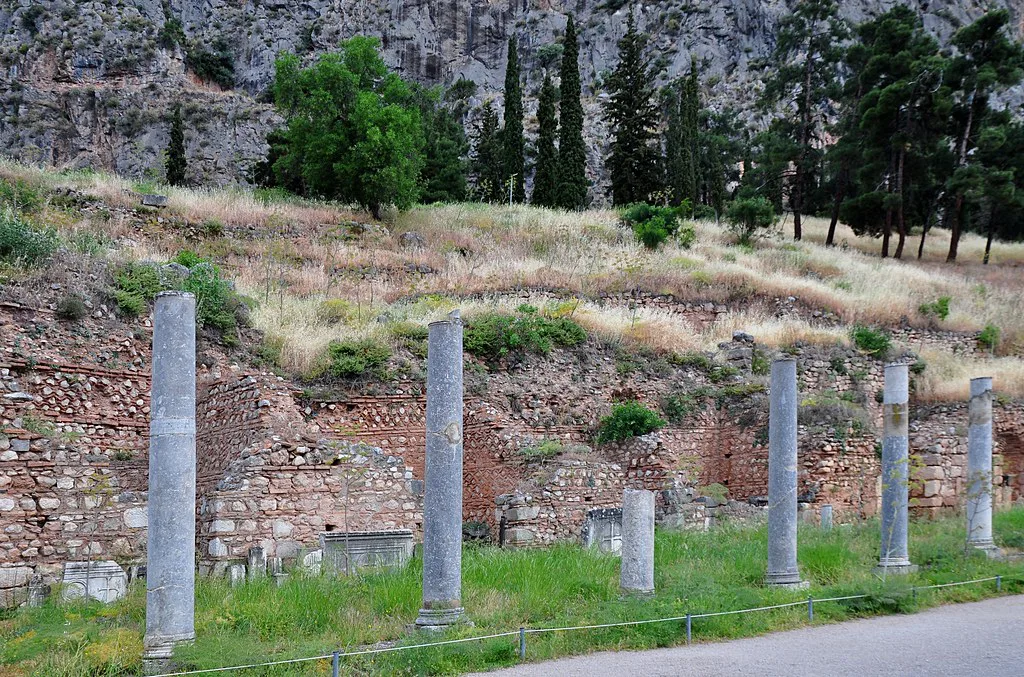
The remains are low foundations and fragments that trace the footprint of a market area, so there are no columns to walk between and no reconstructed arcades. Photographs of the spot show stretches of stone walling on the hillside among the trees, which is a fair preview of what you will see. If you arrive expecting a second Roman Agora of Athens with a marble gate and a clock tower, the reality will feel underwhelming; if you arrive expecting honest ruins, it reads clearly as part of the site's layered history.
Where It Sits on the Slope
Delphi was not chosen at random: the sanctuary occupies a naturally fortified shelf with a view toward the Gulf of Itea, fed by springs and set on mountain routes that linked eastern and western mainland Greece. That geography explains why the site climbs in terraces rather than spreading flat, and why every monument, including the Roman market, had to be fitted to the incline.
In practical terms, the Roman Agora lies inside the main archaeological site, on the lower part of the slope below the Temple of Apollo and above the modern village of Delphi. The Sacred Way, the paved processional route, runs up through the sanctuary past the treasury terrace toward the temple, and the Roman-era remains belong to the same continuous circuit. Plan to see it on foot as part of that ascent rather than as a detour from the road.
How to Get There
Access is through the main entrance of the Delphi archaeological site, on the road that passes through the modern village. Once inside, the Roman Agora is reached on foot along the site paths; there is no separate gate for it and no shuttle. Delphi Attractions: 9 Visitor Guides sets out the site's other stops if you want to plan the order of the whole walk before you arrive.
Because the site is built across a steep slope, the walking between monuments involves steps and uneven stone, and the climb from the entrance to the upper monuments takes longer than the map suggests. Give yourself a comfortable block of time rather than trying to dash between highlights, and carry water for the ascent. The official site page is the place to confirm opening days, ticket arrangements and any seasonal changes before you travel.
Why the Romans Built Here
Delphi's sanctuary had already passed through Greek, Macedonian and Aetolian control before Roman influence became dominant, and the Amphictyony, the league of neighbouring peoples that administered the sanctuary, continued to exist through the Roman period with a role narrowed to protecting the site. Roman-era building at Delphi belongs to that later chapter, when the sanctuary was maintained within an imperial framework rather than as a fully independent panhellenic centre.
The Roman Agora reflects the practical side of that era: a market and gathering area serving the sanctuary and its visitors once the religious landscape had settled into Roman administration. Reading the ruins this way makes them more than rubble, since they mark the point where Delphi functioned as a working sanctuary town rather than only a pilgrimage destination. Much of the interpretation has to come from what you already know, because the remains carry little on-site explanation of their own.
Not the Roman Agora in Athens
The mix-up is common and worth settling before you go. The Roman Agora of Athens, in the Plaka area below the Acropolis, is a separately ticketed site with a monumental gate and the Tower of the Winds, an octagonal marble structure that served as a sundial, weather vane and water clock. That is a very different experience from the low foundations at Delphi.
If you are building a trip around both places, plan the Athenian site as its own stop in Athens and keep Delphi for the sanctuary. The Athens complex is written up in detail elsewhere, but the key point for Delphi is simply that nothing here resembles the Tower of the Winds or Hadrian's Library. Bring that distinction with you and you will judge the Delphic remains on their own terms.
How Long to Allow
Treat the Roman Agora as a short stop, perhaps ten to fifteen minutes, folded into a circuit of the sanctuary that runs from two to three hours depending on how much you read and rest. The headline monuments, the treasury terrace, the Temple of Apollo, the theatre and the stadium, will occupy most of that time, and the Roman remains are a quiet passage between them. If you are short of time, they are the first element to skip.
Set against the view-heavy upper terraces, this corner is short on spectacle and long on atmosphere, so its value depends on your interest in how the sanctuary changed under Rome. Visitors focused on photographs will move through quickly; readers of ancient history may linger. Either way, build the stop into the walk rather than making a special trip for it.
Sequencing the Visit
A sensible order is to start at the Delphi Archaeological Museum below the road, then enter the site and follow the Sacred Way uphill, taking in the treasury terrace and the Temple of Apollo before continuing to the theatre and stadium. The museum holds the finds that give the ruins meaning, so seeing it first sharpens everything that follows. The Delphi Attractions guide is a useful cross-check if you want to reorder stops around opening times.
Below the main road, the Sanctuary of Athena Pronaia at Marmaria is a separate, lower area reached by a short walk or drive, and the Castalian Spring in Delphi sits near the road between the two. Both make worthwhile additions for anyone with a half day or more, and both are far quieter than the temple terrace.
Nearby Sights Within the Same Site
The Temple of Apollo is the centrepiece of the sanctuary, and its surviving columns make the strongest single impression of the site. The Treasury of the Athenians, rebuilt and inscribed with hymns to Apollo, stands on the terrace just below it and is the best-preserved of the city treasuries. The theatre and stadium sit higher up the slope and reward the extra climb with a broader view over the valley.
The Delphi Archaeological Museum, on the other side of the modern road, houses the sculpture and votive offerings recovered from the sanctuary, including the bronze charioteer. Allowing an hour there before or after the site walk is a good use of time, and it fills in the gaps that the unlabelled ruins leave.
The modern village of Delphi sits directly above the archaeological site, with tavernas and cafés along its main street and the road continuing toward Arachova and Livadeia. After the climb through the sanctuary, eating in the village is the natural next step. Expect the usual Greek menu of grilled meat, salads and pies, and confirm the day's dishes with the staff rather than relying on posted menus alone.
What the Site Does Not Tell You
Signage inside the sanctuary is limited for the Roman-era remains, and nothing on site presents the market as a distinct attraction. Read up before you go, or bring a guidebook that covers the Roman phase, because the foundations alone will not explain themselves. This is the main trade-off of including the spot: it costs little time but also gives little back without context.
Facilities are concentrated near the site entrances and in the modern village rather than beside the ruins, so plan water, shade and rest stops around the village or the museum. There are no stalls or market activity at the Roman Agora today, only archaeology.
Plan Your Visit
The Roman Agora of Delphi is best treated as one honest layer of a much larger sanctuary, worth ten to fifteen minutes inside a two- to three-hour circuit. Pair it with the museum, the Sacred Way and the Temple of Apollo, and it becomes part of a coherent picture of how Delphi changed from Greek oracle to Roman sanctuary town.
Before travelling, confirm opening hours, ticket prices and any closure days on the official archaeological site website, since these change with the season, and check the village's restaurant scene separately if you plan to eat after the climb. Keep the Roman Agora of Athens for a different day and a different city.
Explore more Delphi sauna guides
Frequently Asked Questions
What is the Roman Agora in Delphi?
It is the Roman-era market area built inside the Sanctuary of Apollo at Delphi, in Phokis, Central Greece. What survives is mostly low foundations and fragments of walling rather than standing buildings, and it forms part of the wider archaeological site entered from the road through the modern village. Interpretive signage on site is limited, so background reading helps.
Where is the Roman Agora of Delphi located?
Inside the main Delphi archaeological site on the slope above the modern village, below the Temple of Apollo and along the same circuit as the Sacred Way. There is no separate entrance; you reach it on foot from the site's main gate. The climb involves steps and uneven stone.
Is the Roman Agora the same as the Roman Agora in Athens?
No. The Roman Agora of Athens, in the Plaka area below the Acropolis, is a separately ticketed site with a monumental gate and the Tower of the Winds. The Delphic version is a much smaller set of foundations inside the sanctuary. Plan them as two different stops in two different cities.
How long does it take to see the Roman Agora at Delphi?
Allow roughly ten to fifteen minutes for this part, inside a fuller circuit of the sanctuary that typically takes two to three hours. The Temple of Apollo, the treasury terrace, the theatre and the stadium will absorb most of that time. Visitors with limited hours can skip this corner without missing a headline monument.
Do I need a separate ticket for the Roman Agora of Delphi?
No separate ticket is needed; the Roman Agora lies within the main archaeological site, which has its own ticket arrangements. Prices and opening days vary with the season, so check the official site before you travel. The museum is a separate building across the road but is usually covered in the same visit.
What else should I see nearby?
Within the same site, the Temple of Apollo, the Treasury of the Athenians, the theatre and the stadium are the main stops, with the Delphi Archaeological Museum across the road. Lower down, the Sanctuary of Athena Pronaia at Marmaria and the Castalian Spring are quieter additions. The modern village above the site is the logical place to eat afterwards.