
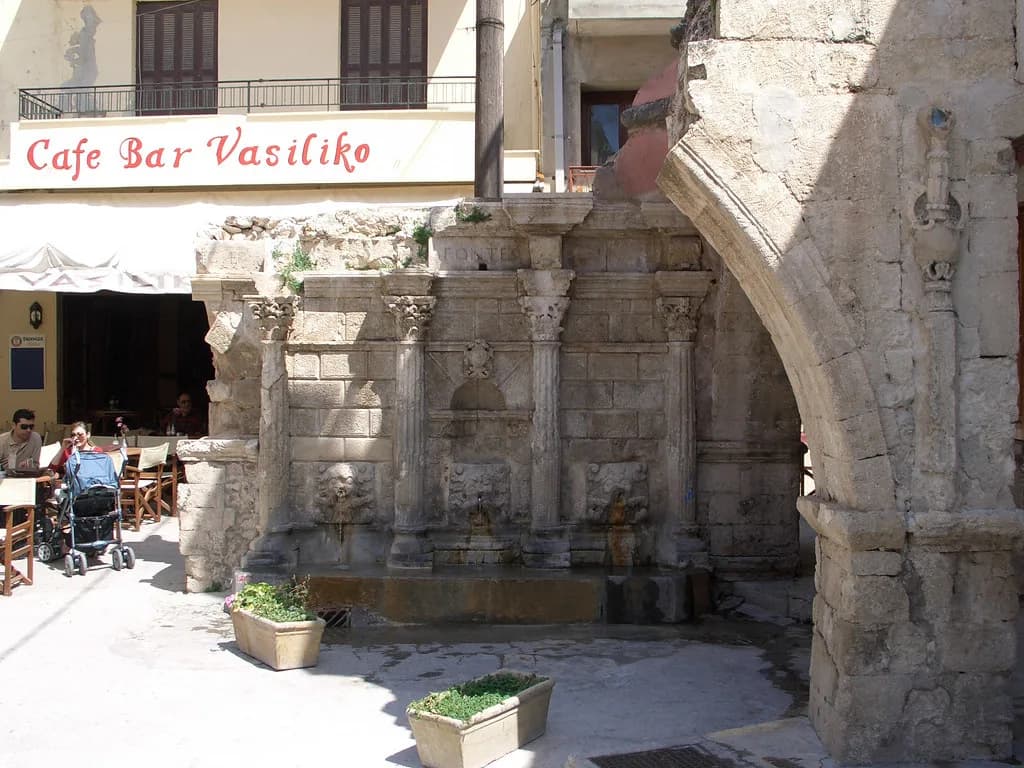
Rimondi Fountain, Rethymno: A Practical Guide to the Venetian Landmark
Rimondi Fountain is the kind of monument you meet by accident while walking Rethymno's old town, and it rewards a few minutes of attention rather than a dedicated trip. It stands in Platanou Square, which the municipality describes as the centre of the Venetian city, and it still runs water today. This guide covers what you are actually looking at, how to fit it into an old-town walk, and which nearby sights pair naturally with it.
Quick facts: what and where Rimondi Fountain is
The fountain sits in Platanou Square in the old town of Rethymno, on Crete's north coast. The Municipality of Rethymnon records that it was built in 1626 by the city's Rector A. Rimondi, and that it covered part of the city's water supply. The same square was the heart of the Venetian city, which is why the fountain was placed there rather than on a quiet edge of town.
Unlike a museum piece, this is a working landmark in an open public square, so there is no separate entrance, hall or ticket desk to look for. The municipality's description treats the fountain as a standing monument among the old town's cultural heritage sites, alongside the Loggia and the Neratzes Mosque. For orientation on the wider old town, the Rethymno Attractions collection maps the other headline sights.
How to get there: walking in from the old town
There is no practical way to drive to the fountain itself: Platanou Square is inside the pedestrian tangle of the old town, so plan on arriving on foot. Most visitors approach from the Venetian harbour side or from the main shopping streets, and the square is a short walk from either direction. The lanes bend and signs are sparse, so allow more time than the straight-line distance suggests.
Use the harbour as your anchor if you are coming from the waterfront. The Venetian harbour of Rethymno and its old breakwater are an easy starting point, and from there you head inland and uphill into the old town until you reach Platanou Square.
What you are actually looking at
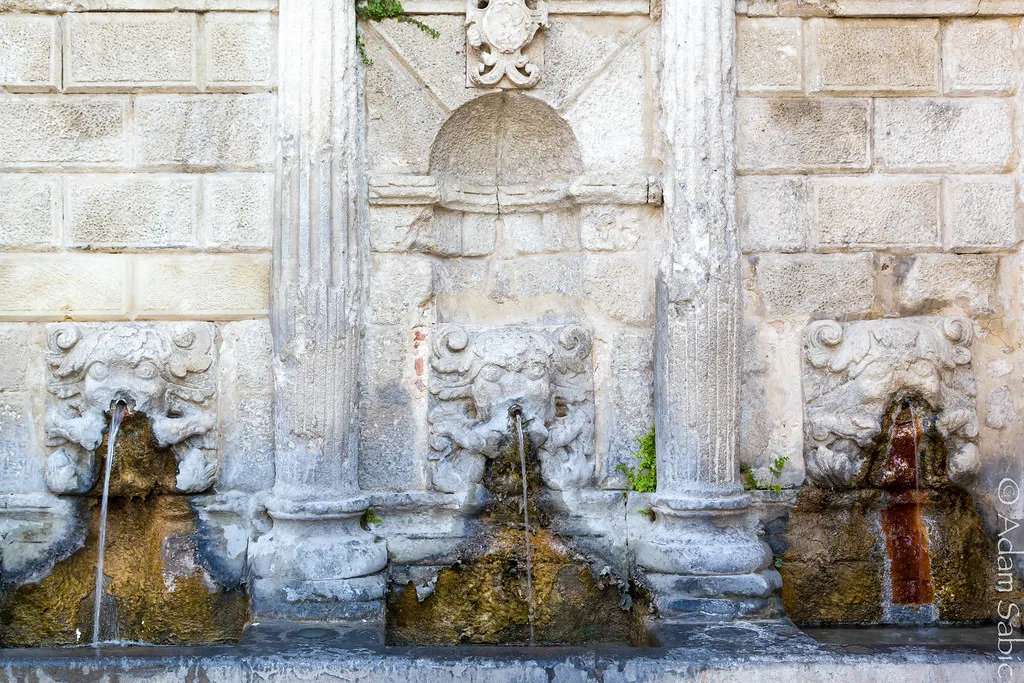
The structure is compact and easy to read once you know the parts. According to the municipality's description, the fountain has three water basins, three lion-shaped water exits and three columns topped with Corinthian capitals, which carry a Latin inscription. Corinthian capitals are the ornate, leaf-carved tops of columns, a standard feature of Venetian-classical building.
The detail most people miss is that the fountain still functions: water runs from the three lion heads today, which is why the square doubles as a meeting point and a place to refill a bottle. Look up at the inscription band before you move on, since it is the part that ties the monument to its 1626 foundation and its Venetian patron.
Lonely Planet lists the fountain as a Rethymno point of interest, which makes it a useful cross-check if you want a second description of the site before visiting. It is a monument in an open public square, and the published descriptions focus on its structure and history rather than on visiting logistics.
Why the location matters
Platanou Square was the administrative and social centre of Venetian Rethymno, so the fountain was civic infrastructure in the most visible spot available. Reading the square that way changes the visit: you are standing where the city's water supply, politics and daily traffic converged. The nearby Loggia of Rethymno, a Venetian meeting hall for nobles, fits the same story of a small city built to Venetian templates.
That context also explains the old town's layout: narrow lanes funnelling into small squares, with monumental buildings placed to be seen. If you want the fullest version of that Venetian picture, the Fortezza of Rethymno on the hill above is the large-scale counterpart to this small fountain square.
How long to allow and when to go
Budget five to fifteen minutes at the fountain itself, then let the square set your pace: it is a pause on a walk, not a destination that fills an afternoon. The realistic plan is to slot it into a half-day loop of the old town that also takes in one or two nearby monuments. Anyone expecting a fenced site with an audio guide will be disappointed; anyone treating it as a living piece of the street will not be.
Timing is less about the fountain than about the square's traffic. Platanou is busy with pedestrians and café seating through the middle of the day, so early morning tends to be calmer if you want a clear view of the lion heads and inscription. Late evening is atmospheric but crowded, and the sources here do not describe any special illumination, so do not plan around a light show.
Nearby stops within the old town
Two monuments sit within a few minutes' walk and belong on the same short route. The Neratze Mosque, Rethymno, a converted Venetian church turned Ottoman mosque with a distinctive minaret, is close by in the old town lanes, and the Church of Saint Francesco is another municipality-listed monument nearby. Both are short old-town walks from Platanou Square rather than separate excursions.
If you want one indoor stop to balance the walking, the Archaeological Museum of Rethymno is the obvious pairing, and it gives context for the Venetian and Ottoman layers you are passing on the street. The order matters less than the cluster: fountain, mosque, church and museum all fall inside the old town core.
Practical notes for the visit
Approach the fountain as a working public amenity. Water runs from the lion heads, people stop to drink and refill, and the square is a thoroughfare, so expect to share the space and keep half an eye on your footing on worn paving. Photography is easiest in flat morning light, when the columns and inscription are not backlit.
Restoration work on old monuments in Greek town centres is routine, so a quick check before you travel is sensible. The municipality's visitor pages carry the official description of the fountain and its monuments; check there for any notice of works before you build a walk around it.
Where to eat nearby
Platanou Square and the surrounding lanes are dense with cafés and tavernas, so the fountain makes a natural decision point for a meal. The trade-off is straightforward: tables on the square buy you the view and the people-watching at a premium, while a few lanes back you get quieter seating and usually better value for the same Cretan standards. Look for places where the menu is short and the locals outnumber the photo-takers.
Order with the basics in mind. A Cretan salad (tomato, cucumber, onion, olives and local cheese) and grilled meats or a plate of dakos, a barley rusk topped with tomato and cheese, are typical markers of a kitchen that is cooking rather than assembling. Menus are posted outside in most cases, so read prices before you sit, and remember that harbour-front and square-front positions are a choice about setting, not quality.
Plan Your Visit
Rimondi Fountain works best as a ten-minute stop inside a longer old-town walk, with the Loggia, the Neratze Mosque and the museums close enough to combine. Go early if you want the square to yourself, read the inscription before you move on, and treat the running water as the detail that makes the monument feel alive. Build the rest of the day around the Fortezza and the harbour, and pick your taverna by menu and seating rather than by view alone.
Explore more Rethymno sauna guides
Frequently Asked Questions
Where is Rimondi Fountain in Rethymno?
It stands in Platanou Square, in the heart of Rethymno's old town on Crete. The square was the centre of the Venetian city, which is why the fountain was built there. It is reached on foot through the pedestrian lanes, a short walk from the Venetian harbour.
How old is the Rimondi Fountain?
The Municipality of Rethymnon records that it was built in 1626 by the city's Rector A. Rimondi. The published description does not give details of later repairs or alterations.
Is Rimondi Fountain free to visit?
It stands in an open public square rather than in a ticketed building, so there is no entrance desk to pass. Any charges would relate to nearby museums and monuments, not the fountain square itself.
Does the fountain still have water?
Yes. The municipality's description notes that water still springs from the three lion-shaped spouts, and the basins remain part of the square's daily life.
How long do you need at Rimondi Fountain?
Allow five to fifteen minutes for the fountain itself. Most visitors combine it with nearby sights such as the Loggia and the Neratze Mosque as part of a half-day walk through the old town.
What is there to see around Rimondi Fountain?
Close by in the old town are the Loggia of Rethymno, the Neratze Mosque and the Church of Saint Francesco, plus the Archaeological Museum of Rethymno. The Fortezza and the Venetian harbour are further but still within walking distance for most visitors.