
The Tree of Hippocrates in Kos: Where It Is and What to See

The Tree of Hippocrates is a single oriental plane tree on a square in the centre of Kos town, and it is the kind of sight you can see in ten minutes without paying anything. Its appeal is not a museum display but a hollow trunk, a wide crown and a claim about who once taught in its shade. This guide covers where it stands, what is genuinely old, and how to fit it into a walk around the north end of town.
Quick answer: what the Tree of Hippocrates is
The Tree of Hippocrates is a living plane tree, known locally as the Platanus of Hippocrates, standing on Plateia Platanou in the heart of Kos town. The Municipality of Kos tourism site lists it among the island's most popular sights and notes that it is easy to access. It is not an archaeological site with a gate and ticket booth; it is a landmark in an open square you walk through.
The story attached to it is that Hippocrates, the physician from Kos, taught pupils beneath its branches. The official island tourism page presents this explicitly as local tradition rather than documented fact, so treat the teaching story as heritage and folklore. That distinction matters when you decide how much of the visit to spend on the tree itself and how much on the square around it.
Where it is: Hippocrates Square, opposite the Knights' Castle
Plateia Platanou, also called Hippocrates Square, sits in the middle of Kos town opposite the Knights' Castle, also known as the Castle of Neratzia, and next to the Ancient Agora of Kos. That three-way junction of tree, castle and ruins is what makes the stop worth planning rather than stumbling on. You can stand at the tree and see the castle walls and the agora without moving.
If you are mapping the town, the square is the anchor point for the northern sightseeing core, not an outlying detour. Our guide to Kos Attractions shows how the tree fits into a wider set of stops across the island, from this square to hillside sanctuaries. If you only have half a day in town, start here and work outward, and use Kos Neighborhoods: 4 Area Guides to decide which parts of town to combine in a single walk.
How to get there: on foot from the harbour and town centre
The tree is a short walk from the compact centre of Kos town and from the harbour, where ferries and excursion boats dock. Because it stands in a pedestrian square, arriving on foot is the practical approach; there is no need to arrange transport for this single sight. Use the square's name, Plateia Platanou, when asking directions or entering it into a map app, rather than searching for an address.
If your map app struggles with the Greek name, the castle opposite and the ancient ruins beside the square are more reliable landmarks to aim for. Cyclists and drivers will still need to park outside the immediate pedestrian zone and continue on foot, which is worth factoring in if you are combining the tree with stops further out of town.
What you are actually looking at: an oriental plane with a hollow trunk
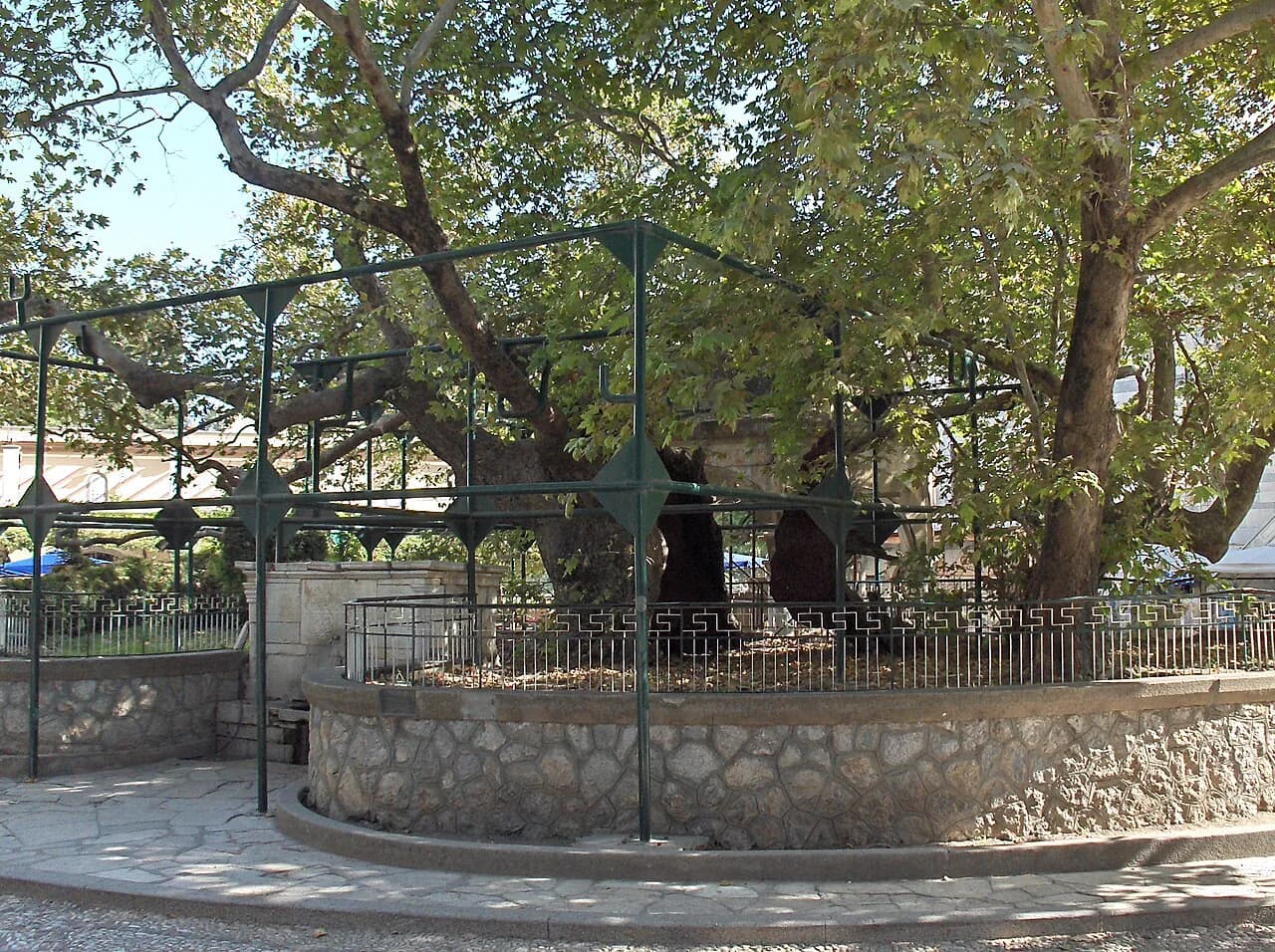
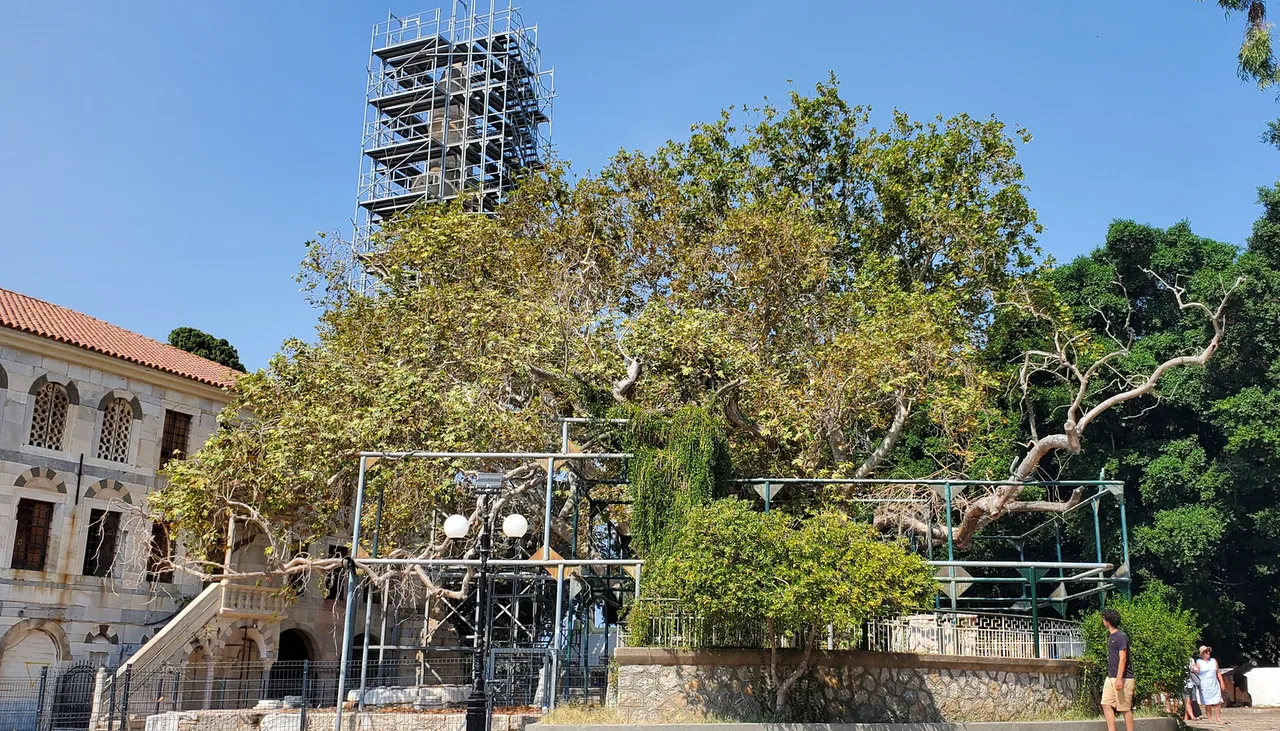
This is an eastern plane tree, Platanus orientalis, and the hollow inside the trunk is the feature most people photograph. Age and disease have eaten out the centre so that the trunk reads as a cave-like cavity; scaffolding supports are part of the modern sight, not a sign you have come at a bad time. Expect a tree that looks propped up and hollow rather than a pristine monument.
The crown of the Kos plane is often described as unusually large, with a spread of roughly 12 metres cited for this species here. Superlatives about the tree being the oldest or largest in Europe circulate widely, but they are claims rather than measurements taken on site, so treat them as tradition rather than fact.
The Hippocrates story and the doubt over its age
The tradition that Hippocrates taught here is centuries old and appears in travellers' accounts, including an engraving of the plane and the square published in a French travel book in 1783. Printmakers and visiting physicians kept the tree's reputation alive long before modern tourism. That long record of visitors is arguably the better-documented story than the tree's biological age.
Botanists and the island's own tourism page note that a plane tree cannot plausibly live for the 2,400 years since Hippocrates, and the present trunk is generally estimated at no more than about five centuries old. The accepted explanation is that the current tree may have grown from a sucker or root of the original. So when you see the tree, you are looking at a successor on the traditional site, not necessarily the exact plant from the fifth century BC.

Size and features: trunk circumference, crown and the two fountains
The trunk has been measured at around 12 metres in circumference, with branches extending several metres to each side of it. Those dimensions are what give the tree its presence in the square; it dwarfs the people standing beneath it. A visit here is mostly a matter of looking up and walking around the trunk.
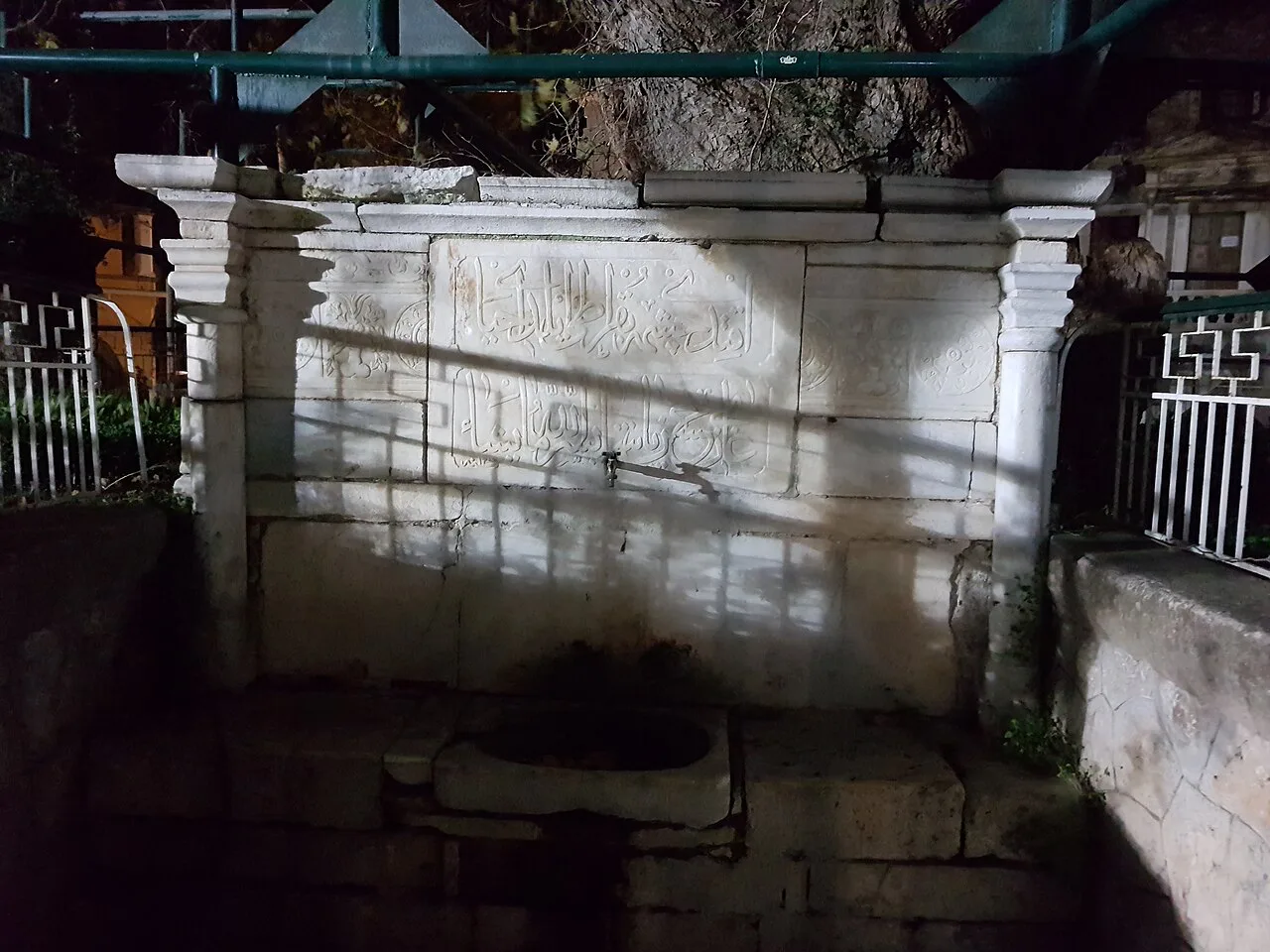
Two fountains frame the tree, and most visitors miss them while queueing for a photo of the trunk. They are part of the sight, not street furniture, and looking for them gives the stop structure. Budget a few minutes to find both before you move on to the castle across the square.
The marble fountains: what to look for on each side
On the north side of the tree stands a white marble urn with an Arabic inscription describing the water as coming from the tree of Hippocrates. On the eastern side there is a domed, fourteen-sided fountain resting on seven arches supported by Corinthian columns. The two are quite different in style, which is why it is worth circling the tree rather than stopping at the first bench.
Look for the arches and column capitals on the domed fountain and the carved lettering on the urn, since both are easy to overlook at eye level. Together they show how the tree has been treated as a monument to be embellished, not simply a plant in a public square.
Protection and propagation: a tree that has been given away
The plane has been a protected natural monument under Greek law since 1985, which is why it is maintained rather than felled despite its hollow trunk. Parts of it have travelled further than most visitors realise: wood, seeds and grafts have been sent around the world, including a graft planted beside the United States National Library of Medicine in 1961. The tree on this square is therefore the parent of descendants on other continents.
How much time to allow, and when to come
Plan on fifteen to thirty minutes at the square if you want to walk around the trunk, find both fountains and read the plaques. That is long enough for the tree itself; the castle opposite and the ruins next door are separate stops that will take considerably longer. Treating the tree as a quick pause rather than a half-day outing keeps the visit realistic.
Because it stands in an open square, the tree is visible whenever you pass rather than being behind a gate. Early morning and late afternoon are cooler and quieter in Kos town, and the plane's crown provides shade in the middle of the day.
Practical points: free entrance and where to confirm details
There is no ticket to see the Tree of Hippocrates; the official tourism site lists the entrance as free. That makes it a low-risk stop even if you are short on time, and it means there is no reason to book anything in advance. Photography is the main activity, so bring what you need with you.
Access is described as easy, and the tree sits in a flat square rather than up a slope. The main constraints are crowds around midday and the heat of an exposed square in summer. If you need specifics such as step-free routes from your hotel, ask at the travellers' information office in town.
Nearby: the castle, the agora and the rest of Kos town
The Castle of Neratzia is directly opposite the tree, and its fortifications are the obvious next stop when you leave the square. Our guide to Neratzia Castle in Kos Town covers what is inside the walls and how to plan that visit as a separate block of time. Pairing the two is the most efficient use of a morning in this part of town.
The Ancient Agora of Kos lies immediately beside the square, so the ruins of the town's old civic centre are effectively part of the same stop. If you want to understand the layout before walking it, the Ancient Agora of Kos guide explains what survives there and how to read it. Between the castle, the agora and the tree you can cover the historic core without any transport.
A little further out, the Roman Odeon of Kos is another ancient monument within reach of the centre on foot, and it gives a useful contrast to the open square. For an overview of how these pieces fit together, the Kos Neighborhoods guides help you work out which parts of town to combine in one walk.
What the tree is not: not the Asklepion, not a museum
The Tree of Hippocrates is often confused with the Asklepion, the hillside sanctuary of healing outside Kos town where patients once came to be treated. They are distinct sites with different histories, and visiting one does not mean seeing the other. If you want the sanctuary, plan a separate trip and read about the Asklepion of Kos before you go.
Nor is this a museum: there are no rooms to walk through and no display cases, just a tree and two fountains on a public square. Readers looking for galleries, mosaics and reconstructed Roman houses should head to Casa Romana Kos instead. Knowing this in advance stops the tree feeling thin when you arrive.
Plan Your Visit
The Tree of Hippocrates earns a stop because it costs nothing, takes minutes and puts you at the junction of the castle, the agora and the harbour in Kos town. Go in with the right expectation: a hollow, supported plane on the traditional teaching site, not a documented 2,400-year-old specimen. Circle it to find the two fountains, then use the square as the start of a longer walk through the historic core.
Explore more Kos sauna guides
Frequently Asked Questions
Where is the Tree of Hippocrates in Kos?
It stands on Plateia Platanou, or Hippocrates Square, in the centre of Kos town, opposite the Castle of Neratzia and next to the Ancient Agora of Kos. The square is within walking distance of the harbour and the town centre, and the castle is the easiest landmark to navigate by.
Is the original Hippocratic tree still there?
Almost certainly not the original. The present plane is generally thought to be no more than about five centuries old, far younger than Hippocrates, though it may have grown from the roots or a sucker of the earlier tree. The teaching tradition is local heritage rather than documented fact.
How old is the Hippocrates tree in Kos?
The official island tourism page states that a plane tree cannot exceed roughly five centuries of life and that the present trunk is doubted as the original. Estimates of the tree's age should be attributed to tradition or to that page rather than treated as a fixed fact, and the tree is protected as a natural monument.
Do you need a ticket to see the Tree of Hippocrates?
No. Entrance is free and access is described as easy, since the tree stands in an open public square rather than a gated site. There is nothing to book in advance and no ticket desk, so you can simply walk up to it.
How long do you need at the Tree of Hippocrates?
Allow about fifteen to thirty minutes to walk around the trunk, locate the marble urn on the north side and the domed fountain on the east, and take photographs. The castle opposite and the ancient ruins beside the square are separate visits that need their own time.
What else is near the Tree of Hippocrates in Kos town?
The Castle of Neratzia is directly opposite, and the Ancient Agora of Kos is next to the square. The Roman Odeon and the harbour are within walking distance, and the Asklepion healing sanctuary lies outside town and requires a separate trip.