
Roman Odeon of Kos: What to See and How to Visit
The Roman Odeon of Kos is a restored ancient auditorium in the heart of Kos Town, close enough to the harbour and shopping streets that it fits into a normal morning of walking. It is a compact site rather than a sprawling archaeological park, so the visit is short, but the building is legible: rows of seating, an orchestra floor and a covered passage underneath.
Officially run by the Municipality of Kos, the site lists free entry and a daytime-only schedule, which makes it an easy addition rather than a half-day trip. Because hours can shift for events or conservation work, treat the published times as a starting point and confirm the day you plan to go.
Quick Answer: What the Roman Odeon Is and Why Stop
An odeon was a roofed hall used in the Roman world for musical and spoken performances, and in Kos it also served the public body that honoured prominent citizens. The Kos building was constructed in antiquity, damaged by an earthquake and later repaired, and it was excavated in 1929 by the Italian archaeologist Luciano Laurenzi. That makes it a useful counterpoint to the open-air ruins elsewhere on the island: here you can read how a covered performance space was put together.
Expect a modest ruin with a strong sense of structure rather than a museum with labels and artefacts. The payoff is the seating cavea, the marble rows, the mosaic panels and the tunnel-like corridors beneath the auditorium, all within a few minutes of the town centre. If you have an hour free before lunch, this is a realistic stop.
Where the Odeon Sits in Kos Town
The Odeon lies in the heart of Kos Town, in the south-western quarter of what was the Roman city, an area that also held wealthy private houses such as the Casa Romana. It stood south of the main processional street, the Decumanus maximus, which is worth knowing because it explains why so much Roman masonry survives in this particular block of the modern town.
Practically, this means you do not need a bus or a taxi: the site is reachable on foot or by bicycle from the centre, and the official tourism page notes a free parking area nearby for anyone driving. Use the coordinates published on that page if your map app struggles with the small street entrance.
How to Get There on Foot from the Centre
From the middle of Kos Town, one published route is a walk of roughly five minutes along Pisandrou and Leoforos Grigoriou V, which puts the site within easy range of the harbour front and the main shopping streets. Distances in this part of town are short, so most visitors will arrive before they have time to consider transport.
Bicycles are a sensible option in Kos Town because the streets are flat and the site sits close to other Roman remains. If you are coming from the harbour area, walk inland and slightly south-west rather than following the waterfront, and look for the tall cypress trees that mark the approach path described by the municipal tourism site.
Hours and Entry: What the Official Site Publishes
The municipality's tourism website lists opening hours of 08:30 to 15:30 except Tuesdays, with free entrance. Those are daytime-only hours, so plan the Odeon for the morning or early afternoon rather than the end of a long day, and check the page again before you travel in case the pattern changes with the season or with maintenance.
Free entry is a reason to keep the visit flexible: if the gate is shut or the site is busy with an event, you have lost nothing but a few minutes. Bring water and use the town's amenities instead.
What a Roman Odeon Actually Was
In the Roman world, an odeon was a smaller, usually roofed performance building used for music, singing and spoken competitions, and the Kos example was also the seat of a public body responsible for honouring distinguished islanders. Ancient inscriptions found in the area support that reading, and one of the most notable, connected with Hippocrates, is now displayed in the Archaeological Museum of Kos.
Historians also describe the building as a venue for public sessions of the senate alongside performances and displays, which is a reminder that these halls were civic as well as cultural. Keep that dual role in mind as you look at the seating: the front rows were not simply the best view, they were also where status was made visible.
What You Will See: Seating, Orchestra and Mosaics
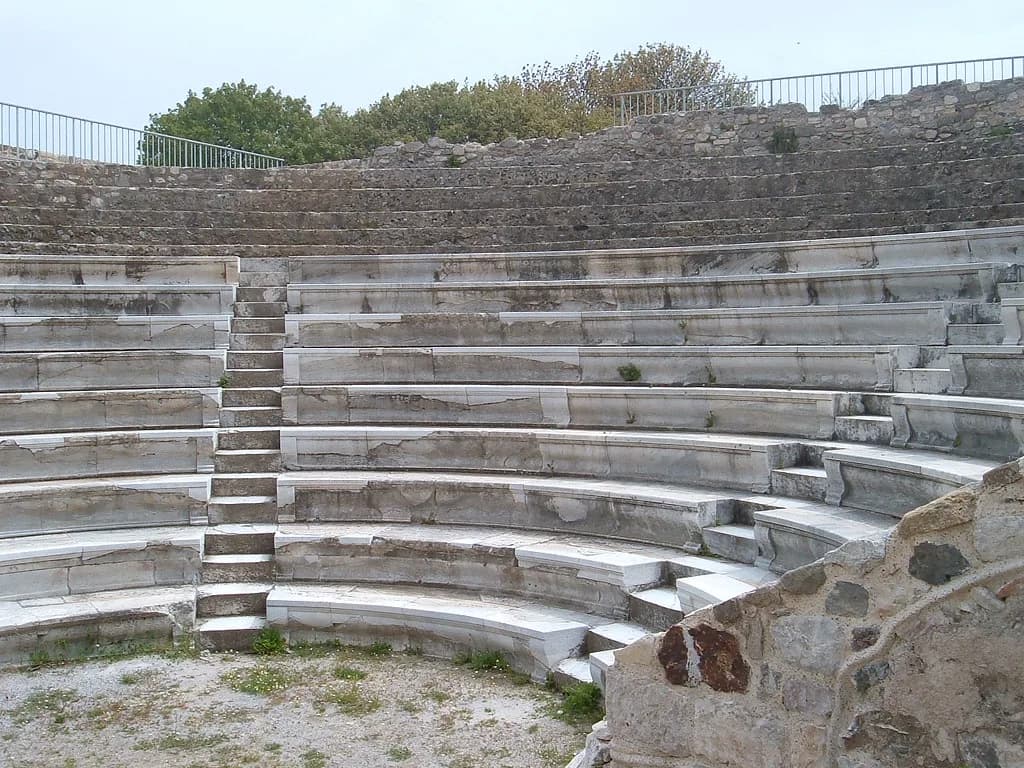
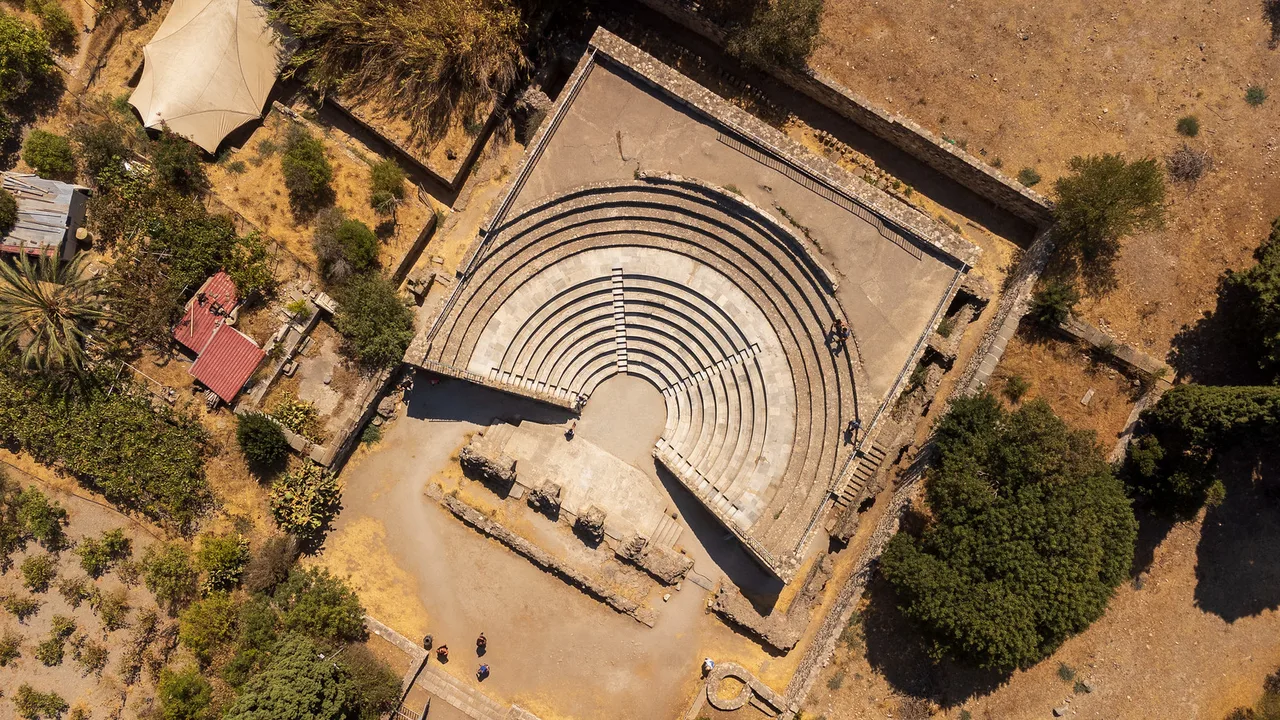
The seating area, or koilon, sits to the south, with the circular orchestra and the stage building to the north; the floor of the orchestra was decorated with marble mosaics and two further mosaic floors adorned the lanes. Look for the mosaic panel to the back left-hand side of the auditorium, which the municipal page singles out as the detail not to miss.
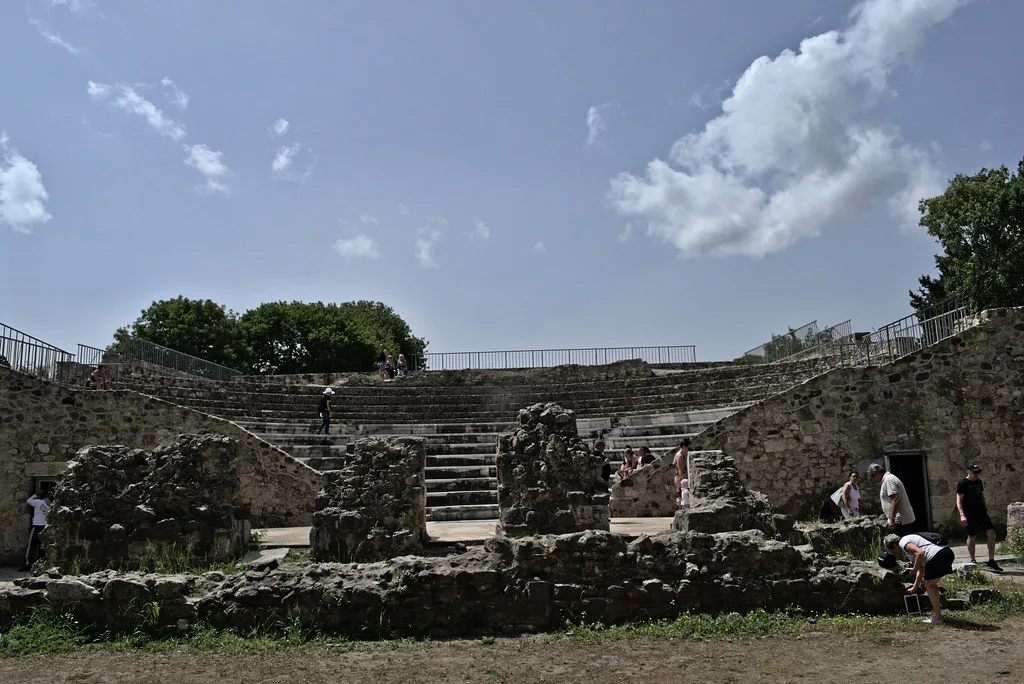
The building originally had fourteen rows of marble seats, nine of which have been restored, and it was divided by a corridor into two sections with the lower part split into four stairways. The first nine rows are original marble and were intended for the most important citizens, while further rows behind them were made of granite for ordinary spectators.
Size and Capacity Explained
The auditorium measured roughly 31.9 by 29.9 metres and stood about 12 metres high, and it was roofed in antiquity so that performances were not at the mercy of the weather. The published capacity is around 750 spectators, which helps explain why the rows feel intimate rather than monumental when you stand in them.
Structurally, the whole auditorium rests on large square-built pillars that created the artificial slope for the seating, so the building was engineered rather than simply cut into a hillside. When you walk around the exterior, look for those supporting elements; they are the reason the cavea sits above ground level.
The Underground Walkways and Photo Display
Beneath the seating, tunnel-like walkways run under the auditorium, and the municipality now uses that space for a display area featuring a photo exhibition from the Aegean Institute of Archaeological Studies. It is a short, cool detour rather than a full museum, and it gives the visit a second layer beyond the stone rows.
The approach path is lined with tall cypress trees and flowers, with crickets audible in summertime, which shapes the first impression of the site as much as the ruins themselves. Allow a few minutes for that entrance rather than rushing straight to the seats.
Restoration History in Brief
The Odeon was discovered and excavated in 1929 by Luciano Laurenzi as part of the Italian archaeological mission, and restoration work began in that same period during the Italian occupation of the island. Further conservation and consolidation took place between 1994 and 1999, which is why parts of the monument read more clearly today than a raw excavation would.
Dating is not a single fixed year in the published sources: the building is described as second century AD in some accounts and second to third century in others, and it was damaged by an earthquake in 142 AD before being repaired under Emperor Antoninus Pius. Treat the construction date as a range rather than a pinpoint, and treat the visible marble as a mix of original stone and restoration.
How Long to Allow
Give the Odeon around thirty to forty-five minutes if you want to read the display, walk the corridors underneath and photograph the seating and mosaics. The site is compact, so an hour is generous; the risk is not running out of things to see but arriving when the gate is shut or when a cultural event has taken over the space.
Pair the stop with something in the same quarter rather than treating it as a standalone excursion, because the value comes from seeing the Roman town as a whole. If you are short on time, see the Odeon first and add nearby sights only if the morning is still cool.
Best Time to Go and Summer Heat
The official page advises going early or later to miss the crowds and get a more immersive experience, which fits a site with narrow walkways and limited shade. In summer, the midday heat in Kos Town is the bigger constraint than the queues, so aim for the first hour after opening.
Wear shoes with grip for the stone rows and the underground passages, and carry water. A hat and sunscreen matter more here than at a shaded indoor museum.
Nearby Options in the Same Quarter
The Casa Romana, a restored Roman townhouse, sits in the same south-western quarter, and the remains of a Roman gymnasium and bathhouse are close by, which makes a compact Roman circuit possible on foot. If you want to understand the wider archaeological landscape of Kos, the island's attractions guides are a sensible next read before you commit to a route. For an overview of how Kos Neighborhoods fit together around the town centre, our Kos Neighborhoods: 4 Area Guides covers the areas you'll pass through.
Two other short stops are within the same town centre: the Tree of Hippocrates, the plane tree traditionally associated with the physician, and the Neratzia Castle, the Knights' fortress by the harbour. Both are easy to fold into a walk that starts at the Odeon, and neither requires a separate day.
Where to Eat Afterwards in Kos Town
For a meal after the visit, the trade-off in Kos Town is between harbour-front tables with a view and back-street tavernas where the setting matters less than the cooking. Harbour tables are convenient and easy to find but often busier and priced for the passing trade; back streets reward a short walk inland, though you should look at the menu before sitting down and check whether prices are per portion or by weight. Seasonal closures are common on the island, so confirm that a specific place is open before making it the plan for the evening.
What to Check Before You Go
Before travelling, confirm the current hours and any closure for events or conservation work on the municipal tourism site, since the Odeon still hosts cultural events organised by local and municipal bodies. If the site is closed, the Roman quarter around it is still worth walking, but plan the day around the Casa Romana and the archaeological museum instead.
Plan Your Visit
The Roman Odeon of Kos works best as a short, well-timed stop: check the published hours, arrive soon after opening, and give it thirty to forty-five minutes rather than a whole morning. Read the seating, the orchestra floor and the mosaics as parts of one roofed building, then use the underground display to fill in the rest.
Build the rest of the day around the same quarter, with the Casa Romana, the Tree of Hippocrates and the harbour castle as natural neighbours, and keep the meal decision separate from the sightseeing one. Confirm current opening details before you set out, and the Odeon will slot neatly into a day in Kos Town.
Explore more Kos sauna guides
Frequently Asked Questions
Is the Roman Odeon of Kos free to enter?
The Municipality of Kos tourism website lists free entrance at the Roman Odeon, alongside opening hours of 08:30 to 15:30 except Tuesdays. Check that page before you go, because hours and access can change for events or conservation work.
What was a Roman odeon used for?
An odeon was a roofed hall for musical and spoken performances. In Kos it also served as the seat of a public body that honoured distinguished citizens, and historians describe it as a venue for public sessions of the senate as well as displays and competitions.
How long does it take to visit the Roman Odeon of Kos?
Allow roughly thirty to forty-five minutes to see the seating, the orchestra floor, the mosaics and the display in the underground walkways. The site is compact, so an hour is generous and there is no need to allocate a half day.
Where is the Roman Odeon of Kos located?
It sits in the heart of Kos Town, in the south-western quarter of the ancient Roman city, south of the old main street known as the Decumanus maximus. It is reachable on foot or by bicycle from the centre, and the municipal page lists a free parking area nearby.
What is there to see near the Roman Odeon of Kos?
The Casa Romana townhouse and the remains of a Roman gymnasium and bathhouse are in the same quarter, and the Tree of Hippocrates and the Neratzia Castle are also within the town centre. Keep these as short nearby stops rather than a full itinerary.
When is the best time to visit the Roman Odeon?
The official page suggests going early or later to avoid the crowds, and in summer the first hour after opening is the most comfortable because the site has limited shade and narrow passages. Check the published hours before setting out.