
Palace of Knossos: What to See at Crete's Minoan Palace Near Heraklion
The Palace of Knossos is the largest and most elaborate of the Minoan palace complexes, set on a hill roughly 20 minutes south of Heraklion in Crete. It covers an area of about 20,000 square metres with more than 1,500 rooms, so it is not a site you cross in twenty minutes between coffee and lunch.
What makes it worth the trip is the combination of real Bronze Age architecture and a very visible twentieth-century reconstruction, plus the myths of the Labyrinth, the Minotaur and Daedalus that have attached themselves to these ruins for centuries. Knowing which parts you are looking at changes the visit completely.
Where the Palace of Knossos sits
The site occupies a hill just outside Heraklion, with the city's suburbs and low hills visible around it. Because it sits above the surrounding ground, there is little shade on the open courts and walkways, and the sun is a bigger factor in planning than the walking distance.
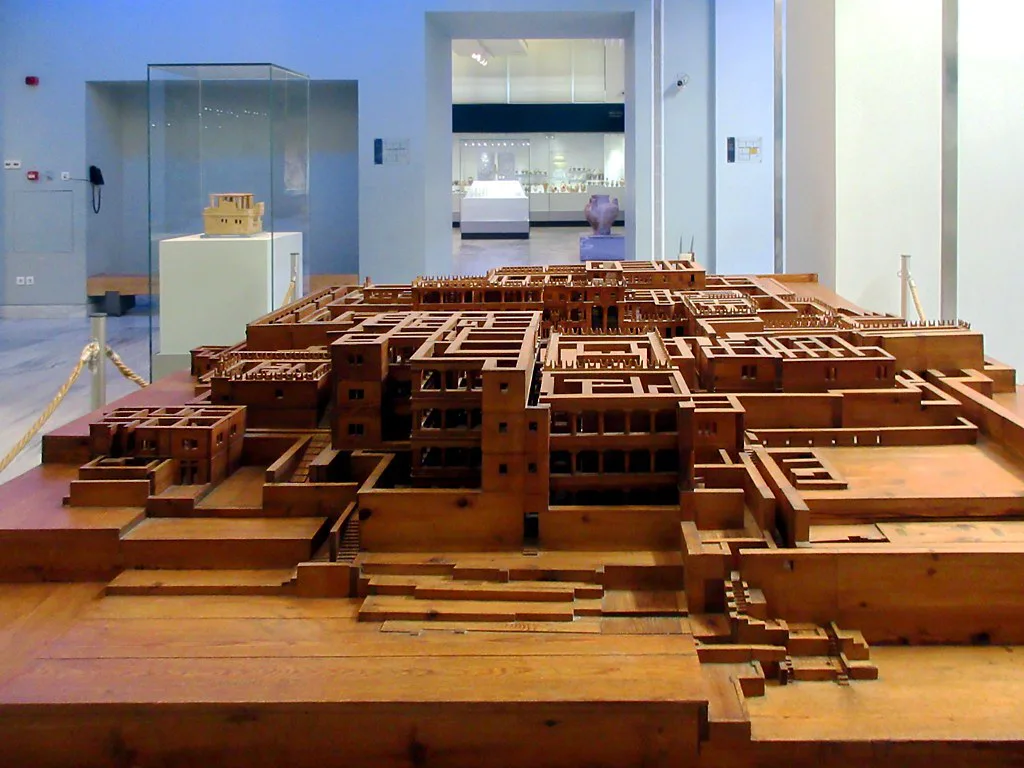
Inside the fence, the Great Palace is the core of the visit: four wings arranged around a central courtyard, with the royal quarters, workshops, shrines, storerooms and the throne room distributed between them. Ruins of the surrounding settlement lie on the hillsides beyond the palace itself.
Getting there from Heraklion
Knossos is close enough to Heraklion that it works as a half-day outing rather than a day trip. The usual approach is by road from the city, either with your own or a hired car, by taxi, or on one of the local buses that serve the Knossos stop; confirm the current departure point and timetable locally, since services change with the season.
If you are working out how the site fits with the rest of the city, the wider set of Heraklion Attractions: 10 Visitor Guides is a useful way to see what else sits within a short ride of the palace before you commit to a schedule.
Allow for the fact that the entrance area and car park are busy in the middle of the day in high season. Arriving at opening time is the simplest way to see the Central Court and Throne Room before the tour groups arrive, and it also keeps you out of the strongest sun.
A short history of the site
The hill was occupied long before the palace: there is a Neolithic settlement here from around the seventh millennium BC, and the first palace went up around 1900 BC. It was destroyed, probably by earthquake or invasion, around 1700 BC, and rebuilt on an even grander scale almost immediately.
The later palace was damaged repeatedly and finally destroyed around 1450 BC, an event the sources link to the Santorini eruption and to Mycenaean invasion. Knossos then served as a Mycenaean capital on Crete until roughly 1375 BC, and the site was not finally abandoned until the Middle Ages.
The first serious excavation was carried out in 1878 by Minos Kalokairinos, a wealthy Heraklion man who opened part of the western storerooms and brought out large storage jars. The full palace was uncovered later, and the site has been under archaeological study and conservation ever since.
Why the Palace of Knossos is famous
Knossos was the ceremonial, political, religious and economic centre of Minoan Crete, and it is often described as Europe's oldest city. Treat that label as a claim made by popular sources rather than a settled fact, since the definition of a city and the competing sites elsewhere in the Aegean are both debated.
The mythological draw is just as strong. The palace is identified in popular retellings with the Labyrinth built by Daedalus to hold the Minotaur, the half-man half-bull offspring of Pasiphae, and with the thread Ariadne gave Theseus so he could find his way out. The story of Daedalus and Icarus escaping Crete on wings of feathers and wax belongs to the same cycle.
Those stories are not decoration added later for tourists; they are the reason the site has been a landmark since antiquity, and they shape what you will hear from guides at the Throne Room and the Double Horns.
The reconstruction question: what is original
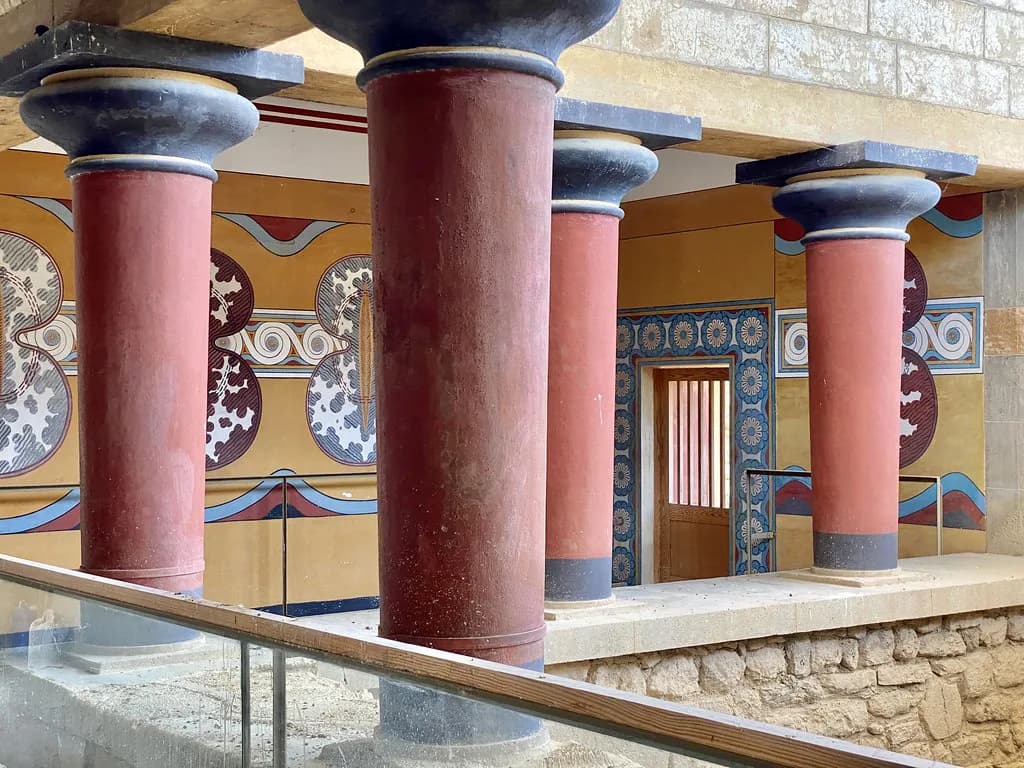
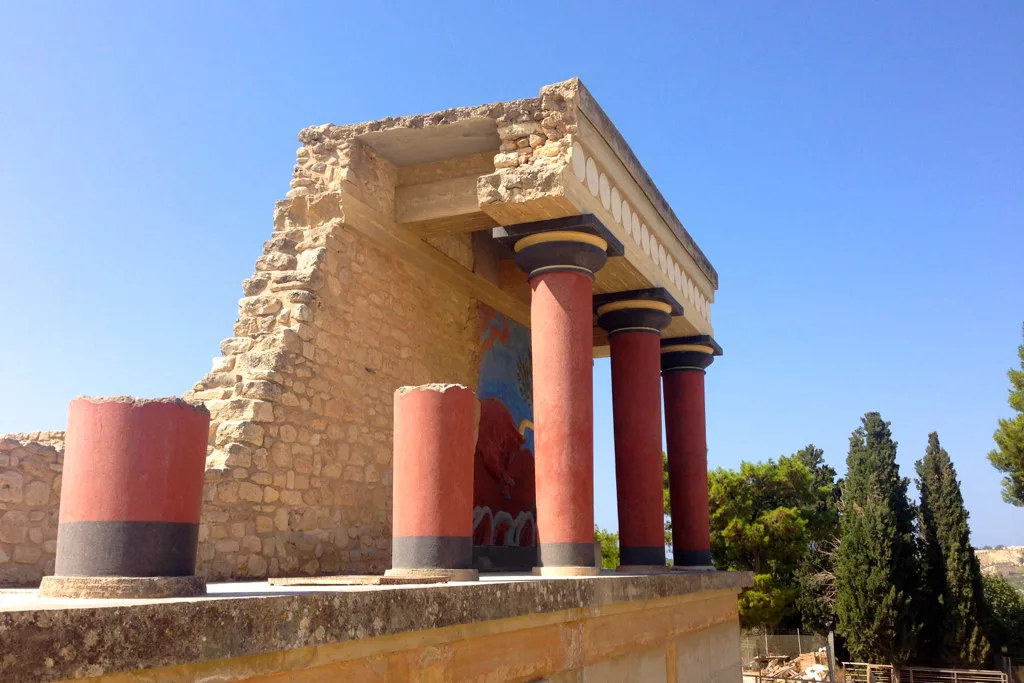
Arthur Evans excavated the palace from 1900 onwards and restored parts of it with cement, a technique that some archaeologists criticise as arbitrary and damaging to the Minoan fabric. As a result, what you see today is a mix of genuine ancient walls and early-twentieth-century interpretation, and some specialists regard parts of the palace as closer to a facsimile than a ruin.
That matters practically. The painted reconstructions and poured concrete give a vivid impression of a multi-storey building, but they are not ancient surfaces, and the most reliable place to see the authentic material is the Heraklion Archaeological Museum in the city, where the original frescoes and finds are displayed.
What to see: room by room
Start at the Central Court, the open rectangle around which the four wings are arranged, then work through the west wing, which held the ceremonial halls, sanctuaries and the Throne Room. The Throne Room is the highlight for most visitors: a stone throne carved to imitate wood, a griffin fresco framing it, and an adjoining lustral basin that points to the room's sacred character.
In the east wing, look for the royal apartments and the Queen's Apartment with its dolphin mural, reached past the grand staircase. On the south-west side, the Procession Corridor is named for its frescoes, and the Double Horns nearby are one of the sacred symbols of Minoan religion.
The storerooms hold the large clay jars known as pithoi, used for oil, wine and grain, and they are a good reminder that this was an administrative and economic machine as much as a royal residence. The theatral area and the cobbled road on the north side show how the palace connected to the settlement around it.
Size and time: how long to allow
With around 20,000 square metres and more than 1,500 rooms, the palace is a long, uneven walk rather than a single circuit. Most visitors will want at least two hours to cover the main rooms and the courtyards without rushing, and closer to three if they read the information panels and stop at the reconstructed sections.
Bring water and sun protection, and wear shoes with grip, because the paths and ancient floors are worn and uneven. The site has little shade, so a morning visit is more comfortable and photographs better than midday.
If you are short on time, prioritise the Throne Room, the Central Court, the Queen's Apartment and the storerooms, and skip the smaller outlying areas. It is better to see four rooms properly than to trail through every corner in the heat.
Tickets, hours and guided visits
Opening hours, admission prices and any seasonal closures are not fixed in the sources here, so check them on the official ticket site or at the desk before you travel rather than relying on a blog post. Ticket bundles that combine the palace with the Heraklion Archaeological Museum are sometimes offered, and the ticket office is the place to confirm what is currently available.
Guided tours are worth considering if you want the mythology and the archaeology explained together, and several operators run half-day trips from Heraklion that include transport. Going independently is cheaper and lets you set your own pace, but you will need to read the panels or bring a guidebook to make sense of the layout.
If you have more time in the city, the Koules Fortress, Heraklion, the Venetian sea fort at the old port, is a natural pairing with a late-afternoon walk after a morning at Knossos. To plan that walk back through town, browse the Heraklion Neighborhoods guide as well.
Where the finds went: the Heraklion Archaeological Museum
Most of the portable finds from Knossos are in the Heraklion Archaeological Museum in the city centre, including the original frescoes displayed on the upper floor. The museum's collection comes entirely from Cretan sites and is arranged chronologically, so it works as a companion to the palace rather than a separate outing.
The Phaistos Disk, a clay disk stamped with symbols that remain undeciphered, is one of the museum's best-known pieces, alongside gold jewellery, ivory combs and swords with golden handles from Minoan tombs. Seeing these objects after walking the palace rooms makes the site considerably easier to picture.
A sensible split is the palace in the morning and the museum in the afternoon, or the reverse if you prefer to understand the layout before you see it in situ. Either way, the two together make a full day in Heraklion.
Nearby: pairing the palace with the city
Back in Heraklion, the Morosini Fountain in Heraklion is the central meeting point of the old town, surrounded by cafes and close to the market streets, and it makes an easy first stop after the site.
The Heraklion Central Market, a covered street of food stalls off Dedalou Street, is where to stock up on olives, cheese and rusks for a picnic, and it shows a side of the city that the archaeological sites do not. If you are travelling with children and want a break from ruins, the Cretaquarium (Crete Aquarium) near Heraklion, out towards Gournes, is a straightforward half-day alternative.
The Historical Museum of Crete on Sofokli Venizelou Avenue covers the island's later history, from Byzantine and Venetian rule to the modern period, and it balances the Bronze Age focus of a Knossos visit.
Practical tips for the visit
Wear a hat, carry water and use sunscreen, because the site is exposed and the stone reflects heat. The ground is uneven, with steps and sloping paths between the wings, so sturdy shoes matter more than a map.
Photography is best in the early morning, when the light on the Central Court is softer and the site is quieter. If you are visiting in July or August, aim to be at the gate when it opens and leave by late morning.
For a wider sense of how the palace fits into a few days in the city, the Things to Do in Heraklion guide covers the port, the walls and the neighbourhoods around them in more detail.
Plan Your Visit
The Palace of Knossos is a site that rewards a bit of homework: know which rooms you are heading for, understand that some of what you see is a twentieth-century reconstruction, and leave time for the museum where the originals are held. Book any guided tour in advance, check the current opening hours and ticket options before you go, and plan the rest of the day around the city centre rather than the site itself.
Two practical decisions shape the day: whether to go independently or with a guide, and whether to see the palace or the museum first. Whichever you choose, the combination of the hilltop ruins and the Heraklion Archaeological Museum gives the fullest picture of Minoan Crete.
Explore more Heraklion sauna guides
Frequently Asked Questions
What is the Palace of Knossos famous for?
It is the largest and most elaborate of the Minoan palace complexes and was the ceremonial, political, religious and economic centre of Minoan Crete. It is also widely associated with the myths of the Labyrinth, the Minotaur and Daedalus and Icarus.
Is Knossos the oldest city in the world?
The hill was occupied from around the seventh millennium BC, and the palace is often described in popular sources as Europe's oldest city. That label is a claim rather than a settled fact, and different definitions of a city produce different answers.
Is the Palace of Knossos worth visiting?
For anyone interested in Minoan Crete or Greek myth, yes. Plan for at least two hours, and pair it with the Heraklion Archaeological Museum so you can see the original frescoes and finds that came from the site.
What destroyed the Palace of Knossos?
The first palace was destroyed around 1700 BC, probably by earthquake or invasion, and rebuilt. The later palace was damaged repeatedly and finally destroyed around 1450 BC, which sources link to the Santorini eruption and Mycenaean invasion.
How long does it take to visit Knossos Palace?
The site covers around 20,000 square metres and more than 1,500 rooms, so allow two to three hours for the main rooms and courtyards. Add more time if you read the panels or visit the museum afterwards.
How far is Knossos from Heraklion?
The palace sits on a hill about 20 minutes south of Heraklion by road. Taxis, local buses and organised tours all serve the site.
Should I see the palace or the Heraklion Archaeological Museum first?
Either order works. Some visitors prefer the museum first for context, but most go to the palace in the morning for the cooler weather and follow with the museum in the afternoon.