
Morosini Fountain in Heraklion: Visiting Lions Square
The Morosini Fountain is the small Venetian monument at the heart of Heraklion's main central square, and it is the easiest historic sight in the city to fold into a walk through the Old Town. It needs no planning beyond knowing where it stands and what you are looking at. Use it as a fixed point on the map and the rest of central Heraklion falls into place around it.
This guide stays with the fountain itself: its location, the approach on foot, what to look for, how long to allow and what sits within a few minutes of the square. Other monuments appear only as short nearby options rather than a full city itinerary.
What the Morosini Fountain Actually Is
The fountain is a Venetian-era public water monument in the centre of Heraklion, known in Greek as Krini Morosini and locally tied to the name Lion Square. It was built under Venetian rule and is now counted among the city's most important surviving Venetian monuments, which is why it anchors the square rather than sitting off in a museum.
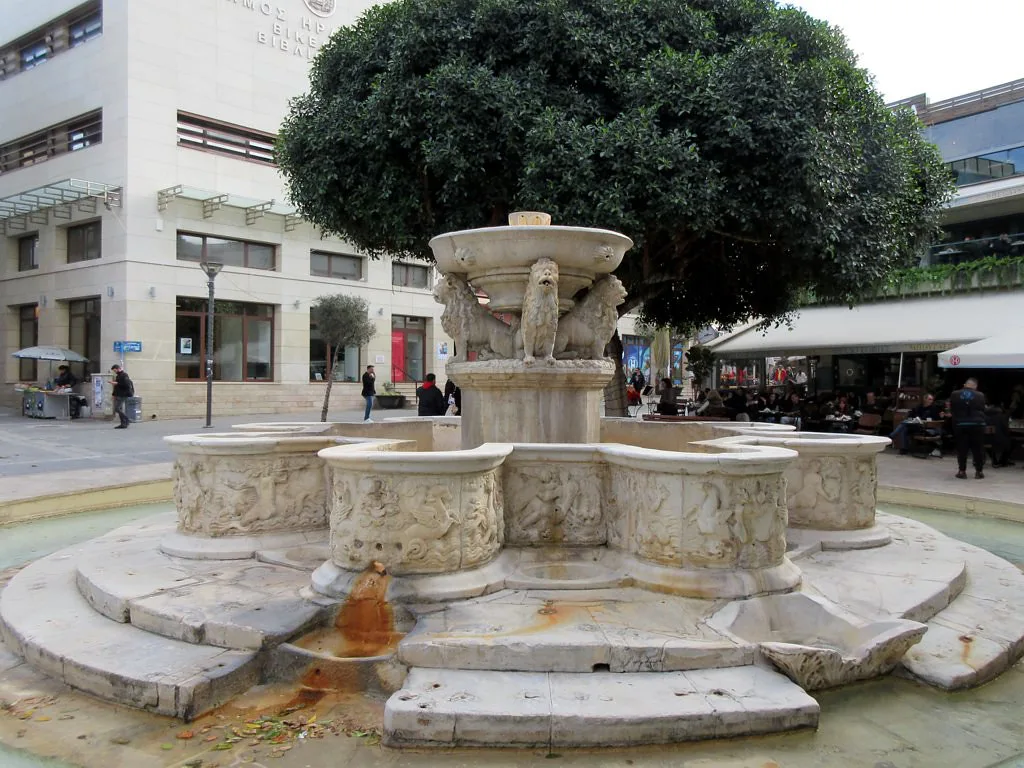
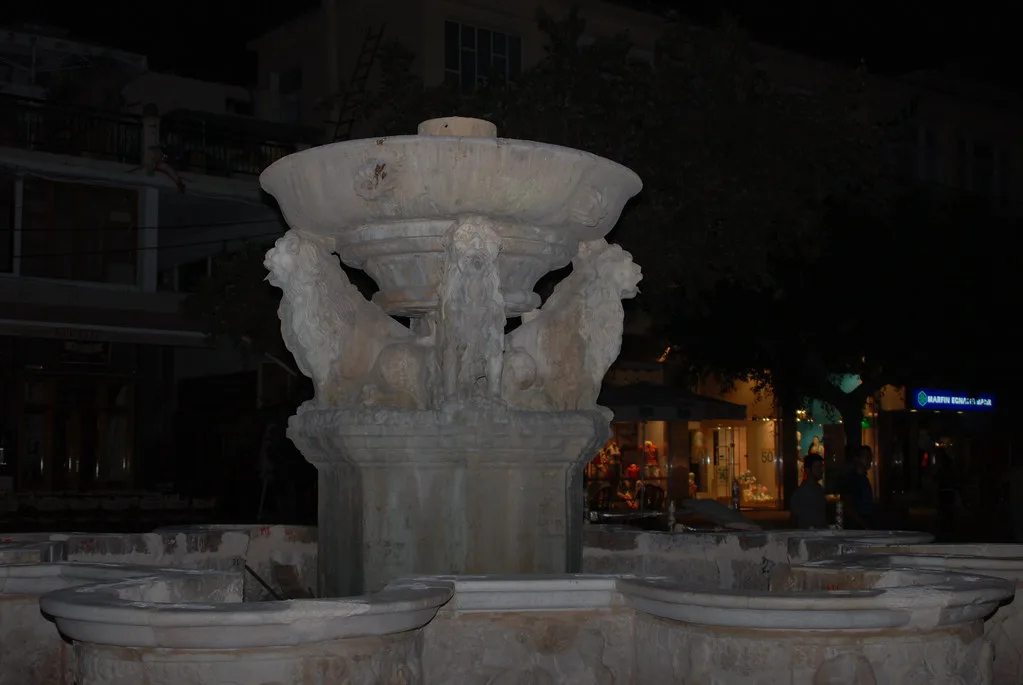
Its structure is what most visitors remember: a tiered base with lion heads that once spouted water into a ring of basins. The popular name Lions Square comes directly from those lion figures, and the square's formal name, Platia Eleftheriou Venizelou, is the one you will see on maps and street signs.
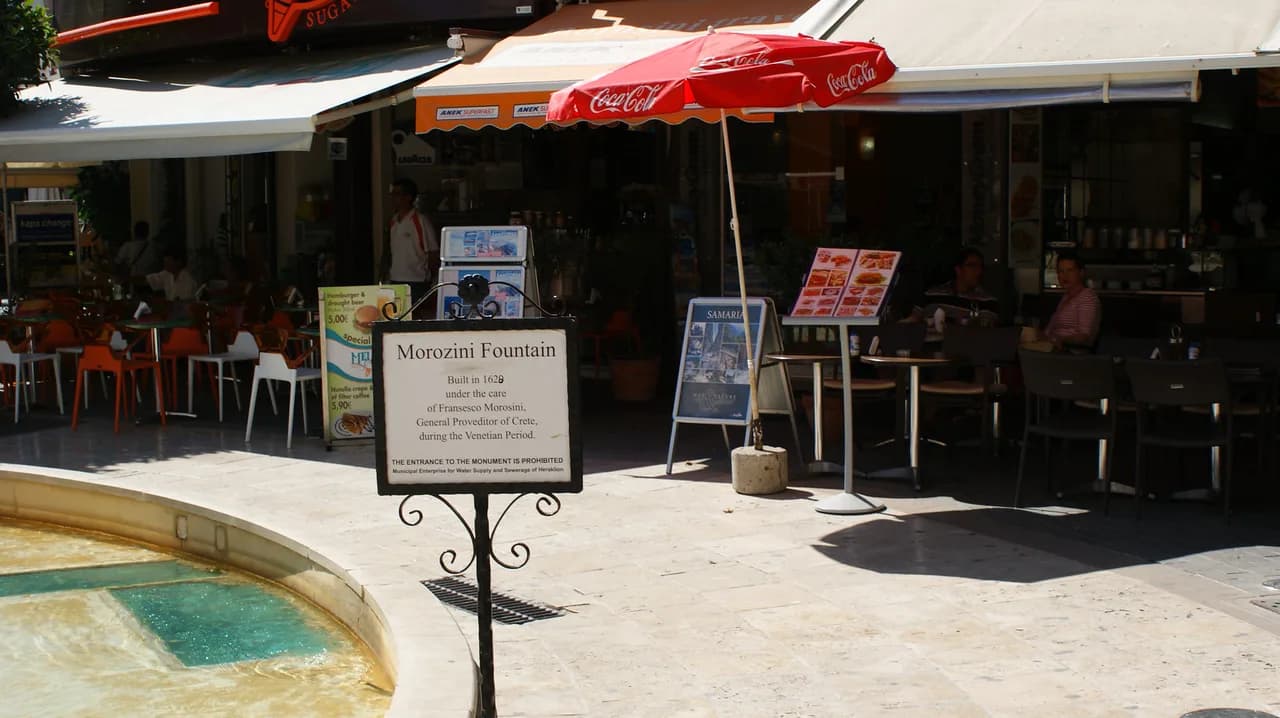
Dating is worth treating with a little care. One description places the fountain's construction in 1629 under the Venetian general Francesco Morosini, while a Greek travel guide gives 1628 and credits the same general. The one-year difference does not change the visit, but it explains why different sources disagree and why the 1620s is the safe way to think about it.
Where It Is: Lions Square in Heraklion Old Town
The fountain sits in Platia Eleftheriou Venizelou, the square everyone calls Lion Square, inside Heraklion's Old Town and a very short walk from the Venetian Loggia. The Loggia, an ornate arcaded building now housing the Town Hall, stands just a few metres south of the Church of St Titus, and the square with the fountain is a couple of minutes further on again. That cluster of three sights within a few hundred metres is the reason the fountain is so easy to reach.
Because it is an open public square rather than a ticketed site, there is no entrance fee and no booking to arrange. You arrive, you look, and you decide whether to sit down at one of the surrounding cafes. Treat any advertised tour that includes the fountain as optional rather than necessary.
Walking There from the Port and 25th Avgoustou
The simplest approach on foot starts at the Venetian harbour. Walk up 25th Avgoustou, the main pedestrian street that runs from the waterfront into the historic centre, passing souvenir shops and boutiques on the way. Once you reach the open square with the Church of St Titus, the fountain square is a short continuation south.
If you are arriving by cruise ship or ferry, the whole transfer is on flat, paved ground and takes only a matter of minutes, so the fountain works well as a first stop before you decide how to spend the rest of the day. Coming from the airport side of the city, a taxi or bus into the centre followed by a walk is the normal pattern; the airport transfer itself is roughly a ten-minute drive to the city.
The old harbour end of that walk passes under the walls of the Koules Fortress, so the fountain pairs naturally with a waterfront stroll rather than a separate trip across town.
What to Look For When You Arrive
Stand back first and take in the whole composition: the raised base, the lion heads around the rim and the layered basins beneath them. Then walk around it, because the lion figures read differently from each side and the square's cafes give you several vantage points. The paved square around the fountain is level and open, with trees providing shade at the edges.
One point to manage expectations on is the water. A visitor report notes that the fountain has not been running, and another account of a trip mentions it being under repair at the time. None of that is a permanent statement about the monument, so treat a dry fountain as a possibility rather than a certainty and check the situation when you arrive instead of assuming a display.
The Square Around the Fountain
Lion Square is compact, mixing historic and modern buildings, and it functions as one of the city's main meeting points. Cafes and restaurants line the edges, so the practical choice is between a quick look and a slow sit: the fountain takes minutes, while a table adds whatever a drink costs that day. Menus are posted outside most places, which is the simplest way to compare before committing.
Opposite the square stands the Basilica of Agios Markos, a Venetian-style church that now hosts events and exhibitions. It is worth a glance from the square even if you do not go inside. Between the fountain, the church frontage and the surrounding cafe terraces, the square is a good place to pause and orient yourself before continuing.
How Long to Allow
Ten to twenty minutes covers the fountain itself comfortably: a circuit of the base, a look at the lion heads, a few photographs. Add half an hour or more if you take a table at a cafe, since the square rewards sitting rather than rushing. Anyone combining the fountain with the Venetian Loggia, the Church of St Titus and the shopping streets nearby should budget an hour to an hour and a half on foot.
For comparison, the city's major sights take considerably longer. Most visitors give the Heraklion Archaeological Museum around an hour and a half, and a visit to the Palace of Knossos, about 5km south of the centre, is a half-day outing in itself. Placing the fountain in that context helps: it is a ten-minute stop between bigger things, not a destination that needs its own morning.
What Is Nearby Within a Few Minutes
South of the fountain, the historic buildings give way to the busier commercial streets around Odos 1866 and the Central Market, Kentriki Agora. That covered market area lines up fruit and vegetable sellers, fishmongers, butchers, cheese shops and herb shops along the same lane, with olive wood products among the common souvenirs. It is a natural next stop if you want something to eat or a look at everyday Cretan food shopping.
At the far end of that lane sits Platia Kornarou, home to the Venetian-era Bembo Fountain and an Ottoman pavilion that has served as a kafeneion. A kafeneion is a traditional Greek coffee house, and the square is a popular local meeting place. From the Morosini Fountain the whole loop back to the port is walkable, so nothing here requires transport.
Practical Tips for Photographs and Crowds
Early morning and late afternoon give the square softer light and fewer people, which matters because the fountain is a central meeting point rather than a quiet corner. On days when cruise ships are in port, the pedestrian street from the harbour and the square itself fill up considerably, and photographs of an empty fountain become difficult. Checking cruise schedules for Heraklion before you set out is a reasonable way to pick a quieter window.
No ticket is needed to see the fountain, so there is nothing to book and no reason to pay for entry. Save your booking attention for the timed sites and any museum you plan to visit.
Plan Your Stop at Lions Square
The Morosini Fountain works best as the fixed point in a walking loop through Heraklion's Old Town: arrive from the harbour along 25th Avgoustou, look closely at the lion heads and basins, then choose between a cafe table and the lanes toward the Central Market. Allow ten to twenty minutes, more if you sit.
Manage two expectations before you go: the water may or may not be running, and the date may read as 1628 or 1629 depending on the source. Neither affects the visit. If you want a wider picture of the area, the Heraklion Neighborhoods guides help you decide where to eat and wander after leaving the square, and our guide to things to do in heraklion shows which bigger sights to pair with it.
Explore more Heraklion sauna guides
Frequently Asked Questions
Where is the Morosini Fountain in Heraklion?
It stands in Platia Eleftheriou Venizelou, known as Lions Square, in the Old Town of Heraklion, a couple of minutes on foot from the Venetian Loggia and the Church of St Titus. Coming from the Venetian harbour, walk up 25th Avgoustou and continue into the historic centre.
Why is it called Lions Square?
The fountain is decorated with lion heads set around its base, and the popular name for the square comes from those figures. The formal name on maps and signs is Platia Eleftheriou Venizelou.
Is the Morosini Fountain free to visit?
Yes. The fountain stands in an open public square, so there is no ticket and nothing to book to see it. Any cost would come only from choosing to sit at one of the surrounding cafes, where menus are usually posted outside.
When was the Morosini Fountain built?
Sources differ by a year: one places construction in 1629 under the Venetian general Francesco Morosini, while another gives 1628 and names the same general. Either way, it belongs to the Venetian period of the 1620s.
How long do you need at the Morosini Fountain?
Ten to twenty minutes is enough to walk around the fountain and look at the details. Allow an hour or more if you add the Venetian Loggia, the Church of St Titus and the streets around the Central Market.
What else is near the Morosini Fountain?
Within a few minutes on foot you have the Venetian Loggia, the Church of St Titus, the Basilica of Agios Markos opposite the square, the 1866 shopping street and Central Market, and Kornarou Square with the Bembo Fountain. The Venetian harbour is a short walk downhill.
Does the Morosini Fountain still have water?
Visitor reports have noted the fountain without running water, and one account describes it under repair at the time of a visit. These are not permanent statements, so check the fountain's condition when you arrive rather than expecting a working display.