
Arch of Galerius in Thessaloniki: What to See at the Kamara

The Arch of Galerius is the Roman monument most Thessalonians pass every day without looking up, and almost everyone calls it the Kamara, from the Greek word for an arch. It stands on Egnatia Street in the city center, close to the Church of Agia Sofia, Aristotle University and the Rotunda, which makes it one of the easiest ancient sights in the city to reach on foot. This guide sticks to that single monument: what survives of it, what the carved panels show, and how to combine it with the sights immediately around it.
Quick Orientation: What the Arch of Galerius Is
The arch was raised in the early fourth century AD to mark the emperor Galerius's victory over the Sassanid Persian empire, and it formed the ceremonial gateway of a much larger imperial quarter. Around it once stood a palace, a hippodrome, the Rotunda and a mausoleum, all linked by a road that ran through the arch itself. That broader group of buildings is known as the Galerian Complex, and understanding it is the key to understanding why a victory arch ended up in the middle of a modern shopping street.
The nickname Kamara is the name you will hear in conversation, on bus stops and from taxi drivers, so it helps to use it when asking directions. The formal name appears on signage and in guidebooks, but locals treat the monument as a meeting point and landmark rather than a museum piece. Expect a monument embedded in everyday street life rather than an enclosed archaeological site.
Where It Is: Egnatia Street in the City Center
The arch stands on Egnatia Street, one of the main east-west arteries of central Thessaloniki, in a busy pedestrian area near the Church of Agia Sofia and Aristotle University. It sits at the heart of the walkable center, and the surrounding blocks are full of cafes, shops and eateries, so you will rarely be standing alone at the monument. Because it is a street landmark, there is no separate entrance gate to look for.
No address number is published for the arch, and it has no walled boundary, so the simplest approach is to navigate to the junction of Egnatia with the streets around the Rotunda and use the monument itself as the marker. If you are coming from the waterfront, head inland from the Aristotle Square area and follow the flow of pedestrians toward the university quarter. Any offline map will place the arch accurately; a street number is not needed.
How to Get There: Walking, Buses and Orientation
On foot, the arch is roughly fifteen minutes from Aristotle Square, a route that passes other central sights and keeps you in the historic core the whole way. Several bus routes serve the area, including routes 45, 12, 2 and 31 among others, according to a local attraction listing, but routes and stops change over time. Check the current network map from the city's transport operator before relying on a specific number, and treat the listed routes as a starting point rather than a fixed timetable.
The monument is directly on the pedestrian route between the Rotunda and the waterfront, so most visitors arrive on foot without planning a separate trip. If you are staying in the center, walking is almost always simpler than taking a bus for one or two stops. Wear shoes you can walk in, since the surrounding streets are paved and often crowded.
What You Are Actually Looking At
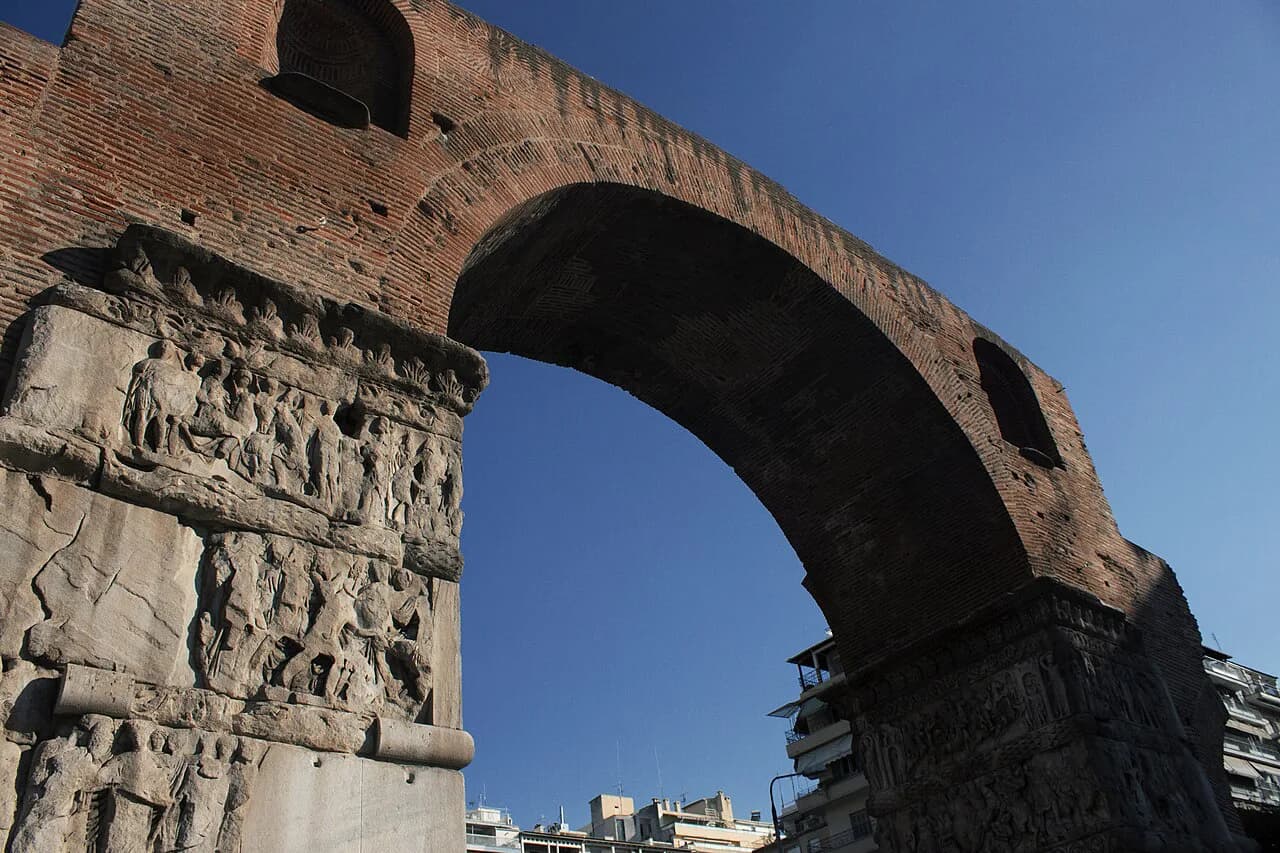
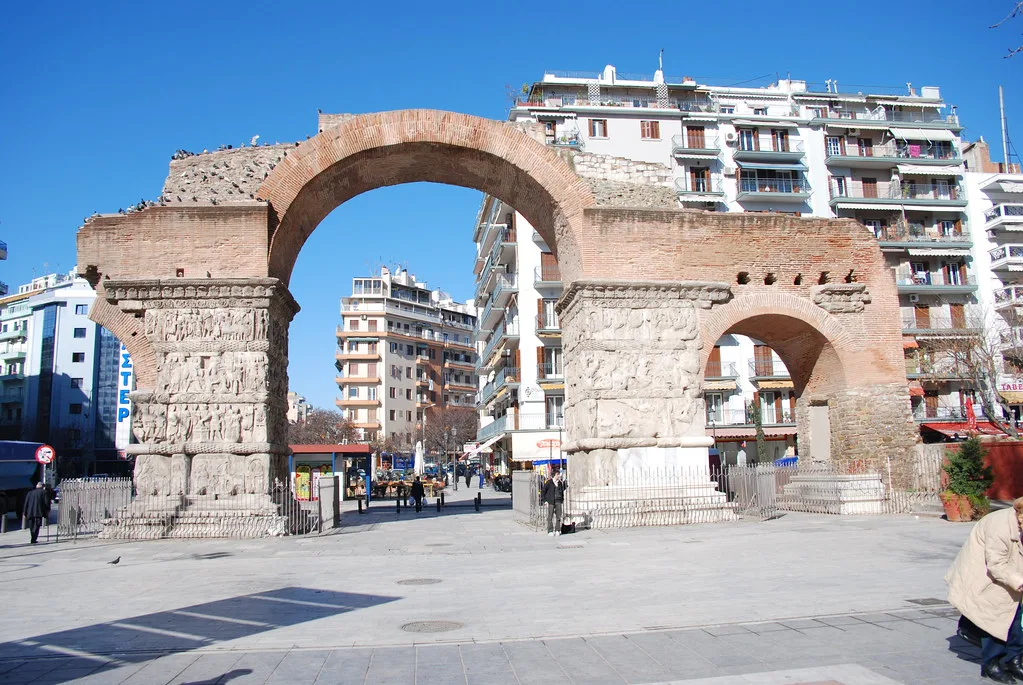
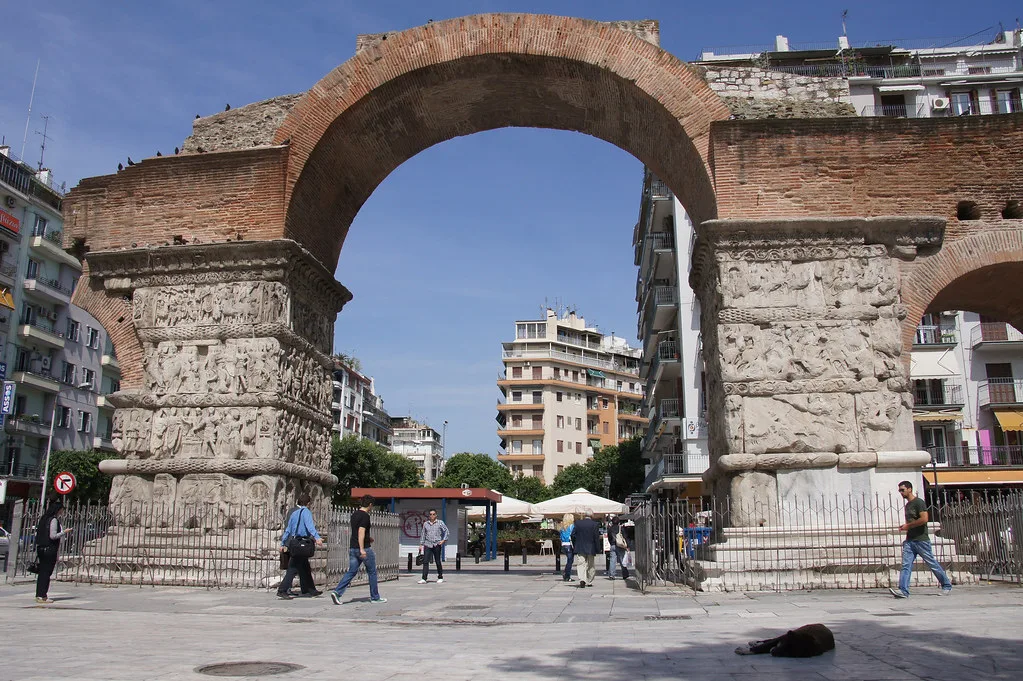
The arch originally rested on eight pillars in two rows of four, with three arched openings between them: a wide central arch flanked by two smaller side arches. The surviving structure is a fragment, with only three of the original pillars still standing, so the monument you see is roughly a quarter of the original design. The central arch measures about ten meters wide and twelve and a half meters high, while the side arches are almost five meters wide, giving a clear sense of the original scale.
What survives is the core of the monument rather than a restored reconstruction, so you are looking at original masonry and carving rather than a modern rebuild. The thick walls of the original structure, reported at about three and a half meters, help explain why this fragment has lasted. The arch was built between roughly 298 and 305 AD, which places it at the very end of the Roman tetrarchy and the start of the Christian era in the city.
Reading the Reliefs: How to Decode the Carvings
The carved panels are arranged in stacked bands around the pillars, and most of them narrate the Persian campaign: battles, sacrifices, the departure of prisoners from conquered cities and the presentation of gifts to the emperor. The panels reward a slow walk around each pillar rather than a single photo from the street. Look for scenes of Galerius receiving delegations, since several depictions present him as a ruler willing to grant clemency as well as victory in war.
The clearest visual clue to how the reliefs work is scale: the Persian soldiers are carved smaller than the Roman ones, and Galerius himself is larger than everyone else, so the hierarchy of size tells you who matters in each scene. Animals reinforce the setting. Camels and elephants appear among the figures, signalling that the events took place in the east rather than in Greece, and they are the easiest details to point out to children or companions.
One related carving is not at the arch at all: the so-called Small Arch of Galerius, originally the arch of a statue niche from the Octagon of the palace, is displayed in the Archaeological Museum of Thessaloniki. If the reliefs on the Kamara leave you wanting more of the same period, that museum is the logical next stop, and it is a short ride or a longer walk from the center. For the practical details, see the archaeological museum thessaloniki.
The Wider Galerian Complex: Palace, Hippodrome and Rotunda
The arch was the ceremonial entrance to a palace quarter, not a freestanding monument, and the rest of that quarter survives in fragments scattered around the modern center. The palace buildings included a large basilica, a central peristyle complex, baths, an octagonal hall and an apsidal hall, some of whose remains are visible today at the archaeological site in Navarinou Square. That site is the place to see the palace remains themselves; the arch is the gateway, not the palace.
The octagonal hall, known as the Octagon, was most likely the palace's audience hall or throne room, later converted into a Christian church, and it had a dome roughly twenty-three meters across. It was destroyed in the seventh century, in the era when earthquakes struck the city, and its vestibule was later turned into a cistern. Knowing this helps explain why so little of the complex remains above ground.
The road that ran through the arch linked the palace with the hippodrome and the Rotunda, so the three monuments were designed to be experienced as one ceremonial route. The Rotunda still stands a short walk from the arch, making it the most visible surviving partner of the monument. Reading the arch first, then walking to the Rotunda, is the best way to imagine the original quarter.
How Much Time to Allow and How to Combine It With Nearby Sights
Allow around fifteen to thirty minutes at the arch itself if you want to walk around all three pillars and read the carved panels at a relaxed pace. The monument is not a museum, so there is no route to follow and no fixed exit; most visitors stop, look up, circle the surviving pillars and move on. Add more time if you plan to photograph the reliefs in detail, since the light changes through the day.
The most efficient pairing is the arch with the Rotunda, a short walk away, followed by the Church of Agia Sofia in the direction of the waterfront. Together these make a compact half-day loop through the Roman and Byzantine layers of the center. If you want to extend it into a full day, the Archaeological Museum and the Museum of Byzantine Culture give the objects and context that the street monuments cannot.
Practical Notes for Visiting the Kamara
The arch is an outdoor monument on a busy street, surrounded by cafes, shops and eateries rather than set behind a ticket desk. If you want to plan a meal nearby, the best restaurants in thessaloniki guide is a useful companion to this walk. Check locally for current access details if those matter to your plan. Many visitors simply pass it as part of a walk; it is not a site you need to schedule an appointment for.
Because the monument sits in a public space, access can be affected by restoration or street works. Look at the city's heritage or culture listings before a special trip if scaffolding would spoil your visit. Otherwise, treat the arch as one stop on a central walk and keep your plans flexible.
The arch sits in a pedestrian area of shops and cafes, so it fits naturally into a morning of sightseeing or a break between meals rather than a dedicated expedition. Nearby, the Modiano Market area is a practical stop for a bite if you are continuing on foot. Clothing, transport timings and meal breaks are the practical variables worth planning; the visit to the monument itself is short.
What Is Nearby: Rotunda, Agia Sofia and the Waterfront
The Rotunda is the nearest major monument, a short walk from the arch and the most visible remnant of the ceremonial route the arch once framed. The Panagia Acheiropoietos area and the Church of Agia Sofia lie on the way back toward the waterfront, so a walk in that direction covers several centuries of the city's architecture in one route. Do not try to see everything in one push; pick two or three highlights and leave the rest for another day.
Toward the waterfront, the walk back to Aristotle Square passes the Roman Forum archaeological site, which adds another layer to the same route. The White Tower is farther south along the seafront, so it works better as a separate outing than as an addition to the arch. If you are building an itinerary, group the arch with the Rotunda and Agia Sofia, and put the waterfront monuments on a different day.
For a longer stay, the Ano Poli district above the center rewards a separate walk with its own Byzantine churches and views over the city. It is not within easy walking distance of the arch for most visitors, so plan it as its own half-day rather than tacking it onto a visit to the monument. The best restaurants in the center and in Ano Poli are useful to know when you are planning where to eat before or after the walk.
Plan Your Visit
The Arch of Galerius, or Kamara, is a short, free-standing stop in the middle of the center, best understood as the surviving gateway to a much larger Roman palace quarter. Visit it first, then walk the short distance to the Rotunda and on toward Agia Sofia, and the pieces of fourth-century Thessaloniki start to fit together. Check current access details locally before a special trip, since the monument stands in a public street rather than at a ticketed site.
Explore more Thessaloniki sauna guides
Frequently Asked Questions
What is the Arch of Galerius famous for?
It is a Roman victory monument built in the early fourth century AD to mark the emperor Galerius's defeat of the Sassanid Persian empire, and it originally formed the ceremonial gateway to a palace quarter. It is also famous for its carved relief panels, which depict the Persian campaign, battle scenes, prisoners and gifts presented to the emperor.
Why is the Arch of Galerius called the Kamara?
Kamara is the Greek word for an arch, and locals use it as the everyday name for the monument. If you ask for directions, it is usually easier to say Kamara than the full formal name, which is mainly used in signage and guidebooks.
How long does it take to see the Arch of Galerius?
Most visitors spend around fifteen to thirty minutes at the monument, circling the three surviving pillars and reading the reliefs. It is an outdoor structure on a public street, so there is no fixed route or exit, and you can stay as long as you like.
Is the Arch of Galerius free to visit?
The arch is a monument standing in a public street rather than a ticketed museum, and it is generally viewed from the surrounding pedestrian area. Check locally for any current restrictions or restoration works before a special trip.
What do the reliefs on the Arch of Galerius show?
The carved bands depict scenes from Galerius's Persian campaign, including battles, sacrifices, the departure of prisoners and the presentation of gifts to the emperor. Figures are carved at different sizes, with Persian soldiers smaller than Roman ones and Galerius larger than everyone, and animals such as camels and elephants signal the eastern setting.
How far is the Arch of Galerius from Aristotle Square?
It is roughly a fifteen-minute walk from Aristotle Square through the center of Thessaloniki. Bus routes serve the area as well, but the walking route is short and stays within the historic core.
Can you walk from the Arch of Galerius to the Rotunda?
Yes, the Rotunda is a short walk from the arch, and the arch was originally part of the ceremonial route that linked the palace quarter, the hippodrome and the Rotunda. Pairing the two is the most efficient way to see the surviving Roman monuments of the center.
What else should I see near the Arch of Galerius?
The Rotunda, the Church of Agia Sofia and the Roman Forum site toward Aristotle Square are all within walking distance. For a deeper context on the palace district, the remains at Navarinou Square show the basilica and palace buildings associated with the arch.