
Chania Lighthouse: A Visitor's Guide to the Venetian Harbour Landmark
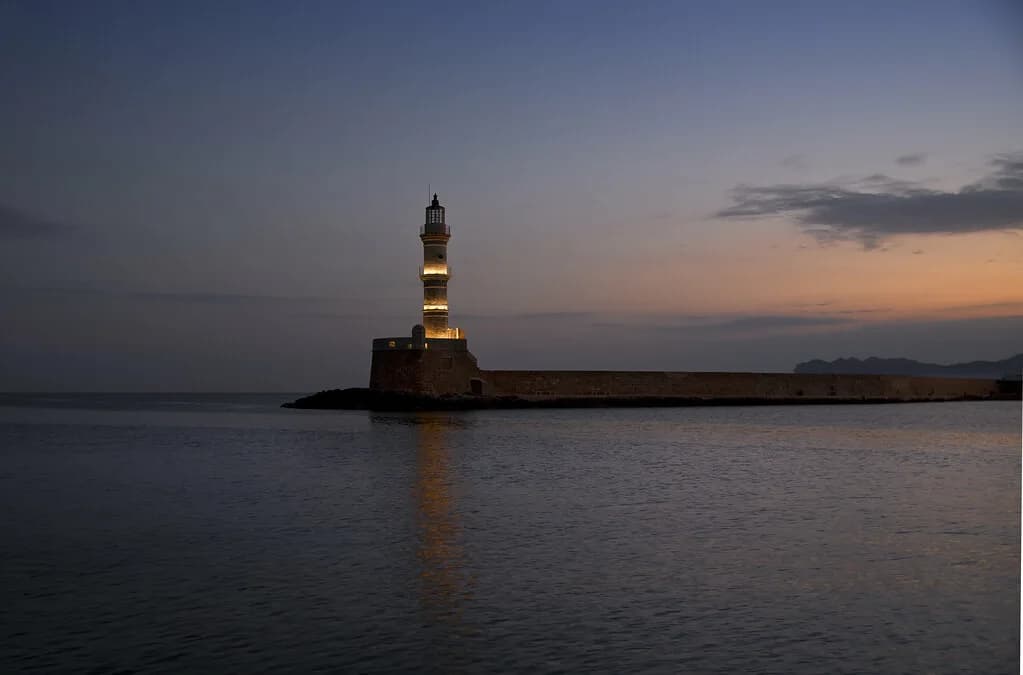
The Chania Lighthouse marks the entrance to the Old Venetian Harbour, closing off the breakwater with a stout stone tower that looks more like a minaret than a beacon. It is the single most photographed structure in Chania, and it is also the easiest major sight in the city to reach, because the route out to it is part of the harbour itself. This guide treats it as what it is: a short, rewarding stop inside a harbour walk rather than a half-day outing.
Expect no ticket queue, no interior staircase and no visitor centre. The value of a visit lies in the walk along the sea wall, the close-up of the stonework at the base, and the view back over the harbour to the domed mosque and the old town rooftops. Plan the rest of your day around that, and the stop fits neatly into an hour of strolling.
What the Chania Lighthouse Actually Is
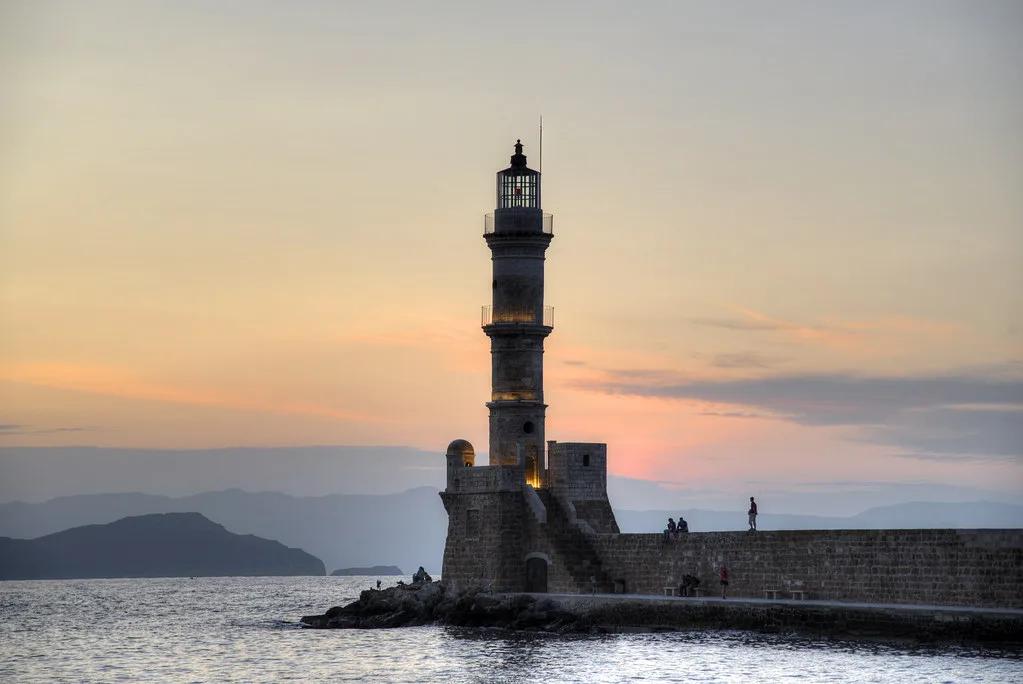
The lighthouse stands at the tip of the old harbour breakwater in Chania, on the west side of Crete. Its silhouette is distinctive: a tapering cylindrical tower with a gallery near the top, deliberately recalling a minaret, which is why photographs of it are so recognisable. It is no longer an active navigational light, but it remains the emblem of the harbour and one of the top attractions in Chania for its architecture and historical interest.
The history is usually told in two layers. A first tower was built under Venetian rule, and the structure was later rebuilt in the nineteenth century during the Egyptian period on Crete, which is why travel accounts describe it as an Egyptian lighthouse despite its Venetian origin. Treat precise dates with mild caution: travel writing, not an official heritage page, is the common source for the sixteenth-century foundation and the 1864 reconstruction. The framing is reliable; the exact years are worth cross-checking if that matters to you.
Where It Sits in Chania Old Town
The tower is at the far end of the harbour that curls through the Old Town of Chania, below the White Mountains that form the backdrop to the city. Everything around it is walkable: the Venetian harbour promenade on one side, the denser lanes of the old town on the other. You do not need transport to reach it once you are anywhere in the historic centre.
The harbour itself is the centrepiece of Chania, a fourteenth-century Venetian port ringed by colour-washed buildings, a harbour-front promenade and a long sea wall. The lighthouse is the punctuation mark on the east side of the harbour, where a modern boat marina sits, and the Mosque of the Janissaries and the Venetian shipyards are strung along the same shoreline. That concentration is the reason a single loop covers so much.
How to Get There: On Foot, Along the Water
The realistic answer is that you walk. Chania's old town is compact and much of it is closed to cars, with parking in the historic centre described as extremely limited, so driving to the lighthouse door is not an option. If you arrive by car, park on the edge of the centre or at a square near the old port and continue on foot.
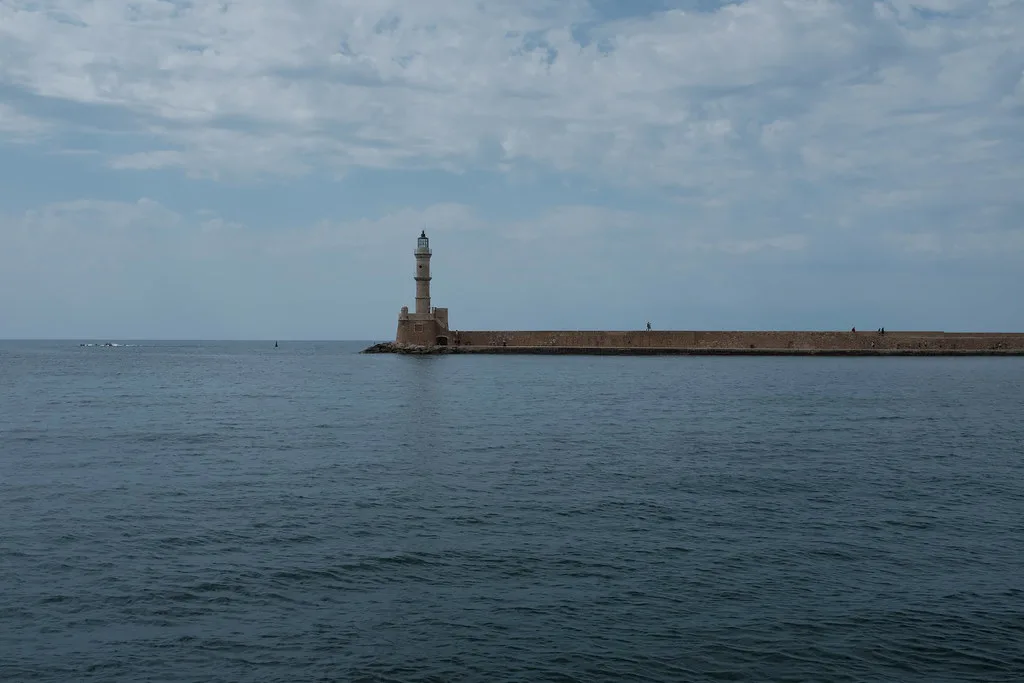
From the harbour promenade the route is straightforward: follow the waterline around the dog-legged port, past the mosque and the shipyards, then out along the breakwater toward the tower. Walking the sea wall is itself one of the best things to do in Chania, with open sea on one side and the old town on the other, and the lighthouse growing larger with every step. Give the approach more time than the destination.
Travellers arriving by air or sea will come through Chania's international airport or the port at Souda, which is roughly a twenty-minute drive from the town centre. Buses serve the town, but once you are in the old town your feet do the work. Ride-hailing apps are not available in Chania, so taxis or the local bus network are the fallbacks for longer hops.
Walking Out to the Lighthouse: What to Expect
The final stretch is a walk along the harbour's sea wall, which lets you get close to the base of the tower but not into it. Visitors are not allowed inside the lighthouse, so there is no climb, no viewing platform and no interior to tour. What you get instead is the base itself, the open water, and a sweeping view back across the harbour to the town.
Set your expectations before you set out, because the disappointment of arriving expecting a climb is entirely avoidable. The reward is the position: from the end of the breakwater you look back at the whole of the harbour, with the mosque domes and the shipyards lined up along the shore. Photographers should note that the best angle on the tower is from the sea wall itself as you approach, not from the base.
Access along the breakwater is not something to assume is guaranteed year-round; maintenance, weather and short-term restrictions are not published in one fixed place. If the walk out is essential to your plan, confirm on the ground or with your accommodation before making the trip.
What to See From the Base
Standing at the lighthouse, the harbour reads as a single set piece. The most prominent building is the Mosque of the Janissaries, also called the Küçük Hasan Pasha Mosque, an orange-domed Ottoman structure from 1645 that no longer functions as a mosque and is used as an exhibition space. Behind it the old town climbs toward the hills, and to the side the Venetian shipyard buildings line the eastern shore.
The lighthouse is also the anchor for a cluster of nearby sights. The sea wall walk, the Firkas Fortress area at the western entrance to the harbour, and the lanes of Splantzia with the Church of Agios Nikolaos and its surviving minaret are all within a few minutes on foot. If you want a wider menu of what surrounds the harbour, the Venetian Harbour Chania guide covers the promenade in detail, including the stretch along Akti Kountouriotou.
How Long to Allow
Budget an hour for the full circuit: promenade, breakwater, a stop at the base, and the walk back. The lighthouse itself takes perhaps ten minutes of that; the rest is the harbour, which is the actual experience. Treating it as a standalone afternoon activity will leave you with time on your hands, so pair it with something else.
A sensible pairing is a loop through the old town's neighbourhoods after the harbour, covering the Jewish Quarter, the Christian Quarter of Topanas and the Turkish Quarter of Splantzia in a single wander. If you want the broader city picture, Chania Attractions: 8 Visitor Guides sets out the sights within walking distance of the port.
Best Time of Day and Season
Light matters more here than at most sights. Morning gives clean light on the tower from the sea wall, while late afternoon and sunset turn the harbour and the old town facades warm. The harbour front becomes busy in the evening, so if you want the breakwater with fewer people, go early.
On crowds, Chania swells in July and August, and the shoulder seasons of late May to early June and September are generally more comfortable while the sea stays warm. On the food side, many island restaurants in Crete close roughly from November to April, so a winter visit changes the eating landscape around the harbour as much as it changes the crowds.
Tickets, Hours and Access
There is no ticket office at the Chania Lighthouse, and the visitor experience is itself a walk along public harbour ground to the base of the tower. Opening hours are not published either, because there is nothing to open. That is the practical position, not a promise about every gate and barrier on the breakwater at every time of year.
Check current details on the ground before you build an evening around the walk out, particularly outside high season, when weather and maintenance can affect the breakwater. Your accommodation or the harbour businesses are the quickest way to get a straight answer.
Nearby: Filling Out the Harbour Walk
Beyond the lighthouse, the old town rewards a slow loop. The Etz Hayyim Synagogue in the Jewish Quarter has been restored as a memorial and museum, visited by ringing the doorbell during posted hours, with donations rather than a ticket. The cathedral, the Maritime Museum of Crete (Chania) near the Firkas entrance, and the Archaeological Museum of Chania a little further out all reward an hour each if you have them.
For food shopping and picnic supplies, the Municipal Market of Chania is the obvious stop, though restoration work has affected it in recent years, so check before you plan a visit around it. Simpler still: buy rusks, cheese and olives from a grocer in the old town and eat them on a bench facing the water.
Eating Near the Lighthouse: Harbour Versus Back Street
The trade-off around the harbour is the classic one: tables on the water buy you the view and the convenience, while a few lanes inland usually buy you better value and more local custom. Harbour-front restaurants in Chania can be touristy, but the meals served there are often still good and not much more expensive than elsewhere in town. The practical move is to read recent reviews before sitting down, especially at the tables closest to the water. It is the same calculation you will make elsewhere in Crete, as our Rhodes food guide shows for the harbour tavernas there.
Wherever you eat, know what to order. Dakos is a Cretan rusk topped with chopped tomato, crumbled mizithra or feta cheese, oregano and olive oil, and it is the standard light starter. Kalitsounia are small pastry pies, often filled with cheese or wild greens, sometimes served with honey. For seafood, grilled fish and fried squid are the harbour staples, and raki or tsikoudia, the clear grape spirit of Crete, is the usual finish.
If you want a proper lunch in a square rather than on the water, Splantzia is the neighbourhood to aim for, and Spatzia Square there is lined with restaurants offering outdoor tables. Prices vary by venue and season, so check the menu board before you commit rather than relying on any figure quoted online.
Practical Mistakes to Avoid
The first mistake is expecting to climb the lighthouse. The second is arriving by car without a parking plan into a centre where parking is scarce. The third is treating the visit as a full afternoon out; it is a stop, best folded into a harbour walk with a meal at one end.
The fourth is skipping the walk out because it looks far. The breakwater walk is short, flat and the best part of the visit. The fifth is coming at midday in high summer for a photograph; the light is harsher and the harbour is busiest.
Plan Your Visit
The Chania Lighthouse is a landmark you visit with your legs, not your wallet: walk the harbour, follow the sea wall, stand at the base and look back at the town. Allow an hour, pair it with a wander through Splantzia or the Jewish Quarter, and eat either on the water for the view or a lane or two inland for the value.
Before you go, confirm that the breakwater is open and check any changes to nearby sights, since restoration work does affect parts of the old town from time to time. Beyond that, the plan is simple and needs no booking.
Explore more Chania sauna guides
Frequently Asked Questions
Can you walk to the lighthouse in Chania?
Yes. The lighthouse sits at the end of the Old Venetian Harbour breakwater, reached on foot from the harbour promenade and then along the sea wall. It is a short, flat walk with no transport needed once you are in the old town.
Can you go inside the Chania Lighthouse?
No. Visitors are not allowed inside the lighthouse, so there is no climb and no interior to visit. The reward is reaching the base and looking back across the harbour toward the mosque and the old town.
How old is the Chania Lighthouse?
The tower is usually described as having Venetian origins, with a later nineteenth-century reconstruction during the Egyptian period on Crete, often dated to 1864 in travel accounts. Precise dating comes from travel writing rather than an official heritage source, so treat the exact years as indicative.
Do you need tickets for the Chania Lighthouse?
No ticketing is published for the lighthouse; the visit is a walk along public harbour ground to the base of the tower. Any short-term barriers on the breakwater are not announced in one fixed place, so check on the ground if the walk out matters to your plan.
Where is the Chania Lighthouse located?
At the tip of the Old Venetian Harbour in Chania, on the west side of Crete, below the White Mountains. It is within the old town, a short walk from the Mosque of the Janissaries and the Venetian shipyards.
How long does it take to visit the Chania Lighthouse?
Allow about an hour for the round trip along the promenade and the breakwater, including time at the base. The tower itself takes minutes; the harbour walk is the substance of the visit.
Is the Chania Lighthouse worth visiting at sunset?
Late afternoon and sunset give warm light on the harbour and the old town facades, which suits photography. The harbour front gets busy in the evening, so arrive early if you want the breakwater with fewer people.
What is there to see near the Chania Lighthouse?
The Mosque of the Janissaries, the Venetian shipyards, the sea wall walk, and the lanes of Splantzia with the Church of Agios Nikolaos. The Etz Hayyim Synagogue and the old town's neighbourhoods are a few minutes further on foot.