
Heraklion Old Town: A Practical Guide to the Historic Centre
Heraklion Old Town is the compact historic core of Crete's capital, running from the Venetian harbour at the bottom up the long pedestrian street 25th Avgoustou to Lions Square. It is not a preserved museum quarter: wars, earthquakes and postwar rebuilding left a centre that mixes Venetian and Ottoman fragments with modern concrete blocks.
That mix is the main thing to calibrate before booking. Travellers who want canal-side prettiness or uninterrupted medieval streets may find the centre scrappy, while sightseers and eaters get a dense, walkable district where fortifications, churches, a food market and dozens of tables sit within a single loop. This page stays inside that district; the wider city is covered in our guide to Heraklion Neighborhoods.
What Heraklion Old Town is and where its edges fall
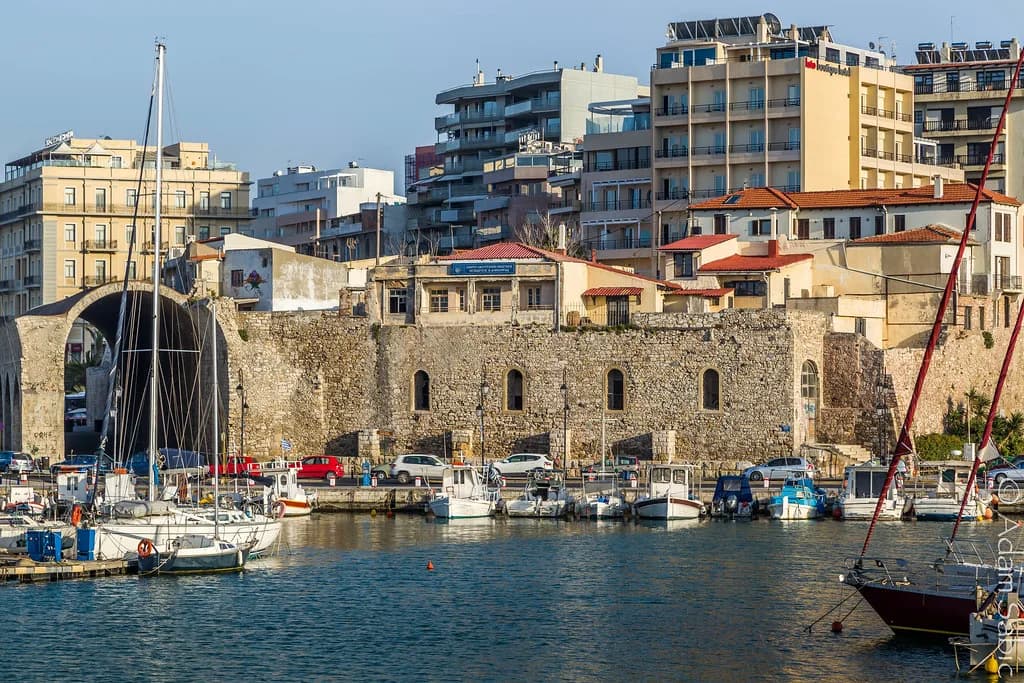
Think of the old town as a corridor with a heavy head. The harbour end holds the Venetian port, the old arsenals and the Koules fortress at the harbour mouth; from there, 25th Avgoustou runs inland as the city's main promenade, lined with shops, hotels and tavernas. In summer and on days when cruise ships are in, that street behaves like a procession route rather than a quiet lane.
The historic centre is usually described simply as the oldest part of the city, a knot of narrow streets and traditional buildings that predate the modern grid around it. The tourist description of the old town as a web of centuries-old lanes is a fair summary of the side streets, but the main axes are broader and busier than that image suggests.
Heraklion also has a Venetian and Ottoman layer that has largely disappeared above ground. A large share of the centre was reduced to rubble by earthquakes and by bombing during the Second World War, which is why the old town reads as fragments set in a modern city rather than as an intact ensemble.
The wider city around this core is large and busy, with around 200,000 residents, and that scale explains the traffic, the concrete facades and the commercial energy of the centre. Expect a working Mediterranean city with a historic core, not a resort village.
Who the old town suits, and who it does not
The old town suits travellers who want to walk out of a hotel and find fortifications, churches, a market and dinner without transport. It rewards people who like cities for their own sake, and it works well for a one- or two-night stop before or after a ferry or a Knossos visit, because almost everything is on foot inside the core.
It suits less well anyone expecting quiet lanes and uniformly old architecture. The centre is traffic-calmed in parts but still urban, the historic fabric is patchy, and the busiest stretches fill with cruise-ship groups; travellers craving silence or a car-free seaside base should look at the edges of the city or the coast instead.
Families and heat-sensitive walkers should also plan around the sun rather than against it. The main promenade has little shade in its middle section, so a morning at the walls and a museum hour in the middle of the day is a more comfortable sequence than one long midday walk.
Orientation: port, museum and wall gates
Use the sea as your fixed point. The Venetian port and the Koules fortress sit at the northern edge, 25th Avgoustou climbs south from the waterfront, and the sequence of Agios Titos church, the Venetian Loggia and then Lions Square with the Morosini Fountain unfolds along and just off that axis.
The Archaeological Museum of Heraklion sits east of the old town, so it is a short detour from the centre rather than part of the harbour walk. The Natural History Museum of Crete lies northwest of the historic centre, directly on the sea side, which makes it a natural pairing with a harbour-first route.
The Venetian city wall marks another edge. Preserved stretches survive on the western and southern sides, with gates separating the old town from the newer city; some entrances, including the Bethlehem Gate and the Porta Chanion at the Pantokrator Bastion, are the points the sources mention for getting onto the wall itself.
If you are choosing where to base yourself across the city rather than within the core, compare the areas before booking. Our Heraklion Attractions: 10 Visitor Guides page covers individual sights in more depth once you have the geography clear.
The harbour end: port, arsenals and Koules
Start at the water. The Venetian port still functions as a harbour, with fishing boats along the bulbous pier, old arsenal and shipyard halls, and large ferries and cruise ships lying offshore; the fortress of Koules, also called Rocca a Mare, guards the entrance. The result is an unusual pairing of island-harbour detail and big-city port traffic.
The walk between the two is short and flat, which makes it the easiest part of the old town to do with luggage or at the end of the day. Above the waterfront there are restaurants and cafés, so the harbour doubles as an evening option, though it is a different proposition from the taverna streets inland.
Koules itself is a fortress with a layered history: built over a Byzantine structure, expanded over roughly two centuries, and used later as a prison, it now houses a small museum with cannons, vases and marble fragments. Visitors go mainly for the walls and the view back over the harbour and out to the island of Dia.
The harbour is not the whole neighbourhood, though; it belongs to a distinct slice of the waterfront. If you want to stay or eat right at the water rather than uphill in the historic lanes, read the Heraklion Harbour District guide before choosing a hotel.
Into the centre: 25th Avgoustou, Agios Titos and the Loggia
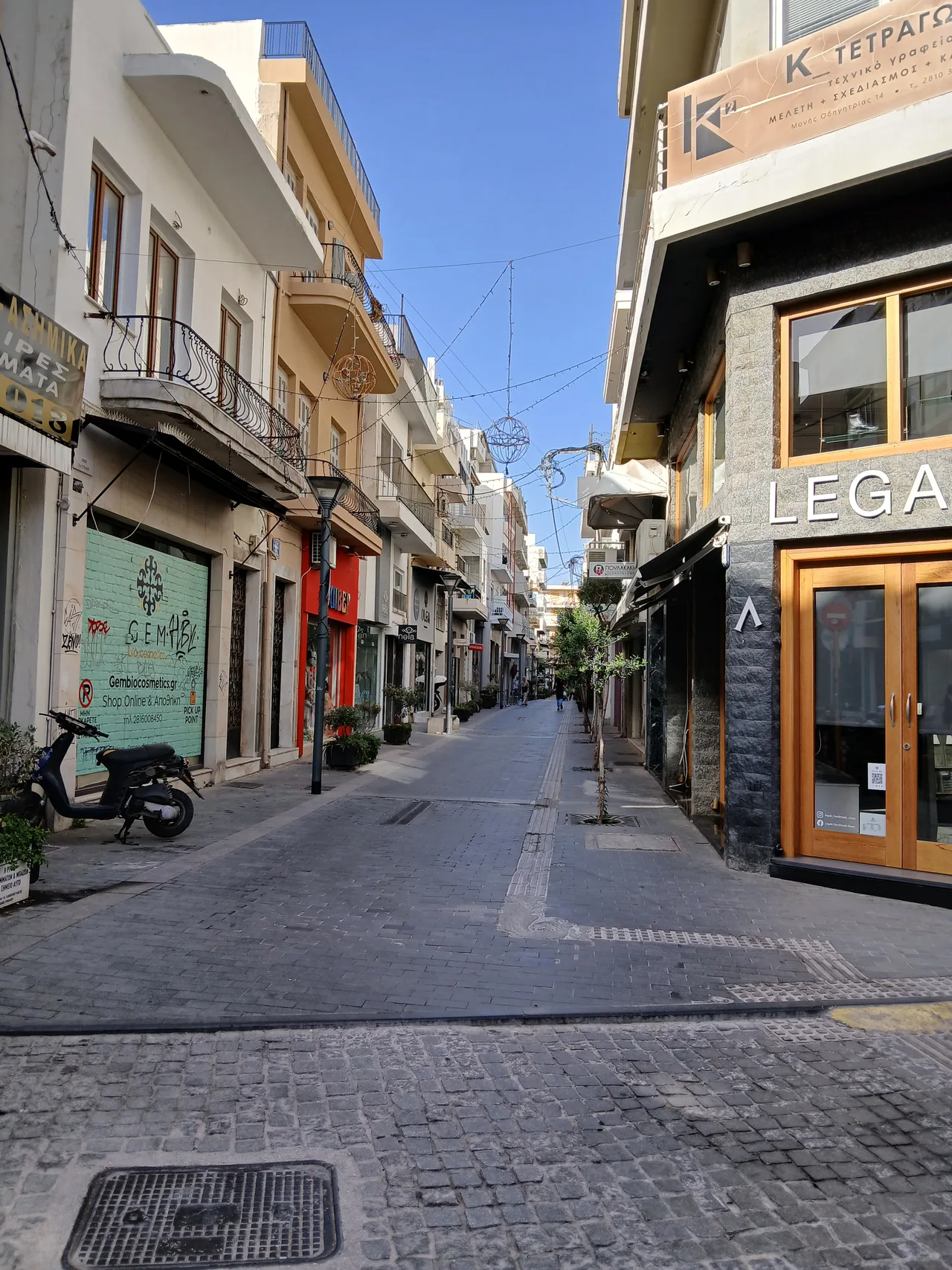
From the port, 25th Avgoustou is the spine of the old town. It is a broad pedestrian boulevard lined with souvenir shops, boutiques, jewellers and everyday stores, with historic buildings on both sides and tavernas and craft shops tucked into the side streets; the atmosphere rewards a slow walk rather than a transit.
The street's trade-off is straightforward: convenience and orientation against crowding. On cruise-ship days and in high summer the promenade can feel like a procession, whereas the parallel lanes behind it are calmer and hold much of the actual eating and drinking. Stepping one street off the axis is the single most useful habit here.
Partway up, the church of Agios Titos sits on an open square and is dedicated to the patron saint of the Cretan Church; the building has been a Byzantine church, a Venetian rebuild, an Ottoman mosque and again an Orthodox church, and it holds the skull relic of Titus. Its layered history is the point, more than any single architectural style.
A few steps south stands the Venetian Loggia, the ornate arcaded building that served as the meeting place of the city's nobles under Venetian rule and was later used as an arsenal. Restoration ran across much of the twentieth century and finished in 1979; the courtyard is open to walk into, and exhibitions and weddings are held inside.
Lions Square, the Morosini Fountain and Agios Markos
Lions Square, formally Platia Eleftheriou Venizelou, is the compact heart of the centre and the easiest place to reset a day. Its Morosini Fountain, built in 1628, has eight basins and lion heads that spout water, and the square is ringed by cafés and restaurants, which makes it a convenient pause rather than a destination in itself.
The trade-off at Lions Square is position against value. Tables facing the fountain pay for the view, while the same city sits a couple of streets away at calmer prices; use the square for coffee and orientation and move inland for a proper meal.
Facing the square is the Basilica of Agios Markos, a Venetian-style church from the thirteenth century that now functions as the city's art gallery, presenting Cretan history through its collection. It is a useful indoor stop when you want a break from walking without leaving the centre.
Odos 1866 and the Central Market
South of the fountain, Odos 1866 leads into the Kentriki Agora, the central market, and this is the part of the old town most often misread. It is a working food street, with fruit and vegetable sellers, fishmongers and butchers lined up alongside jewellers, boutiques and olive-wood craft shops; it is not a souvenir arcade with a few token stalls.
The specialist shops are the reason to come. The market holds a cheese shop, MITATO Masaouti Tirokomeio, and a herb shop, Phaskomilo, while coffee drinkers can look into Koudoumas, a traditional coffee roaster where beans are roasted on site. For a sweet stop, Lukumades me meli next door sells loukoumades, small yeast-dough balls served with honey.
At the southern end of the lane lies Platia Kornarou, where the Venetian-era Bembo Fountain and the Ottoman Sultan Cami pavilion stand; the pavilion has served at times as a kafeneion and remains a local meeting point. A kafeneion is a traditional Greek coffee house, the place for a slow coffee rather than a full meal.
Practical advice: come in the morning if you want to see the market working, and treat the produce and cheese counters as a shopping stop rather than a dining room. Anything you buy as a picnic will need to survive a day of walking.
The evening district around Agios Minas cathedral
The lanes around Agios Minas cathedral hold the highest concentration of places to eat and drink in the centre. The cathedral, completed in 1895, is the largest church on Crete and one of the biggest in Greece, and the streets around it fill after sunset with a mix of tavernas, modern bars, cafés and old kafenia.
Rather than chase a list, choose by type of evening. For a traditional taverna meal, the sources point to Apiri and Kayiabee; Apiri is described as a modern mezedopoleio in the Agiou Mina district, with tables along the alleys, and a mezedopoleio is a small-plates house where you order several dishes to share.
For a drink rather than dinner, Speira is a café option in the same quarter, and Old Cafe answers the mood for a rustic kafeneion. The three formats behave differently: tavernas are for a seated meal, bars for a late drink, kafenia for a cheap coffee and a long conversation; pick one rather than trying to do all three in a night.
If you specifically want the waterfront for dinner instead, the harbour has its own cluster of restaurants above the quay. Compare that option in the Heraklion Harbour District guide before committing, since the walk back uphill at night is part of the decision.
The Venetian walls and bastions
The city wall is the old town's largest surviving structure and its most uneven experience. Under Venetian rule the defences were reinforced with bastions strong enough to withstand the long Ottoman siege, and stretches on the western and southern sides still stand, with gates dividing the historic centre from the newer city.
Go with realistic expectations. The walls have been neglected in recent years, litter is sometimes present, and some entrances have been closed with iron bars; the Dermata Gate survives as a ruin among modern buildings rather than as a restored monument. This is a walk for atmosphere and views, not a curated heritage trail.
If a gate you planned to use is shut, treat the wall as optional rather than forcing a detour; the accessible sections still give a view over the modern promenade and back across the city. Sturdy shoes help, since the surface is uneven.
Where to stay in the old town
Hotels inside the historic centre range from large, practical city hotels to small suites, and the main decision is noise versus convenience. Properties listed in and around the centre include the Aquila Atlantis Hotel, the Olive Green Hotel, the Lato Boutique Hotel, the GDM Megaron Historical Monument Hotel, the Capsis Astoria Heraklion Hotel and the Marin Hotel, among many others.
Matching a hotel to a street matters more here than star ratings. A room on or just off 25th Avgoustou puts the harbour, the market and the evening quarter within walking distance but exposes you to promenade noise, while a property on a side lane buys quiet at the cost of a few minutes' walk.
Book on the hotel's own published rates rather than a packaged flight-and-hotel figure, and confirm the exact address against a map before you commit. Quieter, more residential alternatives further out are covered in our Nea Alikarnassos, Heraklion guide if the centre's bustle is not what you want at night.
Eating in the old town
Eating well here is mostly a matter of choosing your street. Tables on the promenade and around Lions Square sell position, including Coco Cafe 89 and Phyllosophies near the fountain, while the back lanes around Agios Minas and Agiou Mina sell food to people who live nearby; the second group is generally the better bet for a main meal.
For Cretan specialties, the market street is your reference point. Look for the cheese shop MITATO Masaouti Tirokomeio for local cheeses and Phaskomilo for herbs, and use what you see there to decode menus: Cretan cheeses, wild greens and herb-heavy stews are the region's staples.
Timing matters more than any list. The evening quarter fills after sunset and empties only in the early hours, so an early dinner gets you a table without a wait, while a late one gets the atmosphere; tavernas, bars and kafenia each peak at different times.
For a broader city-wide picture of where to eat, including areas beyond the historic core, use the Heraklion Neighborhoods: 4 Area Guides overview rather than trying to stretch one district across a whole trip.
Two half-day plans: harbour-first or market-first
Harbour-first works best in hot weather and on days with cruise traffic. Start at the Venetian port early, walk the pier and the Koules walls before the groups arrive, then climb 25th Avgoustou through Agios Titos and the Loggia to Lions Square, and retreat to the Archaeological Museum during the hottest hours; the museum sits east of the old town and holds the country's principal Minoan collection.
Market-first suits shoppers and anyone who wants to eat before walking. Begin at the Kentriki Agora on Odos 1866 while the produce stalls are active, continue to Platia Kornarou and the Bembo Fountain, then work north to Lions Square and finish at the harbour in the late afternoon light.
Either way, plan the museum as a separate block of several hours if you care about the collection; it is the one sight in the area that cannot be absorbed in a stroll. Combine it with the palace site only if you have a full day, and see our guide to things to do in Heraklion for how Knossos Palace fits into a longer stay.
If you have a spare half-day for a different kind of old quarter, Thessaloniki Old Town (Ano Poli) offers a contrasting, more intact hillside maze, useful for calibrating what Heraklion's centre does and does not preserve.
Practical points: parking and crowds
Driving into the centre is best avoided, but if you arrive by car there is parking at the port, with P1 and P2 areas near the waterfront, and a paid garage near the Natural History Museum called Heraklion Center Parking. Park once and walk; the historic core is compact enough that moving the car between sights wastes time.
Crowds follow the ships. The promenade is at its heaviest in summer and on days when cruise ships are in port, so check the harbour for ship movements or simply start early and use the side streets when the main axis becomes a crush.
For anyone arriving by sea, the walk from the ferry quay into the historic centre is short and signposted by the waterfront itself, and Eleftherias Square, Heraklion sits on that approach as a useful landmark to orient by.
What the old town does not give you
It will not give you an unbroken medieval streetscape. Much of what stands between the monuments is modern, and the pleasure here comes from fragments, food and city life rather than from architectural completeness; travellers who want that should reset expectations before arriving.
It also will not give you a beach or much calm. For sea swimming, a resort base or a quieter street to sleep on, look outside the core and treat the old town as a day's excursion instead of a base.
Finally, it does not hand you a neat restaurant list. Independent travellers do best by walking the lanes around Agios Minas and the Agiou Mina district in the late afternoon, reading menus at the door and choosing by format rather than by reputation.
Plan Your Visit
Treat Heraklion Old Town as a compact, layered city centre rather than a storybook quarter: harbour and Koules at the bottom, the 25th Avgoustou spine through Agios Titos and the Loggia to Lions Square, the working market on Odos 1866, and the evening lanes around Agios Minas at the top. Sequence the walk by heat and ship traffic, and use the museum as a separate block.
Book accommodation by street rather than by star rating, verify fortress and museum hours and any wall closures locally before setting out, and keep your expectations of the Venetian walls realistic. The rest is walking, coffee and small plates, which is what the centre does best.
Frequently Asked Questions
What are some things to do in the old town of Heraklion?
Walk the Venetian port and the Koules fortress at the harbour entrance, follow 25th Avgoustou inland to the church of Agios Titos and the Venetian Loggia, and continue to Lions Square and the Morosini Fountain. South of the fountain, Odos 1866 leads into the central market, and the lanes around Agios Minas cathedral fill with tavernas and bars in the evening.
Is Heraklion Old Town worth visiting?
It is worth it if you want a dense, walkable historic core with a working harbour, Venetian and Ottoman fragments, a food market and plenty of places to eat. It is less rewarding if you expect a fully preserved old town, because much of the centre was rebuilt in concrete after war damage and earthquakes.
How long does it take to walk Heraklion Old Town?
The core from the harbour to Lions Square and the market is compact and walks in a single loop, so a half day covers the main streets and squares at an easy pace. Add several hours if you want to see the Archaeological Museum properly, since its Minoan collection is the largest in Greece.
Where do you eat in Heraklion Old Town?
The lanes around Agios Minas cathedral hold the highest concentration of places to eat and drink, with tavernas, modern bars and old kafenia. Named options in the sources include the tavernas Apiri and Kayiabee, the café Speira and Old Cafe. Tables on the promenade and around Lions Square cost more for the position than for the food.
Where should you stay in Heraklion Old Town?
Hotels in and around the centre include the Aquila Atlantis Hotel, the Olive Green Hotel, the Lato Boutique Hotel, the GDM Megaron Historical Monument Hotel, the Capsis Astoria Heraklion Hotel and the Marin Hotel. Choose a side street for quiet and the promenade for convenience, and check the hotel's own rates rather than packaged prices.
How do you get to Heraklion Old Town from the port?
From the ferry quay, walk along the waterfront towards the Venetian harbour and pick up 25th Avgoustou, the pedestrian boulevard that runs inland into the historic centre. The route is flat and marked by the harbour itself, with Eleftherias Square as a landmark on the approach.
Where can you park near Heraklion Old Town?
There are parking areas at the port, known as P1 and P2, close to the waterfront, and a paid garage near the Natural History Museum called Heraklion Center Parking. Rates are not published in a stable form, so check the signs or ask at the garage on arrival, and park once rather than moving the car between sights.
When is the Central Market in Heraklion busiest?
The market on Odos 1866 is a working food street, so it is busiest in the morning when produce, fish and meat counters are active, and on days when cruise ships are in port. Go early if you want to shop without crowds, and expect the whole centre to be heaviest in summer.