Nafplio History: Venetian, Ottoman and Modern Greek Layers
Nafplio's history runs from Venetian walls to the first capital of modern Greece. See which fortresses, squares and churches show each layer, and where they sit.
On this page
Few Greek towns let you read several centuries of history in a single morning's walk. In Nafplio the layers sit almost on top of each other: the old town crowds around Syntagma Square, the Acronafplia promontory juts south into the sea, Palamidi fortress sits on the cliff above, and the tower of Bourtzi occupies its own islet in the harbour. Because the distances are short, you can plan a route by historical period rather than by map grid, and the same approach works if you compare this with Corfu history, where Venetian, French and British layers stack up in a similar way.
This guide organises the town by layer — Venetian, Ottoman, then the years when Nafplio served as the first capital of the modern Greek state — and names the specific building where each one is still visible. It also flags the practical choices: driving to the fortress gate versus climbing, taking the lift up Acronafplia versus the stairs, and confirming whether Bourtzi can be visited at all. For the wider menu of sights beyond these stones, see the guide to things to do in Nafplio.
What Nafplio's History Actually Looks Like on the Ground
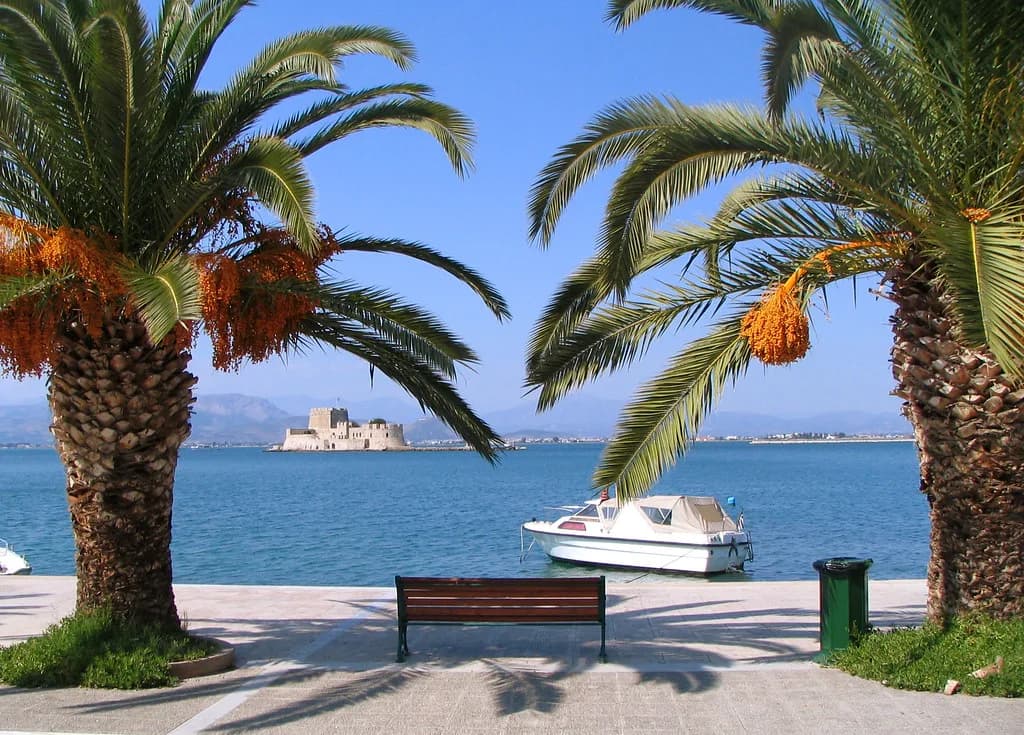
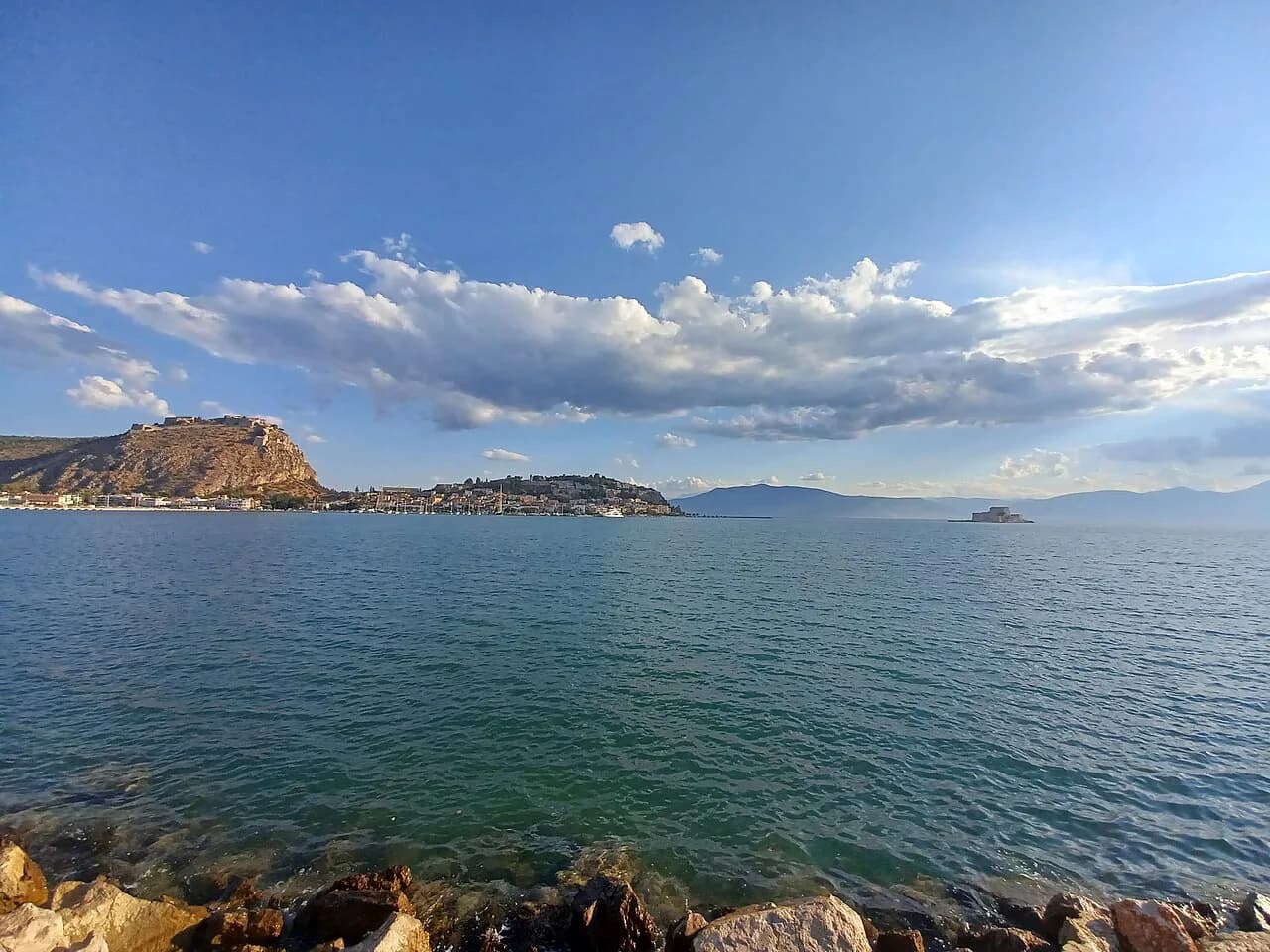
Start with the geography, because the defences explain the town. The old city wraps around the foot of Acronafplia, the finger-like promontory that stretches into the sea south of the harbour, while Palamidi commands the cliff above and Bourtzi sits on the islet of Agios Theodoros in the middle of the town harbour. Seen from the fortress, tiled roofs and stone buildings spread toward the peninsula with the Argolic Gulf beyond.
The defensive logic is a chain rather than a single wall. An iron chain once connected the Five Brothers fortification on the northwestern edge of Acronafplia to Bourtzi, creating what was called the Porto di Cadena, or chain harbour, so attackers could not bring ships into the town. Only one segment of the lower wall from 1502 survives at Five Brothers, where five Venetian cannons were later placed.
In practice, three anchor points organise any visit: Syntagma Square as the civic centre, Acronafplia as the elevated ridge behind it, and Palamidi as the long climb or short drive above everything. Grouping sights by these anchors saves walking, because the lanes between them rise and fall sharply.
The Venetian Layer: Gate, Bastions and a Chained Harbour
The clearest way to enter the Venetian period is literally to enter through it. The Porta dela Terraferma is described as the only entrance to Nafplio in Venetian times and is roughly 300 years old, so walking through it puts you inside the circuit the Venetians defended rather than looking at it from outside. From there, the route continues uphill to the fortifications.
On Acronafplia, the Venetians built the Castello di Toro around 1470 and later strengthened the gates, adding the giant Grimani bastion in 1706. The promontory is crowned with a series of castles — a Frankish one to the east and a Byzantine one to the west — which is why the ridge repays a slow walk rather than a photograph from below. The site is covered in the wider round-up of Nafplio attractions.
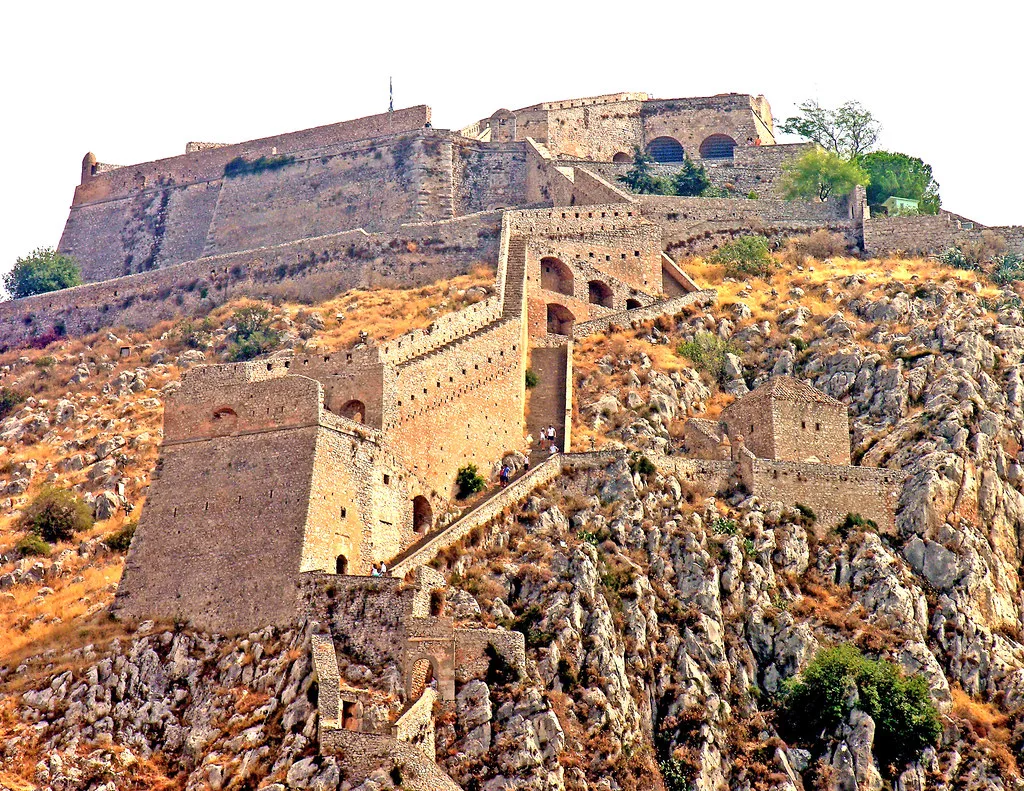
Palamidi is the great Venetian statement: built between 1711 and 1714 with eight self-contained bastions, each named after a Greek hero such as Achilles, Leonidas or Themistocles. The design assumed that if one bastion fell the others could still be held. That confidence did not survive contact with reality, since the fortress fell to Ottoman forces in 1715 after a siege reported as lasting only eight days.
Palamidi: The Fortress Above Town
Palamidi zigzags down a 200-metre cliff in a series of walls, stone bastions and flights of steps, and the approach is the main practical decision of the day. You can drive to the east gate, or take the stepped climb traditionally counted at 999 steps, with a story that the thousandth was smashed by Kolokotronis's horse. The drive saves legs; the steps give the sequence of walls and the widening view across the Argive plain and the Arcadian mountains. The fort is profiled among the Palamidi Fortress entries in the city's sightseeing guide.
The fortress has a second life beyond its construction. After Greek forces captured it in 1822 during the War of Independence, it was converted into a prison that held Kolokotronis and other revolutionary leaders on treason charges, so the same walls that were meant to keep invaders out were later used to keep Greeks in. Sensible shoes matter more than any ticket detail on the stepped route, since the descent is long and the stone is uneven.
Ticket prices, telephone numbers and closing days change, and the figures reported for Palamidi and the Archaeological Museum when travel.gr published its Nafplio guide may no longer match what you pay at the gate. Confirm opening days and admission on the official culture ministry channels before setting out, especially outside the main season.
Bourtzi: The Tower on the Islet
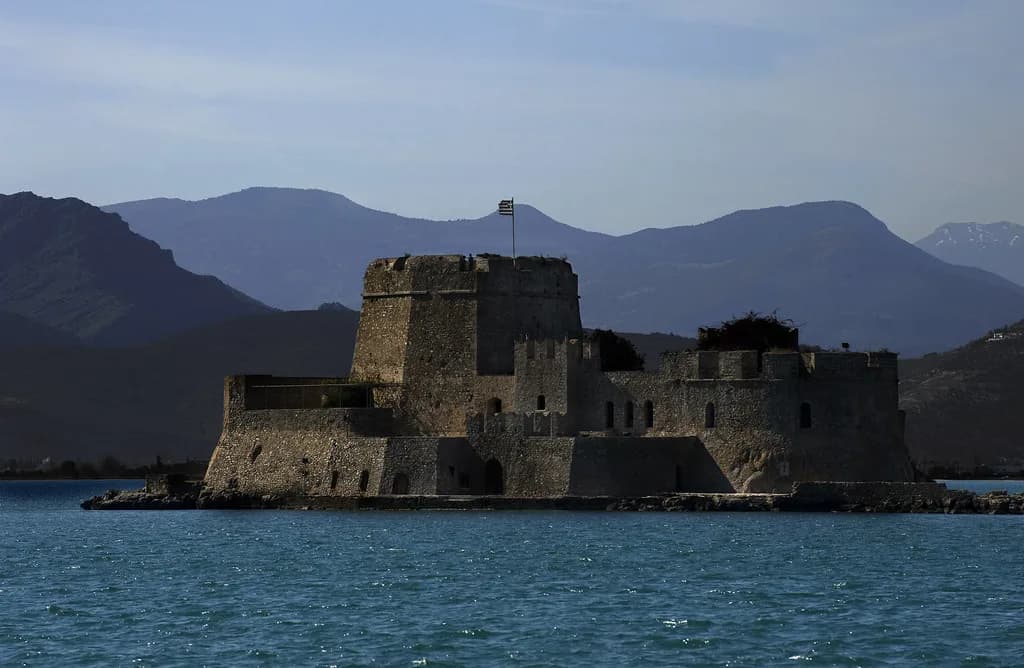
Bourtzi began in 1471 as a single tower built by Antonio Gambello of Bergamo, and the Venetians enlarged it with a second tower and bastion after recapturing Nafplio in 1686. Originally called the Castello dello Soglio, castle of the throne, it took the name that stuck from the Turkish word for tower. Its later uses were grimly varied: a prison for Kolokotronis, then housing for the town executioners after 1865, and in recent years a hotel.
Access is by excursion boat, with the passage from town reported as taking about ten minutes, and in summer the islet has hosted a festival of music and cultural events. The source that records this also reports the fort as undergoing renovation at the time of writing, which means boat access should be treated as unconfirmed rather than assumed. Anyone planning the trip should check locally in the harbour before building a day around it.
The Ottoman Layer in Buildings Still in Use
The Ottoman period is easiest to see in buildings that were converted rather than abandoned. On the southwest corner of Syntagma Square, the Old Mosque has served as a school, a courthouse, municipal offices and a cinema, known locally as Trianon, and now houses the Municipal Theatre. It is described as one of the oldest surviving examples of Ottoman architecture in the city, which makes a functional stop rather than a monument behind glass.
Nearby, the Vouleftiko on the southwest side of Syntagma Square is a former mosque built of dressed grey stone in 1730, with a square chamber and a large domed roof. Its importance is political: the Greek National Assembly held its first meetings there in 1825. Legend adds that a lintel stone from the Tomb of Agamemnon at Mycenae was used in the construction, though this is storytelling rather than verified fact.
The building's afterlife mirrors the town's: it has been a school and a prison, and it held the trial of Kolokotronis and Plapoutas when they opposed King Otto's rule. Today it functions as a conference centre with the Municipal Gallery of Nafplio on the ground floor, so a visit is often as much about the gallery as the architecture. The churches and civic buildings around Syntagma Square are gathered in the guide to Nafplio churches.
The Catholic Church of the Metamorphosis tou Sotiros, known as the Frankoklisia, shows another conversion: a 13th-century church turned mosque under Ottoman rule and later gifted by King Otto to Nafplio's Catholics. Its wooden portico is inscribed with the names of philhellenes who died in the War of Independence, tying the building to the transition out of Ottoman control.
First Capital of Modern Greece
Nafplio's role as the first capital of the modern Greek state is the layer most visitors come looking for. One source dates that period to 1829–1834, but the exact framing varies between accounts, so treat the dates as reported rather than settled and look to the buildings themselves for the story. The Vouleftiko, as the seat of the first National Assembly meetings, is the concrete place where the claim becomes visible.
The square itself tells the same story through its mix. Ottoman, Venetian and neoclassical buildings stand around Syntagma Square, including the first parliament, which is why a slow circuit of the square is worth more than a single stop. This is also the natural place to begin or end a walk through the old town, with cafés for a pause between sites.
The sharpest single moment of that era is at Agios Spyridon Church, a single-aisle basilica with a dome built in 1702. On 27 September 1831, Ioannis Kapodistrias, the first head of the newly independent state, was assassinated in its doorway by the Mavromichalis brothers from the Mani in a long-running vendetta. A glass display case next to the portal shows where the fatal bullet lodged in the church wall.
Acronafplia: Two Ways Up the Ridge
Acronafplia rewards the climb twice over, because the way up is itself a choice. You can take the elevator next to the Nafplia Palace Hotel, or climb the flight of stairs from Potamianou Street that ascends from Agios Spyridon Square. The lift is the easier option for anyone short on time; the stairs put you inside the lanes of the old town and arrive with the ridge already in view.
At the top, the views work in two directions: the old city with terracotta roofs, church bell towers and Bourtzi in the harbour on one side, and prickly pears, sheer rock and the deep blue of the Argolic Gulf on the other. The castles are layered along the ridge, so a walk between them covers Frankish, Byzantine and Venetian work in a single stretch. Allow more time than the map suggests, since the paths climb and the surfaces vary.
Psaromachalas: The Fisherman's Quarter
Psaromachalas is a small district of narrow lanes above Staikopolous Street at the northwestern foot of Acronafplia, and the name means fishmonger. It was already a settlement at the end of the 13th century, inhabited by merchants and fishermen who moored boats below the cliffs of Five Brothers. During the Ottoman occupation it was the only neighbourhood inside the walls to remain Greek, and Agia Sophia was the sole church allowed to hold Orthodox services.
Today the quarter is a cluster of small houses painted in salmon pinks, deep reds, dusty yellows and dark greens, with architecturally diverse buildings, many converted into pensions. Treat it as a residential area to walk quietly rather than a sight with a ticket, which is exactly what makes it a good place to stay or to end a day of sightseeing.
Churches Beyond the Square
The Church of Panagia sits between two cafés behind the Archaeological Museum and is among the oldest and best-loved churches in Nafplio. An older 15th-century church was rebuilt in a post-Byzantine three-aisle style, and it has an elaborate carved wooden reredos worth a look even on a short visit. It is associated with St Anastasios, the city's patron, killed on 1 February 1655, and his icon is carried through the streets on the same date each year.
An ancient olive tree next to the church is said to be where the saint was hanged, and legend holds that it has never borne fruit since. Whether or not you credit the story, the church and the tree make a compact stop that ties the religious calendar to a specific street corner, and the timing of the February procession is worth checking locally if you plan to be in town.
Museums: The Archaeological Collection on Syntagma Square
The Nafplion Archaeological Museum occupies a red stone building on Syntagma Square with an inlaid marble inscription recording that it was built in 1713 by Augustine Sagredo, prefect of the fleet, as a naval warehouse during the second Venetian occupation. The building itself is therefore an exhibit, moving from Venetian storehouse to museum without leaving the square.
The collection draws on nearby sites including Mycenae, Tiryns, Asine and Dendra, and the finds from the Mycenaean tombs are the highlight, with a remarkable bronze suit of armour from the 15th century BC on display. Seeing those objects before or after visiting the fortresses helps connect the defensive story to the wider Argolid, and the museum makes a sensible rainy-hour or midday stop.
Walks That Tie the Layers Together
The Arvanitia Promenade is a kilometre-long seaside walk skirting the Nafplio peninsula, paved with flagstones and offering views of the three fortresses at once: Acronafplia, Bourtzi and Palamidi. It leads to Arvanitia beach, a popular swimming spot, and passes under carved arches with steps down to the sea along the way. Walking it after the fortresses makes the defensive geography click, since you see the town from the water side.
Beyond Arvanitia, the path continues for roughly another four kilometres to the sands of Karathona beach, passing stretches of rocky shoreline. That extension is the better choice for anyone wanting a swim and a longer walk, while the first kilometre alone suits a short evening circuit. Wear shoes that handle flagstone and rough rock rather than smooth soles.
Practical Notes for a History-Focused Day
Distances inside the old town are small enough to walk everything on this list in a day or two, but the vertical gain is real: Palamidi sits 200 metres above town and the lanes up Acronafplia are steep. Sensible footwear, water and a plan that groups Syntagma Square with the museum and churches before tackling the fortress make more sense than crisscrossing the town.
Opening days, prices and phone numbers published for Palamidi and the museum are the details most likely to have changed since they were reported, so check them directly before you go. Bourtzi's renovation status and boat access are the other item to confirm on arrival, since they determine whether the harbour stop is a visit or a view. This is the second and last of those checks; everything else here can be planned in advance.
Plan Your Visit
Nafplio's history is manageable because it fits on foot: the Venetian gate and harbour chain, Ottoman mosques recycled as parliament and theatre, the assembly rooms of the first capital, and the churches where that era turned violent. Choose two anchors per half-day — the square with its museum, then Acronafplia or Palamidi — and leave the evenings for the promenade and the harbour.
Food fits naturally at the end of a walking day, and the old town's tavernas cluster around the lanes below Acronafplia. For where to eat, start with the guide to the best restaurants in Nafplio and pick by area rather than by reputation, since the difference between a harbour table and a back-street one is mostly about what you want to look at while you eat.
Explore more Nafplio sauna guides
Frequently Asked Questions
Where was the first capital of Greece?
Nafplio served as the capital of the modern Greek state before Athens, and one source places that period between 1829 and 1834. The date range is reported rather than settled, but the buildings make the role concrete: the Vouleftiko on Syntagma Square hosted the first meetings of the National Assembly in 1825, and other Ottoman, Venetian and neoclassical buildings around the square mark the same era.
Why did Nafplio become the first capital of modern Greece?
Its position on the Argolic Gulf and its defensible layout made it a practical seat of government during and after the War of Independence. The city already had a walled core, a harbour protected by Bourtzi and a chain across the entrance, and usable buildings around Syntagma Square, including a former mosque that could host an assembly. Those same advantages had attracted invaders for centuries.
Who built Palamidi fortress and when?
The Venetians built Palamidi between 1711 and 1714, laying out eight self-contained bastions named after Greek heroes such as Achilles, Leonidas and Themistocles. The name Palamidi is traditionally connected with the hero Palamedes, and the fortress dominates the town from a 200-metre cliff. It fell to Ottoman forces in 1715 after a siege reported as lasting only eight days.
Is Bourtzi open to visitors?
Access to Bourtzi is by excursion boat from the harbour, with the passage reported as taking about ten minutes. The same account states that the fort has been undergoing renovation, so boat schedules and whether the islet is open at all should be checked locally rather than assumed. In summer the islet has hosted music and cultural events when access is possible.
How do you get up to Palamidi?
You can drive to the east gate of the fortress or take the stepped climb up the cliff, traditionally counted at 999 steps, with a story that the thousandth was smashed by Kolokotronis's horse. The drive saves effort; the steps give the sequence of walls and the view across the Argive plain. Either way, the climb is exposed and the stone is uneven, so wear suitable shoes.
What is left of Nafplio's Ottoman period?
Several Ottoman-era buildings survive in new uses. The Old Mosque on the southwest corner of Syntagma Square, known locally as Trianon, has been a school, courthouse and cinema and now houses the Municipal Theatre. The Vouleftiko, a former mosque built in 1730, hosted the first National Assembly meetings in 1825 and is now a conference centre with the Municipal Gallery on the ground floor.
Where was Kapodistrias assassinated?
Ioannis Kapodistrias, the first head of the newly independent Greek state, was killed on 27 September 1831 in the doorway of Agios Spyridon Church. The church, a domed single-aisle basilica built in 1702, still shows where the fatal bullet lodged in the wall, marked with a glass display case next to the portal.
Is Nafplio a good place to stay for history?
Yes, because the historic core is compact and walkable. Staying in or near the old town puts Syntagma Square, the archaeological museum, the churches and the foot of Acronafplia within a short walk, and Psaromachalas, the old fisherman's quarter, has many buildings converted into pensions. The trade-off is climbing: streets are steep and Palamidi sits 200 metres above town.
Sources
Notes for eating well in Greece
Optional updates to our guides.
You might also like
Continue reading
More guides you'll find useful