
Paraportiani Church in Mykonos Town: How to Visit the Kastro Landmark
Paraportiani Church is the white form on every Mykonos postcard, and most visitors photograph it without realising they are looking at five churches, not one. The complex stands at the western edge of Chora, the island's main town, in the Kastro quarter beside the old castle's northwestern gate.
This guide covers the one place: where it is, how to approach it, what you are actually counting as you walk around, how long to allow, and which nearby sights and tavernas fit naturally around it. Mykonos rewards slow walking here, because the lanes of Chora are the point as much as the building.
Quick Orientation: A Complex of Five Chapels, Not One Church
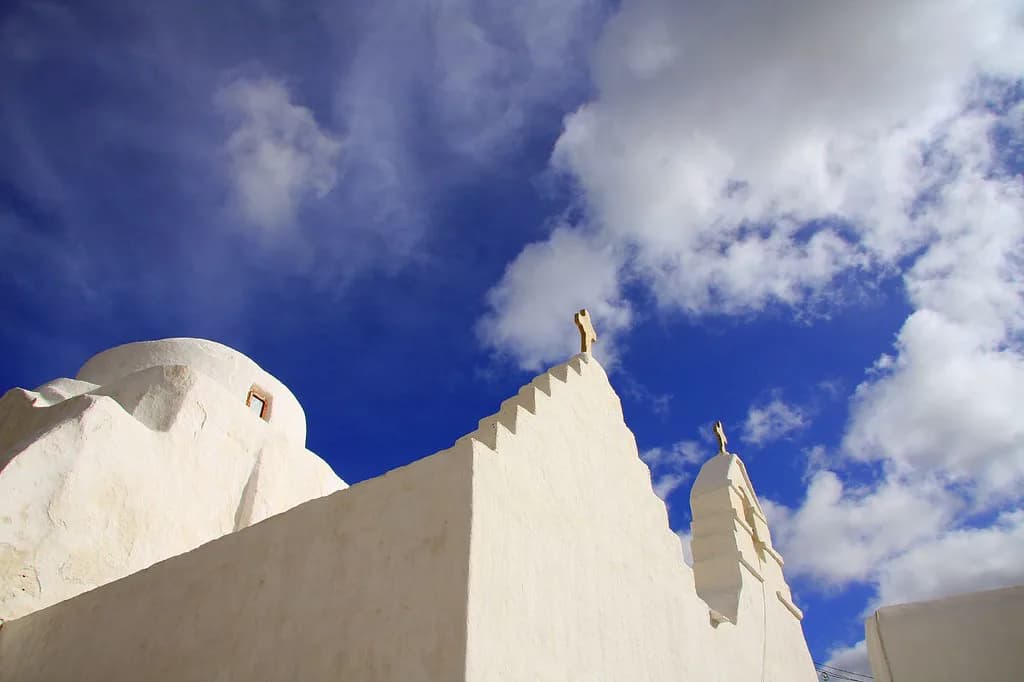
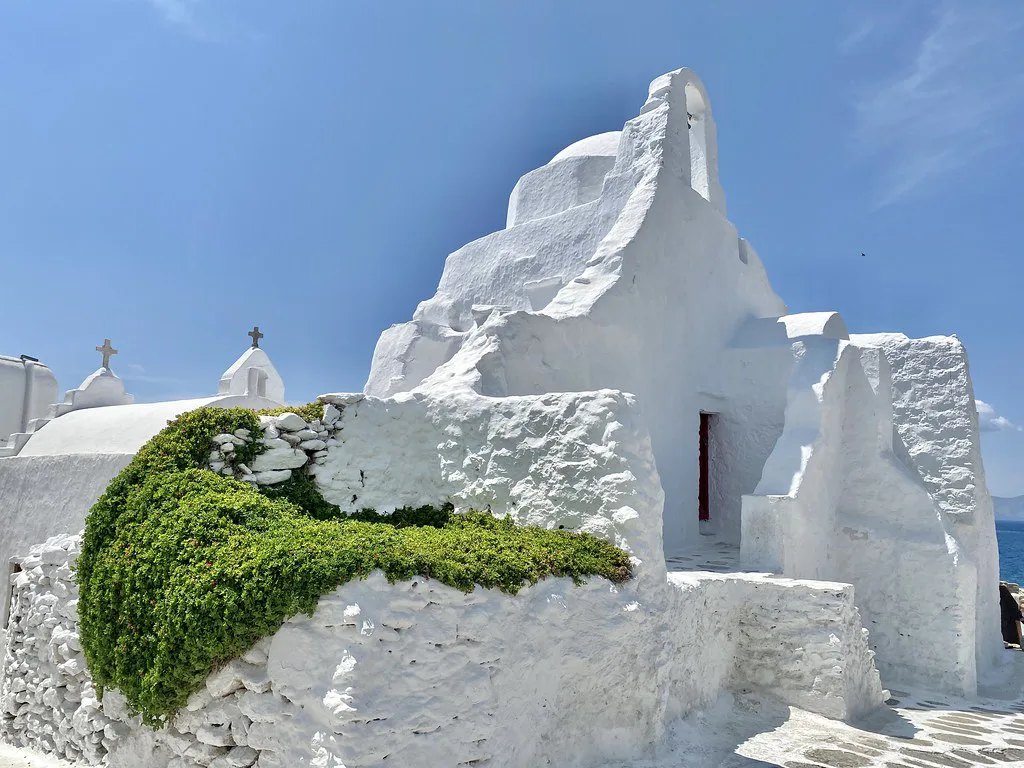
The name covers a composition of five chapels arranged over two levels. Four sit at ground level: Agios Efstathios at the centre, with Agia Anastasia, Agios Sozon and Agioi Anargyroi around it. Above them rises the fifth, Panagia Paraportiani, the chapel that gives the whole complex its name.
Knowing this changes the visit. Instead of looking for a single facade, you circle the building and try to separate four rooflines and a dome that have been smoothed into one continuous white mass. One travel source notes the complex took its present form between the 16th and 17th centuries, which is why the volumes feel grown rather than designed.
Where Exactly It Is: The Kastro Quarter and the Paraporti Gate
Paraportiani sits in the Kastro, the oldest quarter of Chora, next to the small northwestern gate of the medieval castle. That gate was the Paraporti, meaning the side door, and it once marked the exit from the fortified settlement toward the rocky coast. The church's name comes straight from that position.
Practically, you are aiming for the seaward western edge of town rather than the central shopping lanes. If you are navigating by landmark, head downhill and seaward from the busier alleys until the lanes open toward the water; the white mass with the rounded dome sits against the horizon. Pick up a paper town map or use offline maps, because the lanes bend and dead-end regularly.
How to Get There on Foot and From the Port
From the heart of Chora, the church is a short walk on foot, and the whole Kastro area is best explored without a vehicle. Allow extra time for wrong turns in the whitewashed lanes, and wear shoes with grip, since the paving is polished and uneven in places.
Travellers arriving at the port at Tourlos, where ferries dock, can reach Chora by local bus or by SeaBus, the small shuttle boat linking the new port with the town waterfront. Both are short hops; check the current timetables at the port or your accommodation, since seasonal schedules shift.
What You Are Looking At: Chapels, Dome and Cycladic Influences
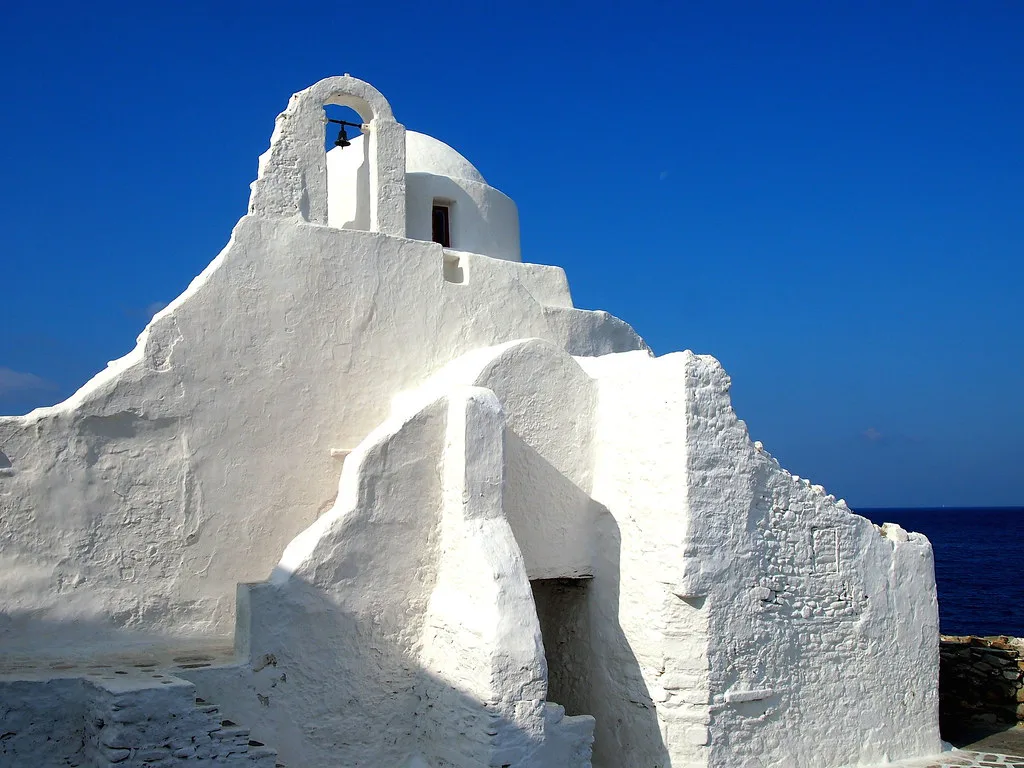
Start with the roofscape: the dome merges almost invisibly into the roofline, with no ornament to interrupt the curve. The walls are smooth white, the edges soft and irregular, and each section steps slightly away from its neighbour. Walk a full circuit to see how the height changes at each corner.
The building is usually described as a blend of Byzantine, traditional Cycladic and Western influences, assembled gradually rather than from a single plan. That layered history is the reason it looks unlike other churches in the Cyclades, and it is the detail worth explaining to anyone you are travelling with.
Access Expectations: Plan an Exterior Visit
The interior is rarely open to visitors, so plan this as an exterior walk-around rather than an inside tour. That is not a disappointment if you set expectations before you go: the architecture, the sea backdrop and the lanes around it are the experience.
Because it remains a functioning religious site, visiting is about the exterior, which can be viewed without a ticket. If you want to know whether anything special is scheduled, ask locally or contact the Municipality of Mykonos or the local parish before travelling; published tour listings should not be read as guaranteed interior access.
How Long to Allow, and When It Gets Busy
Fifteen to twenty minutes covers a slow circuit and a few photographs; most people stay longer because the lanes around it invite wandering. Build the church into a half-day walk through Chora rather than treating it as a standalone outing.
The courtyard fills in high summer, and one source reports crowds gathering around the July feast of Agii Anargyri. Treat that date as reported rather than fixed and confirm the current year's arrangements locally, since feast-day timings are set by the parish.
Photography Notes: Morning Versus Late Afternoon
The building reads best when light rakes across the curves rather than sitting overhead, so early morning and the hours before sunset give the most shape to the dome and roofline. Midday flattens the surface and brings the hardest shadows on the lanes around it.
For the sea in the frame, position yourself on the seaward side and let the water fill the background behind the white walls. Expect company at sunset, when the same idea occurs to everyone else in town; mornings are quieter for a clean shot.
Practical Cautions at an Active Religious Site
This is a working church, so dress with shoulders and knees covered and keep voices low near the chapels. Step aside for worshippers and anyone lighting a candle, and do not climb on the low walls or sit on the steps as if they were a bench.
Nearby: Little Venice, the Windmills and Delos Boats
Little Venice, where houses stand directly above the water, is a short stroll from the Kastro lanes and makes a natural continuation of the walk. The Mykonos Windmills (Kato Mili) on the ridge above town are also within easy walking distance, so the three sights fit into one loop without transport.
From the harbour, boats run to the Delos archaeological site, one of the most important excavations in Greece and an easy add-on for a second day rather than the same afternoon. If smaller collections appeal, the Archaeological Museum of Mykonos and the Aegean Maritime Museum in Mykonos are both in or near town.
Where to Check Opening, Restrictions and Feast-Day Arrangements
If you are travelling specifically for a religious date, such as the July feast of Agii Anargyri, confirm the current year's arrangements directly with the parish or your accommodation before booking ferries, since feast-day timings are set locally.
Beyond the immediate lanes, the wider areas of Mykonos are worth mapping before you arrive, since where you stay shapes how easily you reach Chora on foot or by bus. For a fuller picture of the island's sights, see things to do in Mykonos and the area guides.
Eating Nearby: Harbour Tables Versus Back-Street Tavernas
Mykonos Town splits roughly into waterfront tables with a view and inland tavernas with better value. Harbour-front seats buy you the sunset and the people-watching; back-street places trade the view for quieter rooms and more generous plates. Decide before you set out which you want, because walk-in demand at the water's edge is high in summer.
Whichever you choose, order a few Greek standards to share: horiatiki, the village salad of tomato, cucumber, onion, olives and feta with no lettuce; tzatziki, yoghurt with cucumber, garlic and olive oil; and grilled octopus or a whole fish priced by weight, which you should confirm before ordering. Prices vary widely by location, so check the menu board at the door for current prices and dates.
Fitting Paraportiani Into a Chora Walk
The best approach is to thread the church into a walk rather than making it a destination trip. Start in the commercial lanes, drift downhill toward the Kastro, circle Paraportiani, then continue along the water to Little Venice and up to the windmills for the view back over town.
If you have time for one excursion beyond Chora, the Panagia Tourliani Monastery in Ano Mera, Mykonos offers a very different, inland religious setting. Otherwise keep the day local: the pleasure of this corner of town is repetition, passing the same white corner twice and seeing it differently in new light.
Plan Your Visit
Paraportiani rewards a visitor who arrives knowing it is five chapels, not one, and who plans to walk around the outside rather than wait for a door to open. Give it twenty minutes and the surrounding lanes an hour more, ideally early or late in the day for the light.
Confirm any feast-day or access questions locally before you travel, and settle your meal plan between harbour view and back street before the evening rush. Done that way, the church becomes the anchor of a good day in Chora rather than a quick photo stop.
Explore more Mykonos sauna guides
Frequently Asked Questions
What is Paraportiani Church and why does it look like that?
It is a complex of five chapels in Mykonos Town: four at ground level, including Agios Efstathios at the centre, with Panagia Paraportiani above them. The chapels were added gradually, which is why the building reads as one soft white mass rather than a single symmetrical church.
Where in Mykonos is Paraportiani Church?
It stands in the Kastro quarter at the western edge of Chora, beside the old castle's northwestern gate, the Paraporti or side door. That seaward position is how it got its name.
Can you go inside Paraportiani Church?
The interior is rarely open to visitors, so plan on an exterior visit. Walk a full circuit to see the chapels and the dome, and ask locally if you want to know whether anything special is scheduled.
How long do you need at Paraportiani Church?
Fifteen to twenty minutes covers a slow walk around the building and a few photographs. Most visitors stay longer because the surrounding lanes of the Kastro are worth exploring on foot.
What is the best time of day to see Paraportiani Church?
Early morning and late afternoon give the most shape to the whitewashed curves, while midday light flattens them. Sunset brings the biggest crowds, so mornings are better for a quiet look.
What is within walking distance of Paraportiani Church?
Little Venice and the Mykonos windmills on the ridge above town are both a short stroll away, so the three fit into one walk through Chora without transport.
Is Paraportiani Church free to visit?
No entry fee is published for viewing the exterior, but do not rely on any figure you have not confirmed. Check locally for current arrangements, and treat tour listings as separate from church access.