
Profitis Ilias Monastery, Santorini: How to Visit the Hilltop Monastery Above Pyrgos

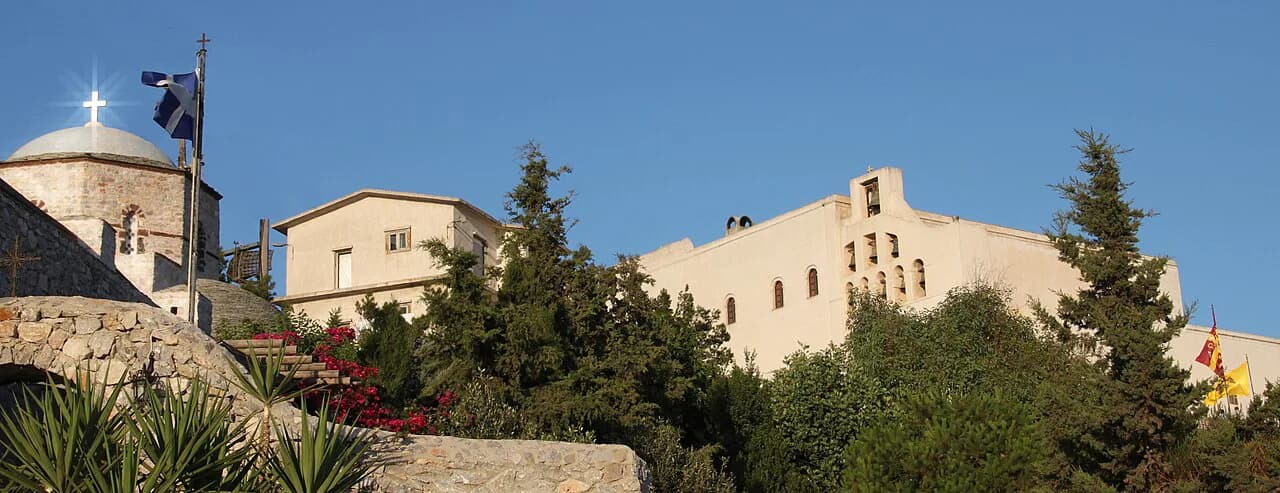
Profitis Ilias Monastery, known in Greek as Moni Profitou Iliou, is a Greek Orthodox monastery on the summit of Mount Profitis Ilias, the high point above the village of Pyrgos Kallistis in the middle of Santorini. The monastery's own account places it at 567 m and about 3 km from Pyrgos. That combination of height and short distance is what makes it a different stop from the caldera villages: you go up for the building and the view rather than for a cliffside square.
This page sticks to that one place: where it is, how people reach it, what the monastery says is inside, and how much time the trip takes. It is a modest visit rather than a full day out, and it works best as an anchor for a few hours spent in the island's interior. For the wider set of sights beyond this summit, see Santorini Attractions: 7 Visitor Guides.
Where Profitis Ilias Monastery Is
The monastery crowns the mountain of the same name, roughly 3 km from Pyrgos Kallistis, which is also called Pirgos of Thira and sits in the island's central highlands rather than on the caldera rim. The monastery source gives the summit elevation as 567 m, which is high enough that the summit feels cooler and windier than the coast. Its postal address is listed as Pyrgos Kallistis, Thira, Santorini.
Because it is close to Pyrgos but on top of a mountain, the approach is a short road climb rather than a village stroll. If you are staying in Oia or Fira, the drive crosses the middle of the island, so it makes sense to treat the monastery and Pyrgos as one outing rather than two separate trips. Pyrgos itself is the natural base for the visit, and if you are still weighing where to stay, the Santorini Neighborhoods guide compares the caldera villages with the inland ones.
The Monastery's History and What's Inside
According to the monastery's own published account, Profitis Ilias was founded in 1711 by two priest-monk brothers, Gavriil and Ioakim, who built it on family land. The same source says the community held between 10 and 20 monks up to around 1880, that its influence later declined, and that it now counts five monks. Treat these figures as the monastery's account rather than an independently audited record.
The source also lists the relics kept at the monastery, among them items associated with saints including Georgios, Dimitrios, Minas, Panteleimon and Marina, plus a portion of the Cross and the tiara of Patriarch Saint Grigorios the Fifth. The same page describes the miraculous icon of Profitis Ilias, the Prophet Elias, which it says is carried out at times of drought so that the saint will send rain to the island. If you are visiting for the relics or the icon, keep expectations realistic: this is a working monastery, not a museum with labels and display cases.
The monastery also describes a long record of educational and charitable work, including a Greek school, a school of Thira founded in 1831, and support for the poor and for earthquake victims. That context explains why the building matters to islanders beyond its role as a viewpoint.
How to Get to the Summit
The practical route is by road from Pyrgos Kallistis, following the signed climb toward the summit. The monastery publishes the distance from Pyrgos as about 3 km but gives no information on bus services, timetables, taxi fares or the condition of the summit road, so check those with your accommodation or a local travel agency and plan around a car, a taxi arranged in advance, or an organised tour, as public transport is not described as running to the gate. Drivers should expect a narrow, winding final stretch typical of island hill roads.
Travellers without their own vehicle should ask their accommodation or a local taxi operator in Pyrgos or Fira to confirm that the summit road is being driven and what a return trip costs before committing. Independent tour descriptions of the Prophet Elias stop exist, but they vary in what they include, so read the itinerary of any tour carefully rather than relying on the name alone.
Once on the mountain, the visit and the viewpoint share the same small area, so there is no separate trail or second car park to factor in. The main planning decision is simply whether you drive yourself for flexibility or join a tour that handles the road for you, the same trade-off to weigh when you compare the islands' sights in this guide to things to do in santorini.
Outside on the Summit
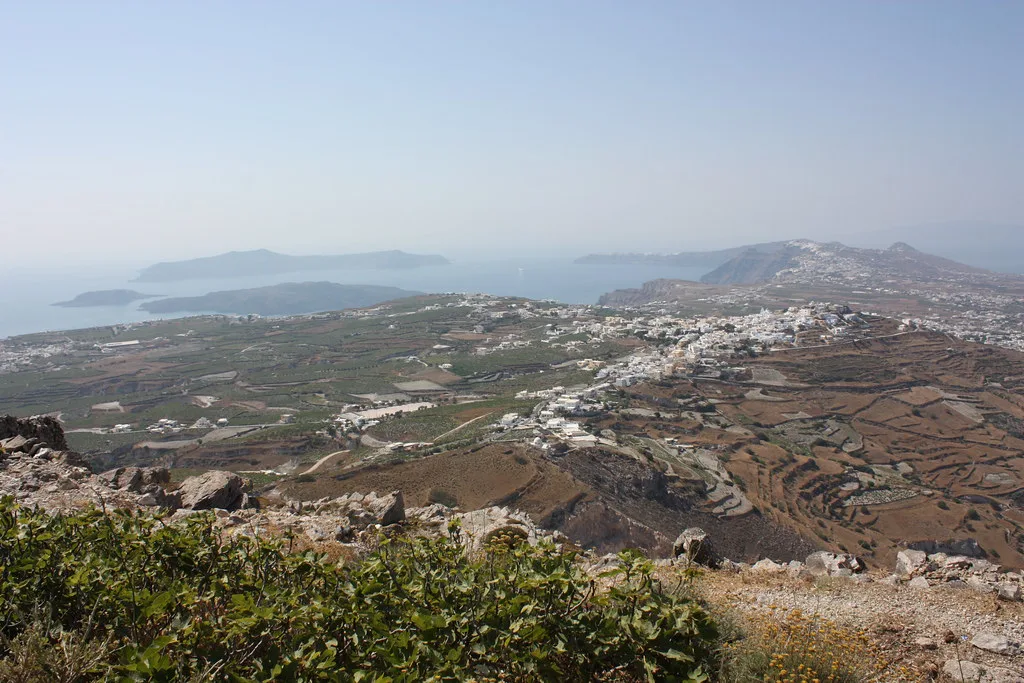
The mountain is the island's high point, and the monastery source notes the sweeping view over Santorini from the top. That elevation is the reason to linger outside after seeing the buildings: you get an inland panorama rather than the caldera-facing view that defines Oia and Fira, and the two are not substitutes for one another. For the caldera side of the island in more detail, compare these things to do in santorini with your summit plans, and use the Santorini Neighborhoods guide to decide which caldera village suits your base.
Exposure is the trade-off. At 567 m the summit catches wind and sun with little shelter, so a light layer and water are sensible even when the coast feels still and mild. The courtyard area is small, so a visit during a busy stretch of the day will feel crowded in a way the open mountain does not.
How Much Time to Allow
The monastery itself is a compact stop, and most visitors will spend well under an hour inside and around the buildings. Add the drive up and back down from Pyrgos, which is short but slow on the winding road, and the summit easily fits into a half-day combined with the village below.
The better plan is to give the morning or afternoon to the pair: Pyrgos first for its lanes and views, then the monastery, or the reverse to catch cooler air early. If you are building a longer day, the Akrotiri Archaeological Site in the south of the island is a substantial indoor-and-outdoor visit and a natural second stop, though it deserves its own time slot rather than being squeezed in.
Opening Hours, Entry and Access
No opening hours, entry fee or closure days are confirmed in the available sources, so do not build a day around an assumed schedule. The monastery's own listing gives a telephone number, 2286031210, which is the direct way to confirm whether it is receiving visitors and whether any parts of the complex are off-limits on your dates.
Dress and behaviour matter more than at a viewpoint. This is an active Orthodox monastery, so covered shoulders and knees are the safe default, and voices should stay low around the church and the relics. Confirm any photography restrictions on arrival.
The Historic Ban on Women
The monastery's account states that when it was built, women were barred from entering, and it records the community's history up to the present without saying that the rule still applies. Read this as history rather than as a description of current access. Before travelling, ask the monastery directly about who may enter and where visitors may go.
Nearby: Pyrgos Kallistis and the Island Interior
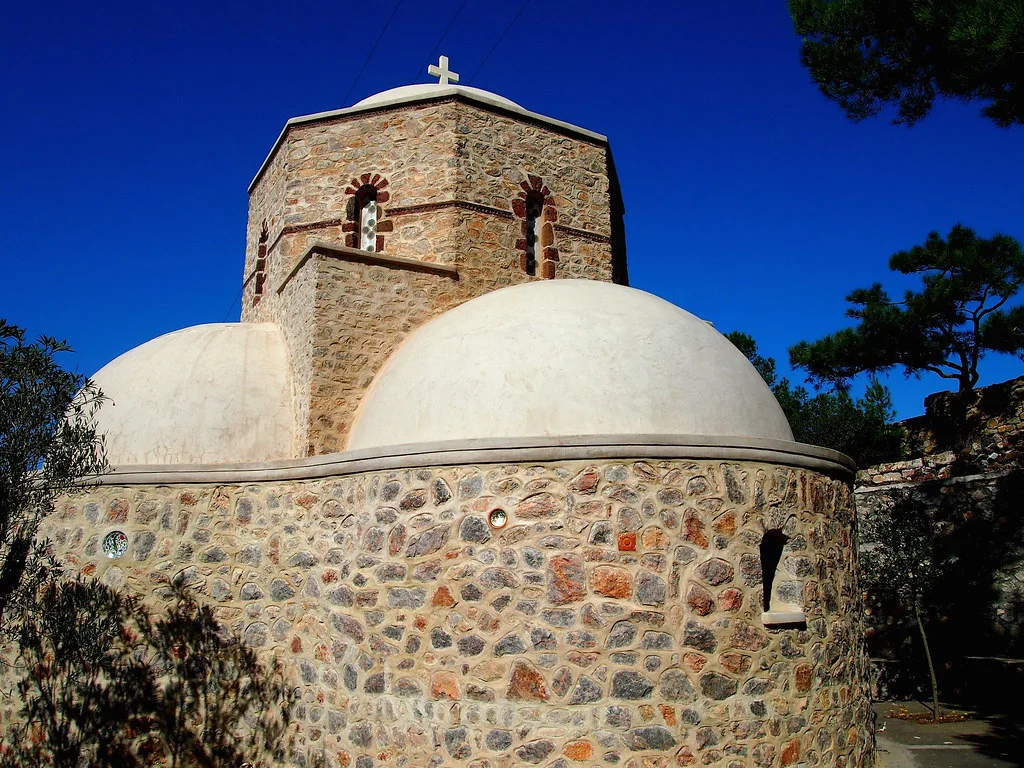
Pyrgos Kallistis is the obvious companion stop, about 3 km below the summit and one of the island's older hill villages, with lanes that climb toward its own upper church and views. Spending time there gives the monastery trip a proper frame: the village explains the settlement pattern, and the summit explains the island's shape.
If you want a second archaeological stop on another day, Ancient Thera on Mesa Vouno in the southeast and the Akrotiri excavation in the south cover very different periods and both need their own half-day. Neither is walkable from the monastery, so plan transport between them.
Practical Trade-offs Before You Go
The main choice is view versus flexibility. Driving yourself means you can time the summit for quieter hours and combine it with Pyrgos on your own schedule, while a tour removes the road stress but ties you to a fixed stop. Neither is wrong; pick based on whether you value control or convenience more.
Weather is the second variable. The summit is exposed, so wind or haze can flatten the view that justifies the climb, and a calm, clear day at sea level does not guarantee the same at 567 m. If conditions look doubtful, do Pyrgos first and decide on the summit road once you can see the mountain.
Planning Your Visit
Profitis Ilias Monastery is a small, specific stop: a 1711 foundation on Santorini's highest mountain, 3 km above Pyrgos Kallistis, reached by a short winding road and seen in well under an hour. Build the morning or afternoon around Pyrgos rather than around the monastery alone, and treat the summit as the high point of that loop.
Before you set out, call the monastery on 2286031210 to confirm that it is receiving visitors and what access applies on your dates, since opening times and entry rules are not published in the sources consulted here. Have a backup plan in Pyrgos in case the summit is shut or the weather turns. For the rest of the island's sights, start from the Santorini Attractions guide.
Explore more Santorini sauna guides
Frequently Asked Questions
What is Profitis Ilias Monastery on Santorini?
It is a Greek Orthodox monastery, Moni Profitou Iliou, on the summit of Mount Profitis Ilias in the island's interior, listed by the monastery as 567 m high and about 3 km from Pyrgos Kallistis. Its own account dates the foundation to 1711.
How do I get to the Prophet Elias Monastery?
The practical approach is by road from Pyrgos Kallistis, following the signed climb to the summit. Sources consulted give the distance but no bus routes or timetables, so arrange a car, a taxi or an organised tour and confirm the road is being driven before you set off.
How far is the monastery from Pyrgos?
The monastery's published account puts it about 3 km from Pyrgos Kallistis, also called Pirgos of Thira. The road winds, so allow more time than the distance alone suggests.
What can you see inside the monastery?
The monastery lists relics of several saints, a portion of the Cross, the tiara of Patriarch Saint Grigorios the Fifth, and the miraculous icon of the Prophet Elias, which it says is carried out during droughts. It is a working monastery, so expect quiet and simple interiors rather than museum displays.
How much time should I allow for a visit?
The buildings themselves take well under an hour, plus the short drive up and down from Pyrgos. Most visitors can pair the summit with Pyrgos village in a morning or afternoon.
Is there an entry fee or set opening time?
No entry fee or fixed opening hours are confirmed in the sources consulted. Call the monastery on 2286031210 to check whether it is receiving visitors and what applies on your dates before building a day around it.
Can you visit the monastery and Pyrgos in the same day?
Yes, and it is the sensible pairing: Pyrgos is about 3 km below the summit and works as the base for the trip. Do the village lanes and the monastery in one block and leave the rest of the island for other days.
Was the monastery ever closed to women?
The monastery's account states that women were barred when it was built in 1711 but does not say the restriction still applies. Ask the monastery directly about current visitor access.