
Akrotiri Archaeological Site: What to See and How to Plan a Visit
The Akrotiri Archaeological Site is the excavated remains of a Bronze Age town on the southwest side of Santorini, preserved under volcanic ash and now sheltered by a large roof. It is a genuinely substantial archaeological visit rather than a quick photo stop, and it rewards travellers who arrive knowing what they are looking at. This guide sticks to the site itself: location, access, layout, what is on display and what is held elsewhere.
What the Akrotiri Archaeological Site actually is
Akrotiri was a prehistoric settlement on Santorini, and the ancient city there is described as the most important archaeological site on the island and the most significant prehistoric settlement found anywhere in the eastern Mediterranean. Its importance rests on the state of preservation and the volume of finds recovered, which is why it is often likened to Pompeii. The comparison is a useful shorthand for a town frozen by eruption, not a claim that the two sites look or function alike.
The settlement's story runs deep: occupation at the site is traced back to the fifth millennium BC, when it was a small fishing and farming village, before it grew into a key node in the copper trade. That long arc, ending with the volcanic eruption of Thera in the second millennium BC, is what the excavation sequence is meant to illustrate. Read the panels at the entrance before walking the covered routes, because the streets themselves are fragmentary without that framing.
Where Akrotiri is and how to orient yourself
The site sits in the southwest of Santorini, in the Akrotiri village area rather than up on the caldera rim where Fira and Oia are. If you are staying in the caldera villages, plan it as a separate excursion down to the coast rather than something you stroll to. Coming from the south-coast beaches, it is a natural pairing with the same half-day. Deciding where to base yourself is part of the puzzle, so weigh the options in these Santorini Neighborhoods guides.
For orientation, treat Akrotiri village as the reference point and follow signs for the archaeological site from the main south-island road. The excavation is a covered, fenced complex with its own entrance area, not something embedded in the village lanes. If you are combining it with the south coast, note that the site is inland of the beach strip rather than on the sand.
How to get there: car, taxi and bus
Driving yourself or taking a taxi from Fira and the caldera villages is the most direct approach, and there is parking at the site entrance. A local bus to Akrotiri also serves the area, but schedules are the constraint, so check the current timetable on the day rather than counting on a convenient return. If you are reliant on buses, build slack into the plan so a missed service does not cut your visit short.
Organised half-day tours typically include private car transfer from your accommodation together with admission, which removes the transport problem entirely if your base is far from the south. That convenience is the trade-off: you commit to a fixed window and a guide's pace. Independent visitors can stay as long as they like but must solve the logistics themselves.
What you see inside the covered excavation
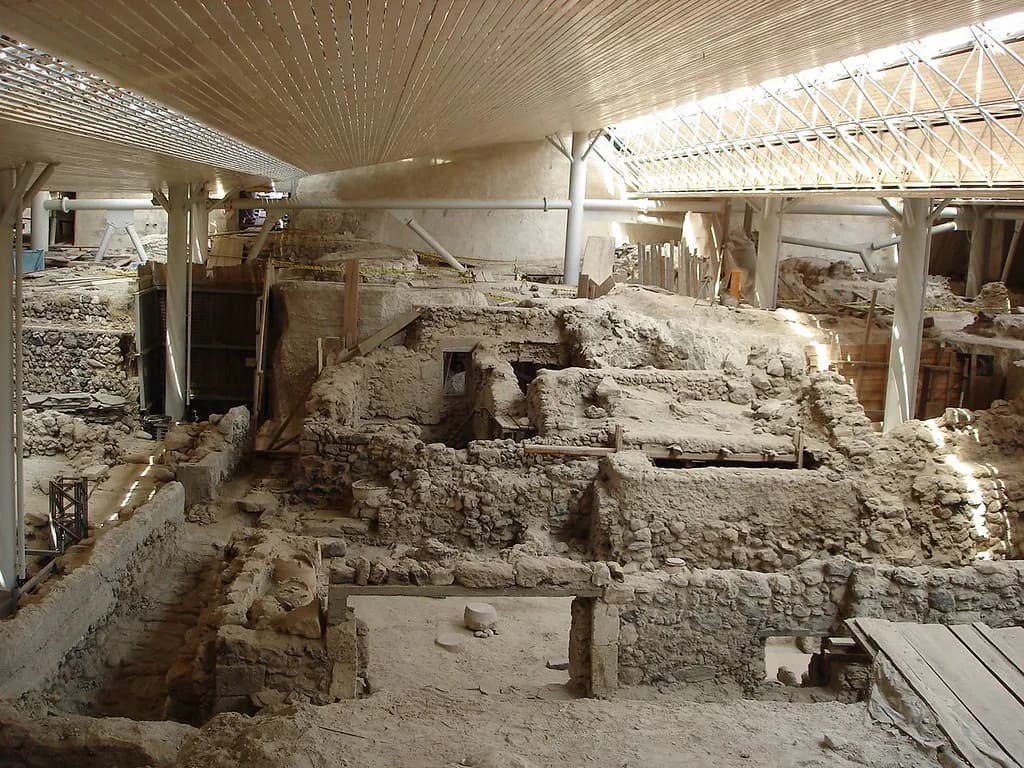
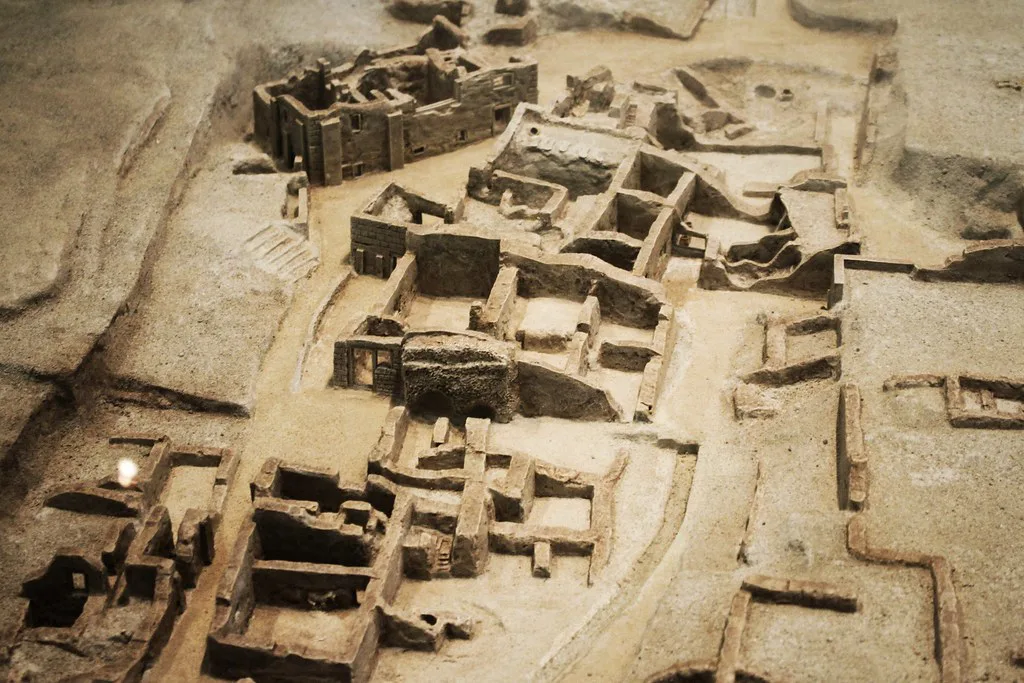
Inside, you walk above excavated streets and the remains of multi-storey buildings, looking down onto the layout of the Bronze Age town. Pottery and fragments of wall painting give a sense of daily life and craft, though the most celebrated pieces are not displayed here. Expect ruins read from a distance rather than rooms you enter.
The protective structure is worth understanding before you arrive. The site is covered by a bioclimatic roof designed to keep temperatures comfortable even in peak summer through natural ventilation, while admitting daylight and shielding the artifacts from the elements. In practice that means you are indoors in shade for much of the visit, which changes how you should dress and what you carry compared with an open-air ruin.
Wooden walkways and step-free viewing
Visitors view the ruins from above along a series of flat wooden pathways rather than walking down among the buildings. The layout is described as easy to visit with a wheelchair for that reason, since the route runs above the excavation on level boards. Comfortable walking shoes still matter, because you are on your feet for the whole circuit and the surfaces are not carpet.
The viewing-from-above arrangement is the central trade-off of the site: access is easier and the archaeology is protected, but you never stand in the streets themselves. Photographers should expect to shoot down into the ruins and to work around the roof structure and railings. If close-up, walk-through ruins are what you want, this is not that experience.
Frescoes and finds: what is not on site
The wall paintings Akrotiri is famous for are largely held in the Museum of Prehistoric Thera in Fira, along with many recovered artefacts, rather than left in the excavation. A tour combining the two typically spends time at the museum after the site so the frescoes can be seen alongside what they came from. Plan the two as one unit or you will leave with half the story.
The museum collection extends beyond Akrotiri's own pieces, including Byzantine works and a notable group of geometric vases from the fifth century BC. That breadth makes it a worthwhile stop even for travellers who have seen a lot of Greek museums. Check the museum's own listing for current hours and admission rather than relying on secondhand summaries.
The Minoan and Cycladic context
Akrotiri belonged to the Late Cycladic world and had strong links with Minoan Crete, which is why its material culture is often discussed in the same breath as Knossos. Its position as a trading port, particularly in copper, explains the wealth visible in the buildings and objects. Knowing this makes the site legible: you are looking at a prosperous maritime town, not an isolated village.
Some writers speculate that the destruction of this town fed the Atlantis legend described by Plato, but that remains speculation and should be treated as such. The firmer ground is the eruption of Thera and its effect on the settlement. Take the Atlantis framing as storytelling layered onto real archaeology.
The 'prehistoric Pompeii' label, handled carefully
Calling Akrotiri the Pompeii of the Aegean captures the essential fact that a working town was sealed by volcanic material and later excavated. It also oversimplifies: Pompeii is a Roman city with standing structures and casts, while Akrotiri is earlier, differently preserved and viewed from above under a modern roof. Use the nickname to understand the concept, then set it aside when you walk in.
The comparison has practical value too, because it sets expectations about scale. This is a single excavated complex, not a sprawling multi-site park, and the visit is contained. Travellers who arrive expecting a full day of walking between monuments will be surprised by how compact it is.
How much time to allow
A reasonable on-site window is modest, but the paired museum visit nearly doubles the commitment because it is in Fira rather than next door. A guided half-day format covering both the site and the museum runs about three and a half hours, which is a fair benchmark for planning. Independent visitors should add travel between the two.
If you have only one free morning, do the site and museum together and leave the afternoon for the coast. If you are short on time and not especially interested in archaeology, the site alone is the piece to cut, not the museum. That is a blunt trade-off but it matches how most visitors actually spend their hours.
Tickets, opening hours and closures
Admission is charged, and opening hours and any seasonal closures change, so check them on the official culture ministry listing or the site's own notice before you travel. Do not plan around a schedule copied from an old blog post or a tour operator's summary. This is the one detail worth checking twice.
Guided tours that include admission remove the ticketing question but not the hours question, since tour companies schedule around opening times. Ask whether tickets are included when you book, and check the day's start time. For independent visits, buy on arrival or via the official channel rather than a reseller.
Practicalities on the day
Wear comfortable footwear, bring water, and dress for a covered site that can still be warm in high summer. Tours run rain or shine, and in poor weather a guide may shift more of the time indoors, so an umbrella and a layer are sensible. Do not bring glass bottles onto the site.
Standard archaeological-site rules apply: stay on the marked routes, do not touch the remains, and take everything out with you. The walkways exist to protect the excavation, and stepping off them is both unsafe and damaging. Keep bags close on the narrow sections.
Nearby: the village, the beaches and the south coast
Akrotiri village itself is a low-key base with tavernas and rooms, and it pairs naturally with the south-coast beaches for a morning-site, afternoon-sea day. If you want a hilltop village instead of a coastal one, Pyrgos Kallistis inland offers a quieter alternative with broad views and a compact old core. Both work as lunch stops after the excavation.
For a different kind of viewpoint later in the day, the ruins of Skaros Rock above Imerovigli and the castle remains at Oia both reward a short walk at sunset. They are scenery, not archaeology, so treat them as a separate outing rather than an extension of Akrotiri. Booking a caldera-facing table for dinner is wise in high season.
Akrotiri or Ancient Thera?
Ancient Thera on Mesa Vouno is the island's other major archaeological site, a classical city founded by Lacedaemonian colonists that served as the island's urban centre for centuries. It is a hilltop ruin with wide views and a very different feel from the covered Bronze Age town. If you can only do one, Akrotiri is the more singular experience; Ancient Thera suits those who want a walkable classical site with a view.
Doing both in one trip is feasible if you spread them across two days and keep each visit focused. Trying to squeeze both into a single short window usually means rushing the one you care about. Decide which period interests you more and give that site the better hours.
Plan Your Visit
Akrotiri rewards preparation more than most Santorini stops: know that it is a covered, viewed-from-above excavation, and that the famous frescoes are in Fira rather than on site. Pair the two, allow roughly a half-day for both, and check current opening details before you go. Then use the rest of the day for the south coast or a hill village.
If you are building a wider island plan, the monastery at Profitis Ilias adds a high viewpoint and a quiet counterpoint to the coast, and works well on the same driving day as Akrotiri. Keep the archaeology in the morning and the scenery later.
Explore more Santorini sauna guides
Frequently Asked Questions
Where is the Akrotiri Archaeological Site located?
It is in the southwest of Santorini, in the Akrotiri village area, inland of the south-coast beaches and away from the caldera villages of Fira and Oia. Follow signs for the archaeological site from the main south-island road; the excavation is a covered, fenced complex with its own entrance.
Are the Akrotiri frescoes at the site or in a museum?
The best-known wall paintings and many recovered artefacts are held at the Museum of Prehistoric Thera in Fira rather than left in the excavation. Plan the site and the museum as one visit if the frescoes are your main reason for going.
How long does it take to visit Akrotiri?
The on-site circuit is contained, but pairing it with the museum in Fira makes a half-day. A guided format covering both runs about three and a half hours; independent visitors should add travel time between the site and Fira.
What are the opening hours of the Akrotiri Archaeological Site?
Hours and any closures change, so check the official culture ministry listing or the site's own notice before you travel rather than relying on secondhand summaries. Admission is charged, and guided tours that include tickets are scheduled around opening times.
Is the site accessible for wheelchair users?
The ruins are viewed from above along a series of flat wooden walkways, which makes the circuit easier for wheelchair users than walking among the buildings would be. Comfortable shoes still help, as you are on your feet throughout.
Should I visit Akrotiri or Ancient Thera?
Akrotiri is the more singular experience, a covered Bronze Age town preserved by volcanic ash. Ancient Thera on Mesa Vouno is a classical hilltop city with wide views. If you have time for only one and want something you will not see elsewhere, choose Akrotiri.