
Filerimos Monastery: A Practical Guide to Rhodes' Hilltop Site
Filerimos Monastery sits on a pine-covered hill above the villages of Ialyssos and Trianda on the northwest side of Rhodes, and it is rarely the only thing on the hill. The same ground holds the acropolis ruins of ancient Ialyssos, a restored two-storey monastery, and a separate stone path that climbs to a giant cross and a wide view over the coast. Understanding that layout before you go makes the visit far easier to plan, because part of the hill is ticketed and part of it is open to anyone.
This guide stays on Filerimos itself: where it is, how to drive or ride up, what survives of each building, and how to pace the site so a short coach stop does not become your whole visit. It also explains the one detail most visitors miss, which is that the famous icon in the church is a copy.
What Filerimos Actually Is: One Hill, Two Halves
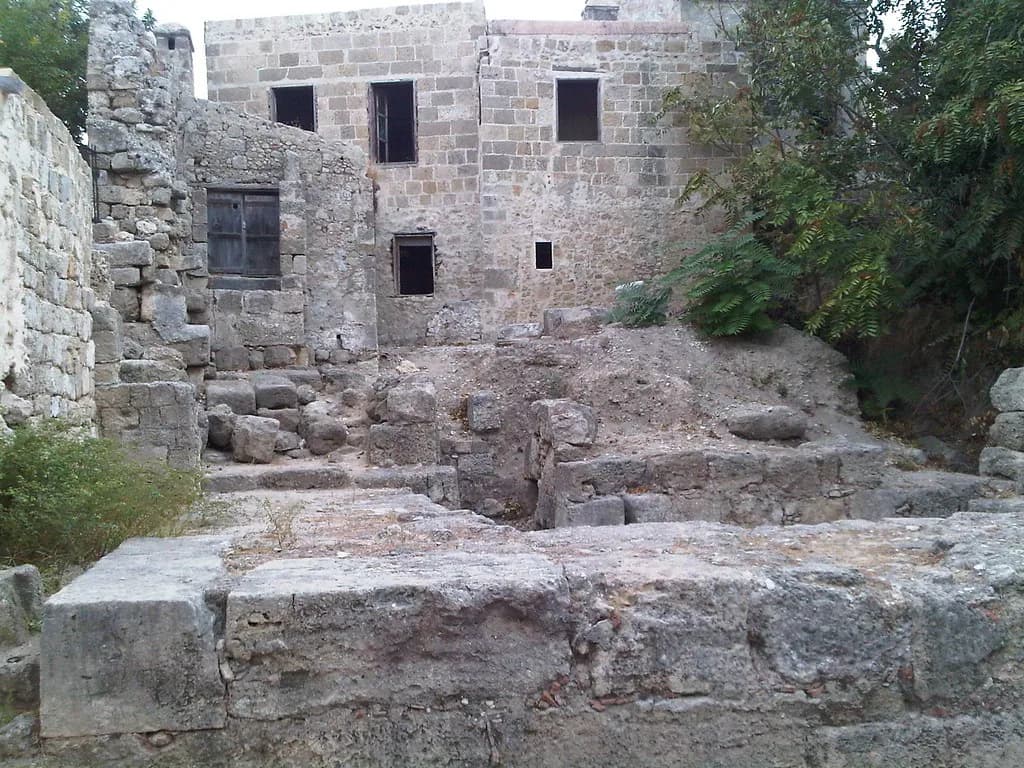
Filerimos is best understood as a layered site rather than a single monastery. The hilltop was the acropolis of ancient Ialyssos, one of the three important city-states of Rhodes alongside Lindos and Kamiros, and later carried a Byzantine monastic complex, a church built under the Knights of St. John, and a reconstruction carried out during the Italian occupation of the island. That means you walk past ancient temple fragments, medieval walls, and twentieth-century stonework within a few minutes of each other, and the Knights-era layer here reads very differently from the fortress architecture you see in Rhodes Old Town.
Practically, the hill splits into a paid archaeological site, which contains the monastery and the ancient remains, and a free section around the Calvary Path and the cross. The free part is where the best-known view is, so travellers who only want the panorama do not need a ticket at all. Decide which half matters more to you before you arrive, because the two are entered and timed differently.
Where It Sits and How to Get There
The site stands on Filerimos hill at roughly 267 m above sea level, about 15 km from Rhodes Town and about 5 km from Trianda village, with Rhodes International Airport Diagoras and Ixia Bay visible below, according to the Manos Going guide to Filerimos and Ancient Ialyssos. The approach is a wide but winding road through pine forest, and it narrows in places where tour coaches and rental cars share the same bends. Drive slowly and use the parking at the top rather than stopping on the road for photos, since the viewpoint higher up is better anyway.
Options are a rental car, a taxi, a public bus, or a tour coach. The hill is also a hiking destination, with marked loops climbing from Ialyssos and Ixia to the summit, some of them a couple of hours or more on foot. A taxi from Ialyssos is short enough that you can treat it as a half-day outing, but arrange the return leg in advance because the road is not a place to rely on hailing a passing cab.
If you are driving up from Rhodes Town, allow around twenty minutes in normal traffic, and roughly ten from the airport side. The final stretch is the slow part rather than the distance, especially when coaches are arriving.
The Monastery Itself: Courtyard, Church and Italian Restoration
The monastery building as you see it today is a two-storey structure wrapped around an interior courtyard with arched arcades, originally giving onto monks' cells on the ground floor and the abbot's quarters above. The church alongside has a vaulted roof and two hexagonal chapels, and it stands on ground that has held religious buildings since early Christian times. Much of the present appearance dates to the Italian-era restoration, inaugurated in 1931, which rebuilt on older foundations rather than preserving a single medieval layer.
That restoration history explains the site's slightly mixed feel: Byzantine and Knights-era masonry sits beside neat twentieth-century stonework, and the courtyard reads more Mediterranean-restored than ruined. If you want the older, rougher fabric, look to the archaeological remains outside the monastery walls rather than the cloister itself. It is also worth knowing that physical signage around the site is limited, so a printed note or an audio guide adds a lot to what otherwise look like anonymous stones.
The Church and the Virgin of Filerimos Icon
The church is closely associated with the Virgin of Filerimos, but the image kept there is a copy. The original icon, attributed to St. Luke the Evangelist, is said to have left Rhodes with the Knights in 1523 and passed through France, Italy, Malta and Russia before ending up in the National Museum of Montenegro. Knowing this avoids the common misunderstanding that you are looking at the historic original.
Dress and behaviour here follow Greek church convention, so shoulders and knees covered is the safe default even on hot days, and keep voices low while anyone is praying. The church is a working sacred space inside a ticketed site, not a museum room, so treat photography accordingly.
Ancient Ialyssos on the Same Ticket
The archaeological remains on the hill are the acropolis of ancient Ialyssos, whose main sanctuary was dedicated to Athena Polias, protector of the city. What survives of the Hellenistic temple dates from roughly the 3rd or 2nd century BC and is fragmentary, with much of its stone later reused for a large three-aisled basilica on the same spot. Inscriptions from the 3rd and 2nd centuries BC also record worship of Zeus Polieus, which is a reminder that the hilltop held more than one cult.
The other substantial ancient monument is the Doric Fountain House, built in the 4th century BC. Two underground tunnels fed a rock-cut reservoir from a natural spring, the facade carried six Doric columns, and water once left through marble spouts carved as lion heads. It is easy to walk past without noticing, so look for it deliberately. Many of the site's finds, including pottery, votive offerings and jewellery, are not on Rhodes at all, with pieces in the British Museum and the Louvre.
If the archaeology is the reason you came, pair the hill with the Archaeological Museum of Rhodes in Rhodes Town, where part of the Ialyssos material is displayed. It is a separate ticket and a separate trip, so plan it as another half day rather than squeezing it in afterwards.
The Calvary Path and the Cross
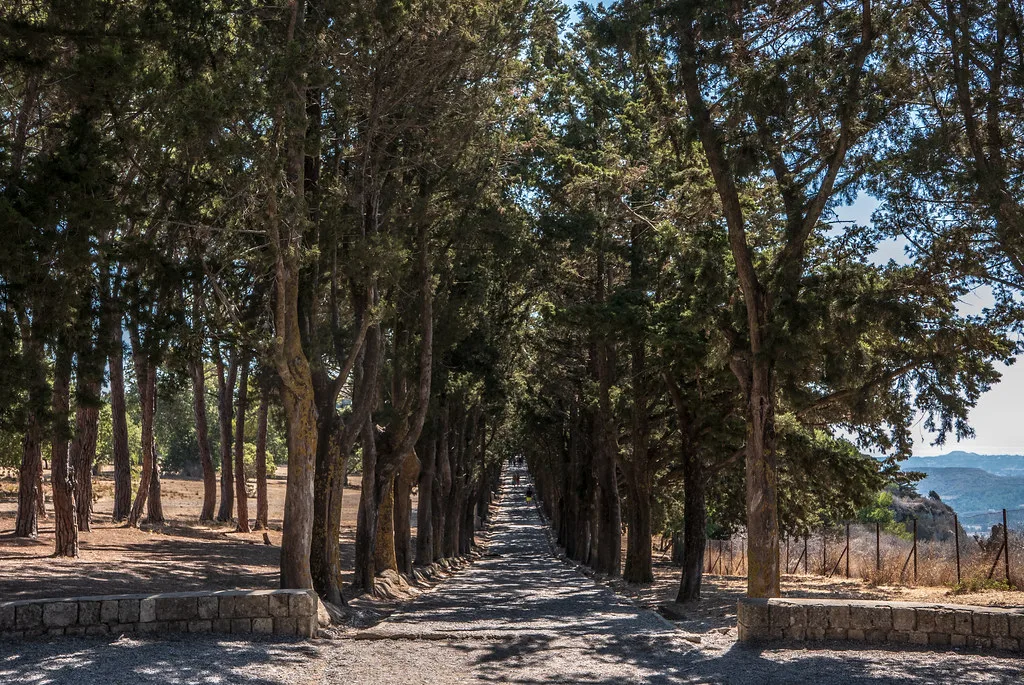
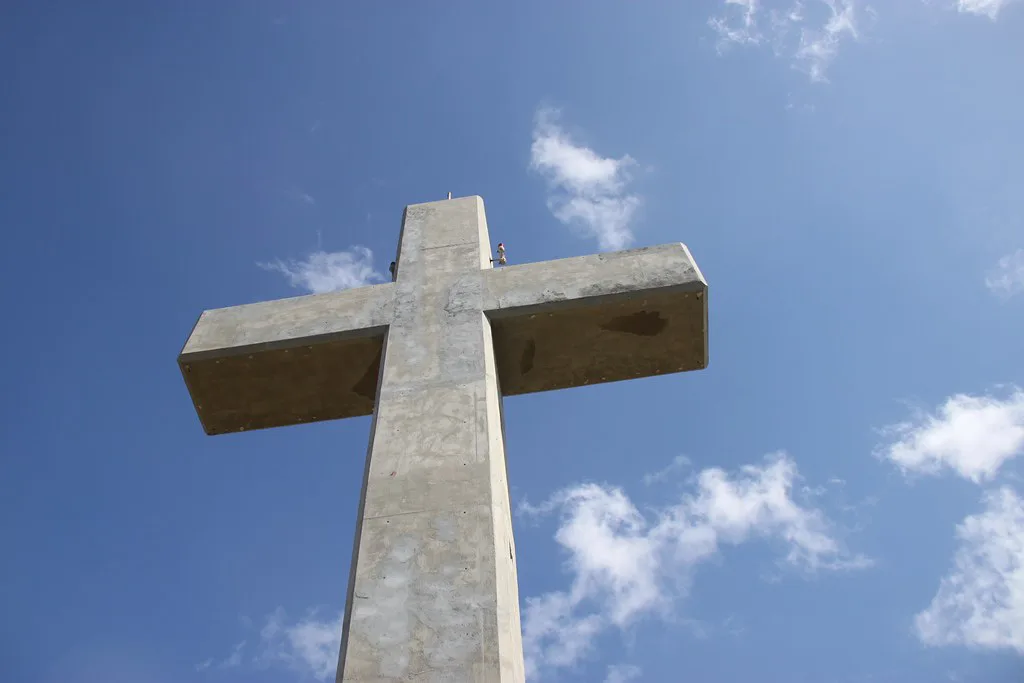
The Calvary Path, or Via Crucis, was added in the 1920s during the monastery's reconstruction. It runs 400 m along a stone-paved route lined with 14 shrines sculpted by Antonio Maraini depicting Christ's Passion, and it ends at a small square with a cross 17.8 m tall looking over the northeast of the island, as the Manos Going guide describes it. The path and the parking are free, so this half of the hill costs nothing to visit.
The cross you see is a later replacement; the Italian-era cross was destroyed during the Second World War and a new one was put up in the 1990s, and climbing inside it is no longer permitted. The reward is the platform view over Ialyssos, Ixia, the airport runway and, on clear days, the Turkish coast.
Because the west coast faces the sunset, late afternoon is the strongest time for the viewpoint, and the light is the reason many locals come up in the evening. The trade-off is that you may then be leaving after the ticketed site has closed, so decide whether you want the monastery or the sunset, or split them across two visits.
The Chapel of Ayios Georgios Chostos
Just to the left of the main entrance stands Ayios Georgios Chostos, a small 15th-century single-cell chapel whose interior is covered in wall paintings using a technique developed under the Knights. It is one of the easiest things at Filerimos to walk straight past, since it reads as a modest side building next to the ticket point. Step in before or after the monastery rather than treating it as an afterthought.
Behind the monastery a circular path continues past the remains of an old fortress and through more forest, adding around ten to fifteen minutes of walking. The castle masonry is not dramatic, but the circuit gives a sense of why the hill was defensible and how the site sits above the coast.
Peacocks, the Canteen and the Seven Herbs Liqueur
Peacocks roam the grounds in numbers and their calls carry across the whole hill, so expect noise as well as plumage. Watch them from a distance and let them move freely; feeding and handling are not something to assume, and the birds are the responsibility of the family that looks after the grounds.
The Capuchin monks who lived here between 1912 and 1943 left behind their recipe for a Seven Herbs liqueur, known in Italian as Sette Erbe, a sweet herbal digestif made from seven locally found herbs. A local family now tends the monastery area, feeds the peacocks and runs a small canteen where the liqueur is sold, and the Manos Going guide describes it as available only at Filerimos. Treat it as a small edible souvenir tied to the site's Catholic history rather than a general Rhodes product.
Tickets, Opening Hours and What to Budget
The Manos Going guide lists the adult entrance fee at 10 EUR per person, with free entry for EU visitors under 25 and non-EU visitors under 18 on production of ID, plus a half-price rate for EU seniors over 65 between October and May. The same source gives summer hours running daily until 20:00, and a winter season from November to April closing at 15:00 and shutting entirely on Tuesdays. The Calvary Path and parking are listed as free.
Note that a Tuesday in winter is the day to avoid if you want the monastery, since the site is closed, and that a late winter afternoon will not give you the sunset view and the ticketed interior on the same visit. In summer the long opening hours make an early morning or late afternoon slot easy to fit around the heat and the coach waves.
How Long to Allow and How to Pace It
Allow at least an hour and a half if you want the cross viewpoint, the monastery, the ancient remains and the chapel without rushing. Walk the Calvary Path first while the light is soft, then take the ticketed site at an unhurried pace, and finish at the canteen. If you are bringing children or photographing, add another half hour.
Group tours often allow only about an hour on the hill, which is workable for the monastery and the viewpoint but leaves no room for the fortress circuit or a slow look at the fountain house. If you arrive by coach, head for the monastery courtyard first, before the crowd thickens, and leave the cross for last.
Trade-offs: Crowds, Shade and Which Half to Choose
The main compromise is view versus substance. The free cross path delivers the panorama with no ticket and no closing time pressure, but it skips the monastery, the church and the ancient stones entirely. The paid site is where the history is, yet the best photographs are usually taken outside it.
Shade matters more than most visitors expect. The pine forest keeps the hill noticeably cooler than the coast, which makes it a sensible choice on a hot or windy day, but the paths themselves are uneven stone and the exposed stretches near the cross have no cover. Wear shoes with grip and carry water, since the kiosk is a canteen rather than a full cafe.
Morning coach arrivals are the other variable. Tours cluster mid-morning and early afternoon, so a first-thing or late-afternoon visit usually means a quieter courtyard and a better chance of a clear view from the cross.
What Else Is Near Filerimos
Below the hill, Ialyssos and Ixia are the obvious places to eat and swim after a morning up top, and Trianda is only about 5 km away for supplies or a taxi. Butterfly Valley sits roughly twenty minutes' drive onward and appears on many half-day tours paired with Filerimos, though the two are distinct stops with separate tickets. If you are weighing Ialyssos and Trianda as a base rather than just a lunch stop, see these Rhodes Neighborhoods: 5 Area Guides for the wider picture.
In Rhodes Town, the medieval monuments such as the Palace of the Grand Master of the Knights of Rhodes and the Street of the Knights (Odos Ippoton) in Rhodes Old Town make a natural second half of the day, and they help put the Knights-era church at Filerimos into context. Ancient Kamiros on the west coast is the other major archaeological site if you are comparing ancient Rhodian cities.
For a broader sense of what else fits around the hill, from beaches to old-town walks, see these things to do in Rhodes and plan the driving distances before committing to a day.
Plan Your Filerimos Visit
The simplest plan is to drive up in the late afternoon, walk the free Calvary Path to the cross while the west light is good, and see the monastery and ruins on a second visit or an earlier slot when the site is open. If you only have one window, check the seasonal closing time first, because a winter afternoon will not stretch to both the ticketed site and the sunset.
Bring cash for the ticket office, wear shoes for uneven stone, and confirm the current entrance fee and Tuesday winter closure before you go. The parking and the cross are free.
Frequently Asked Questions
Is Filerimos Monastery worth visiting?
It rewards anyone interested in layered history or a wide west-coast view, because one hilltop holds the restored monastery, the church, the acropolis ruins of ancient Ialyssos and the free Calvary Path to the cross. It is less dramatic than the acropolis at Lindos, and the ancient remains are fragmentary, so come for the combination rather than for a single showpiece.
How do you get to Filerimos Monastery?
Most visitors drive or take a taxi up the winding pine-forest road, and tour coaches and public buses also serve the hill. Walking routes climb from Ialyssos and Ixia to the summit, some of them a couple of hours or more. If you take a taxi, agree the return journey with the driver, as passing cabs on the upper road are unreliable.
How much is entry to Filerimos Monastery and the archaeological site?
The ticketed archaeological site has a published adult fee, with free entry for EU visitors under 25 and non-EU visitors under 18 on proof of age, plus a reduced senior rate outside the summer months. The Calvary Path and the parking are free. Fees and discount rules are revised from time to time, so confirm at the ticket office.
What are Filerimos Monastery opening hours?
The site publishes long daily summer hours and a shorter winter schedule from November to April, when it also closes one day a week. Hours are seasonal and can be adjusted, so check the official listing or call the ticket office before making the drive, particularly outside the summer season.
How long does it take to visit Filerimos?
Budget at least an hour and a half to walk the Calvary Path to the cross, tour the monastery, see the ancient remains and step into the chapel without hurrying. A coach stop of about an hour covers the monastery and view but skips the fortress circuit and a close look at the Doric Fountain House.
Is the Calvary Path at Filerimos free?
Yes. The 400 m stone path with its 14 shrines, the cross at the end and the parking are free to visit, so the panorama can be seen without buying a ticket. The monastery, church and archaeological remains sit inside the paid site, which has separate opening hours.
What is the Seven Herbs liqueur at Filerimos?
It is a sweet herbal digestif called Sette Erbe in Italian, made from seven locally found herbs, and its recipe is credited to the Capuchin monks who lived at the monastery between 1912 and 1943. A local family keeps the grounds and sells it at a small canteen on the hill.
What else is near Filerimos Monastery?
The beaches and restaurants of Ialyssos and Ixia lie below the hill, Trianda is about 5 km away, and Butterfly Valley is roughly twenty minutes' drive onward, often paired with Filerimos on half-day tours. Rhodes Town, with the Palace of the Grand Master and the Street of the Knights, is around 15 km off.