
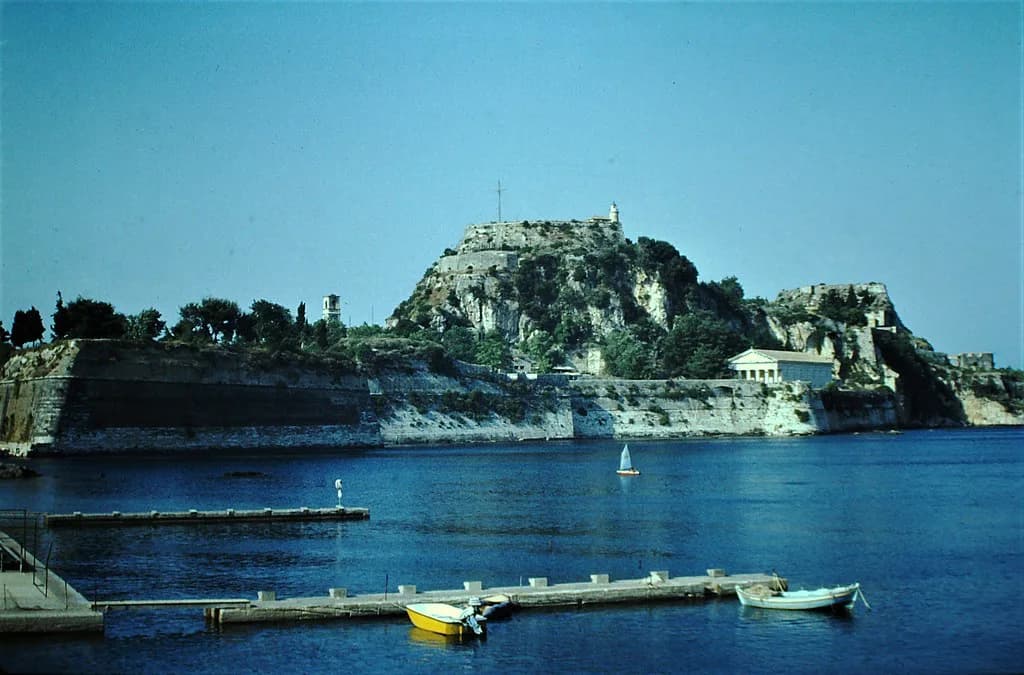
Old Fortress Corfu (Palaio Frourio): What to See, Time Needed and Getting There
The Old Fortress is the landmark most travellers picture before they arrive: a Venetian stronghold on a rocky peninsula at the eastern edge of Corfu Town, separated from the town by a channel of seawater. It is a single ticketed site rather than a district, so a visit is easy to plan around one morning or afternoon. The practical questions are how you walk in, what you see once you are across the moat and how much time to set aside.
This guide treats the fortress on its own terms, with the town streets, the New Fortress and the Garitsa waterfront appearing only as things to do afterwards. Opening times and ticket prices are not published here because they change with the season; the section below explains exactly where to confirm them before you set out.
What the Old Fortress actually is
The Old Fortress, called Palaio Frourio in Greek, is a fortified complex built across a rocky promontory on the eastern side of Corfu Town. Its layers come from different periods: Byzantine and Venetian defensive works, later British additions, and the walls and ramps visitors walk over today. The site is not a single ruin but a spread-out complex of gates, churches, barracks buildings and ramparts, which is why the visit rewards a little wandering.
The feature that shapes the whole approach is the Contrafossa, a moat of seawater that the Venetians used to turn the peninsula into an island. You cross it on an iron bridge, and the change of atmosphere is immediate: the noise of the town falls away and the ground underfoot turns to stone ramps and cobbles. Understanding that basic layout, a walled island you enter by one bridge, makes everything inside easier to navigate.
Where it is and how to orient yourself
The entrance stands at the eastern end of Spianada Square, the long open esplanade that runs along the edge of Corfu's historic centre. If you are already exploring the old town, the fortress is the obvious endpoint of a walk through the streets toward the sea. Reading a short orientation guide to Spianada Square before you go helps you place the entrance, the Liston colonnade and the town's lanes in relation to each other.
The town outside the walls and the ticketed fortress grounds are two different things, and mixing them up leads to confusion about what you are paying for. The streets, squares and alleys of the historic centre are free to walk at any hour, and only the bridge and gate lead into the paid site. Corfu's Old Town guide is the place to plan the free half of the day, while this page stays inside the walls.
Getting there: on foot, by bus or by car
On foot is the simplest option if you are staying in or near the centre, since the fortress sits at the end of the town's main square and cannot be missed. All local Blue Bus services terminate at San Rocco Square, which puts you roughly five to ten minutes' walk from the fortress entrance. The inter-resort Green Bus station, known as KTEL, is a longer walk of about thirty minutes from the entrance, so judge whether to walk or take a short taxi if you are arriving with luggage or in the heat.
Driving into the historic centre is restricted, and the largest paid public car park sits at the base of the fortress, which makes a car practical if you are coming from elsewhere on the island. Check current parking arrangements and any restrictions before you commit to driving in, since town traffic rules change. For the bus network and route details, the published arrival points above are the practical reference for planning, though timetables should be checked ahead of travel.
Tickets and opening hours
Entry to the fortress grounds is ticketed, and tickets are bought at the booth at the entrance rather than reserved far ahead. Opening hours depend on the season, so a time that works in July may not apply in November. Check the current hours and ticket price before you travel rather than planning around a figure remembered from an older guide, and the fortress's own website is the source to trust.
Because the site is outdoors and largely unshaded at the top, the time of day matters as much as the date. A morning or late-afternoon slot is more comfortable in summer than the middle of the day, and arriving near closing time leaves too little margin for the climb. Build in some slack so a slow queue at the ticket booth does not eat into your time on the ramparts.
Crossing the Contrafossa
The iron bridge over the Contrafossa is the first thing worth slowing down for. The seawater channel was dug to isolate the promontory from the town, and the crossing makes the fortress's logic obvious: one controlled entry point, deep water on either side. Look back toward the town from the bridge for a view of the square and the waterfront that most visitors photograph only from the other direction.
Once across, the route continues through the outer gate and up onto the fortified levels. The ground is uneven cobblestone in places and the paths climb gradually, so sturdy shoes make a real difference. There is little shade on the upper sections, which is worth remembering before you commit to a midday visit in high summer.
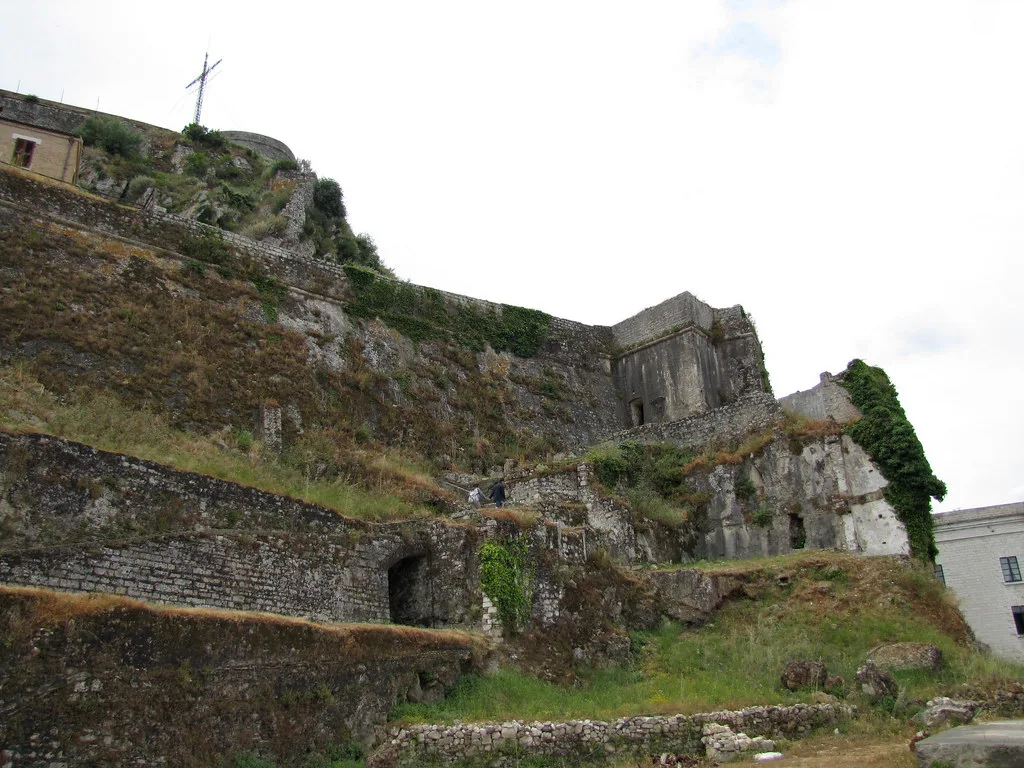
The main gate and the Lion of St. Mark
Above the main entrance, a marble relief of the Lion of St. Mark marks the Venetian Republic's claim on the site. The winged lion was the emblem of Venice, and finding it carved over a gate tells you who commissioned the defences and who considered the fortress theirs. It is a small detail that repays a moment's look before you pass through.
The Church of St. George
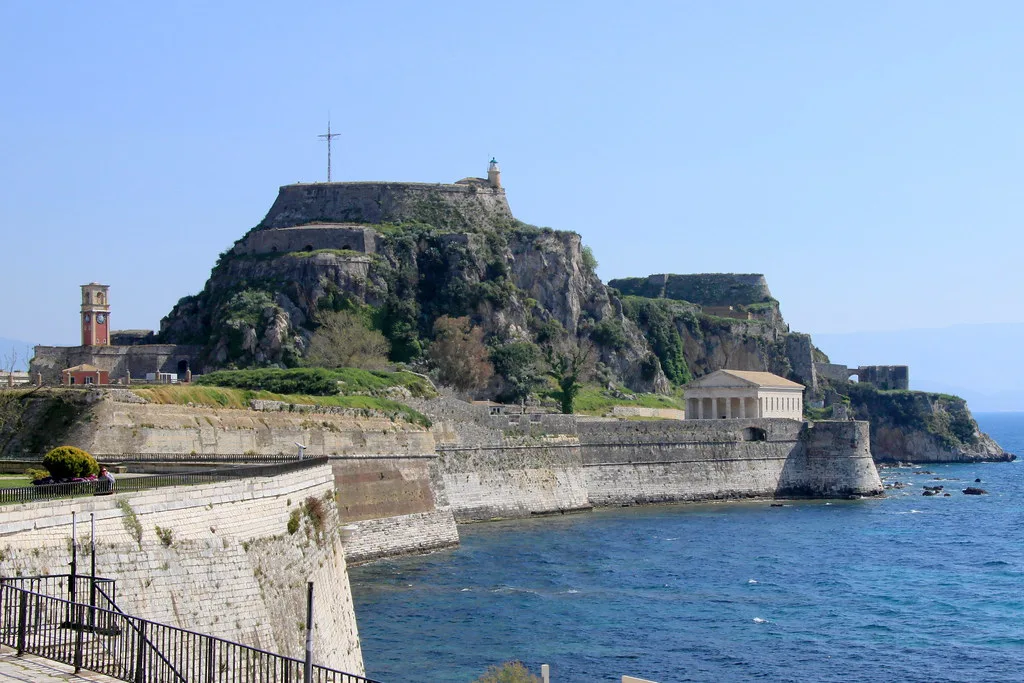
Inside the complex stands the Church of St. George, built by the British in 1840 and unusual for its design, which echoes an ancient Doric temple rather than a Greek Orthodox church. That classical look is a reminder that the fortress passed through several hands and that the British period left its own stamp on the buildings. It sits within the walled area, so you will pass it as you move between the lower levels and the ramparts.
The clock tower is a near neighbour from the same era, erected by the British around 1850 and built in a Venetian style. Seeing the church and the tower close together makes the mixed architectural layers of the site easy to read. Neither requires a long stop, but together they explain why the fortress looks less uniform than a single-period castle.
The climb to the twin peaks and lighthouse
The climb to the highest point is the reason most people come. A sustained uphill walk on stone ramps and stairs leads to the twin peaks and the lighthouse, and the reward is a wide view over Corfu Town, the Ionian Sea and Vido Island. It is not a mountain hike, but it is continuous uphill walking rather than a gentle stroll, and taking it slowly is the sensible approach.
The view is the trade-off at the heart of a visit: the fortress is worth entering mainly for the panorama from the top, and the walk there is unshaded and uneven. If photography is the goal, allow extra time at the summit. If you are visiting with children, the open spaces and cannons tend to appeal, but the high ramparts need close attention.
Lower levels and the British barracks
The lower part of the complex holds the old British barracks buildings, now used by the public library and archives rather than as a visitor attraction. They are worth a glance for the scale of the complex and for understanding that the fortress was a working military site, not just a monument. Unless you have a specific research interest, plan the library and archives as a passing look rather than a scheduled stop.
How much time to allow
Most visitors spend about one and a half to two hours inside, which covers a steady walk to the top, time for the views and a look around the lower levels. Photographers and history-focused visitors often stretch that, while a quick look at the church and the ramps could fit into less. The walking distances from San Rocco Square and the KTEL station should be added on top when you plan your day.
If you are combining the fortress with the rest of the town, put the fortress first when the day is hot and leave the shaded lanes for later. The reverse works in cooler months, when the climb is comfortable at almost any hour. Either way, keep the visit as a single block rather than splitting it, since re-entering means crossing the bridge again. For the same decision in Greece's other big city, our Thessaloniki food guide shows where to eat in Thessaloniki around a day of sightseeing.
What to wear and bring
Wear sturdy shoes for the cobblestones and the ramps, and carry water and a hat in summer, because shade is scarce at the top. The route involves climbing stairs and walking up slopes rather than any technical difficulty, so most reasonably fit visitors manage it with a slow pace. Children need watching near the summit ramparts, where the drops are real.
Is it worth it for you
The fortress suits travellers interested in Venetian and military architecture, photographers after the best view of the town, and anyone who enjoys exploring a large historic site with several distinct areas. It is less appealing if you want a short, shaded stop or if stairs and uphill stone paths are a problem. Being honest about that trade-off saves a disappointing visit.
Nearby options after your visit
Steps from the bridge, the historic centre takes over again with its alleys, squares and arcades, and it costs nothing to wander. Outside the walls you can also find the Church of Saint Spyridon in Corfu, the town's most important religious building, and the Museum of Asian Art Corfu, housed in the Palace of St Michael and St George. Both sit within the old town and work well as a short add-on rather than a full second sight.
If you want a second fortress, the New Fortress is the obvious counterpart and sits on the other side of the historic centre. For a swim and a waterfront walk, Garitsa Bay lies south of the town and makes a pleasant end to an afternoon. Mon Repos Palace, Corfu, a former royal villa in parkland, is a further option if you have a car or are happy to take a taxi.
Fitting the Old Fortress Into a Corfu Town Day
Treat the Old Fortress as a half-day anchor: cross the bridge, walk the lower levels, climb to the lighthouse for the view and come back down at an unhurried pace. Pair it with the free streets of the old town rather than stacking several ticketed sights into the same morning. That way the fortress gets the time it deserves and the rest of the day stays flexible.
Before you go, confirm the current opening hours and ticket price, since both follow the season, and check the weather forecast for heat and rain. Then plan your walk-in route from San Rocco Square or the town centre and set off early enough to enjoy the summit without rushing. If you want more context on the surrounding sights, the Corfu attractions collection covers the rest of the town.
Explore more Corfu sauna guides
Frequently Asked Questions
Where is the Old Fortress in Corfu?
It stands on a rocky peninsula on the eastern side of Corfu Town, entered from the eastern end of Spianada Square. A seawater moat called the Contrafossa separates it from the town, and you cross on an iron bridge to reach the gate.
How do you get to the Old Fortress from Corfu Town?
From the centre, walk to the end of Spianada Square and cross the bridge. Blue Buses stop at San Rocco Square, about five to ten minutes on foot from the entrance, while the Green Bus KTEL station is roughly thirty minutes away on foot. A paid car park sits at the base of the fortress for drivers.
How long does it take to walk around the Old Fortress?
Most visitors spend around one and a half to two hours inside, including the climb to the top and a look at the lower levels. Photographers often need longer, and you should add the walk from your bus stop or parking place on top of that.
Is the climb to the top of the Old Fortress difficult?
It is a sustained uphill walk on stone ramps and stairs rather than a technical hike, and most reasonably fit visitors manage it by taking their time. The summit is exposed, so carry water and a hat in summer and wear shoes with grip for the cobblestones.
Do you need tickets for the Old Fortress?
Yes, entry to the fortress grounds is ticketed and bought at the booth at the entrance. Opening hours change with the season, so confirm the current times and price before you travel rather than relying on an older figure.
Is the Old Fortress suitable for children?
Children usually enjoy the open spaces, cannons and castle walls, and the site is large enough to explore without feeling cramped. Keep a close watch near the high ramparts at the summit, where the drops are unprotected.
What can you see near the Old Fortress?
The lanes of the historic centre begin right outside the walls, and the Church of Saint Spyridon and the Museum of Asian Art are both within the old town. The New Fortress sits on the opposite side of the centre, and Garitsa Bay is a short walk south for a waterfront stroll.