
Rhodes New Town: A Practical Guide to the Modern City

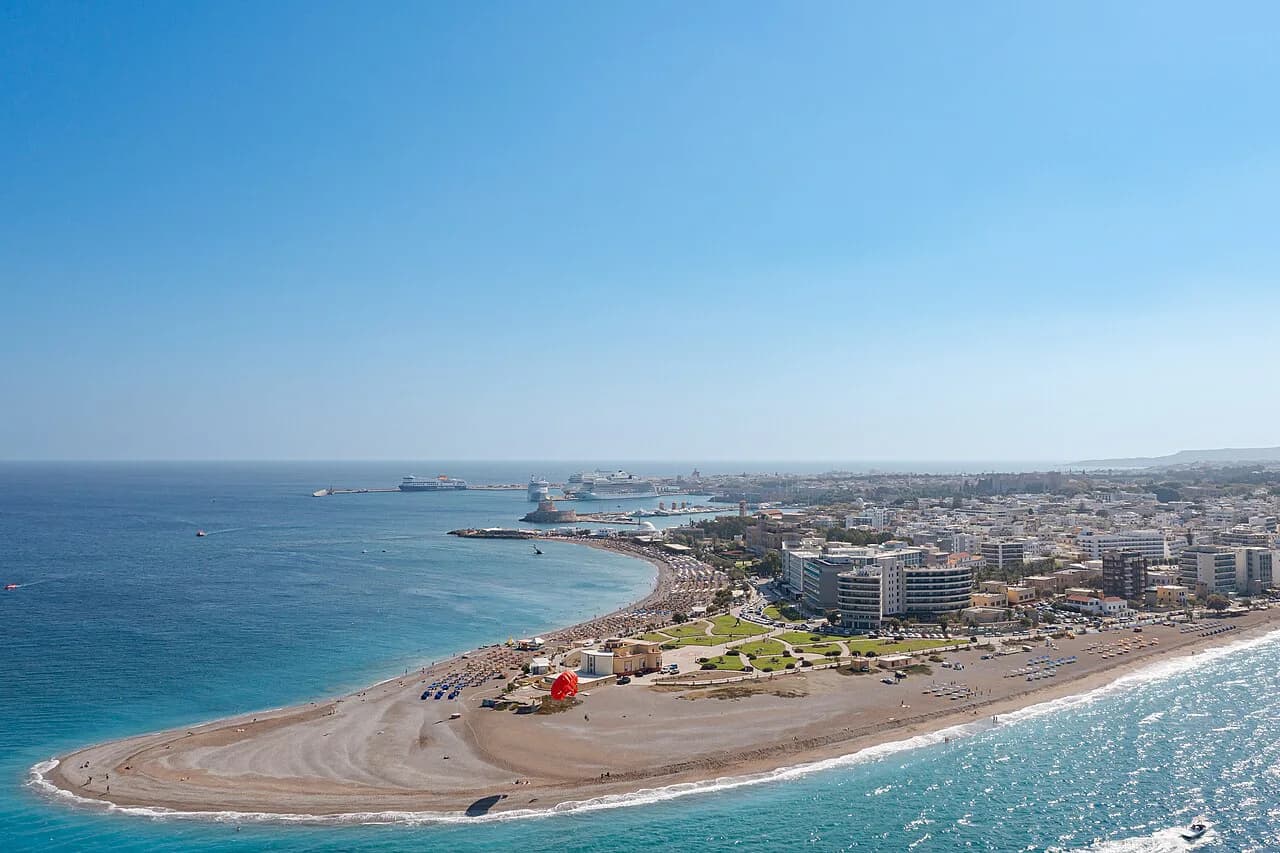
Rhodes New Town is the modern city that grew outside the medieval walls, on the northwest side of Rhodes Town. Locals and early maps knew it as Neohori, the new quarter settled by islanders and outsiders in the centuries after the Knights left, and much of what you see today was built under Italian rule in the early twentieth century. It is not a resort strip but a working city of traffic lights, apartment blocks and broad avenues, wrapped around Mandraki harbour.
For a visitor, the district delivers three things the walled city cannot: beaches within walking distance, roads wide enough for hire cars and taxis to reach your hotel, and a real market where people shop. The trade-off is atmosphere — the lanes and ramparts of the old town are a short walk away, but you sleep in a modern grid. Use this guide to decide whether to base yourself here, what to see in a day, and where the eating clusters are.
Orientation: How the New Town Fits Together
Picture the peninsula with Mandraki harbour at its heart. The Old Town sits to the southeast behind its walls, and the New Town wraps around the harbour and spreads northwest toward the beaches and the airport road. The Nea Agora, or New Market, faces the harbour in a seven-sided building with an inner courtyard, and it is the easiest landmark to navigate by.
West of the harbour lies the Italian-built civic core: Elefterias Square and the avenue beyond it hold the Town Hall, the Courts, the National Theatre and the Governor's Palace, a cluster worth a slow walk even if you skip museums. South of the harbour the ground rises to Monte Smith, the hill holding the Acropolis of Rhodes, and east of the town centre the coastal road runs north toward Ixia. Everything in this core is walkable in a single morning.
Old Town vs New Town: Which Base Suits You
Choose the New Town if your priorities are a beach on the doorstep, an easy taxi or hire-car pickup, and a hotel lift rather than a spiral staircase. The broad, tree-lined avenues and the Aegean breeze keep the area noticeably cooler in summer than the enclosed lanes, and the coastal road can funnel wind hard enough that many seafront restaurants are glassed in or walled.
Choose the walled city instead if medieval atmosphere is the whole point of your trip, and accept narrower streets, harder parking and a longer haul with luggage. The two are not far apart in practice: the local guidance puts the Old Town about a twenty-minute walk from most of the New Town, so staying outside the walls does not mean skipping them. Read the rhodes old town guide before deciding how many days the lanes deserve.
A third option is to treat the New Town as a logistics base and the Old Town as the sight. You can sleep near Elli Beach, walk into the medieval city in the morning, return for a swim in the afternoon and eat by the market in the evening. That rhythm suits families and anyone travelling with a car far better than moving hotels mid-trip.
Getting There and Around
Diagoras International Airport sits roughly 14 km from Rhodes Town. A local bus is the cheapest link to the city, with a journey of around 35 minutes depending on traffic, and the stop is outside the terminal about 300 metres from arrivals. Taxis with dark blue bodies and white roofs wait at a station beside arrivals; the published fare comparison in the same source puts the bus ride at 2.20 euros and the taxi at around 25 euros; confirm current fares locally before you travel.
Once in town, walking covers the harbour, the market, the municipal buildings and both beaches, and the Old Town is reachable on foot. If you plan to explore the island, basing here pays off: the wide avenues and easier parking make getting in and out of the city simpler than from inside the walls, and drivers picking up or dropping off at the port or airport generally prefer New Town addresses.
What to See in Rhodes New Town
Start at Mandraki, the ancient harbour, where three surviving medieval windmills line the breakwater, once part of a longer row used to grind wheat. The Tower of Saint Nicholas at the end of the pier was pounded to rubble in the sieges of 1480 and 1522, and the two bronze deer on pillars at the harbour mouth are Italian-era symbols of the animals brought in to clear the island's snakes. Walk the loop late in the day when the buildings are lit.
The Nea Agora, or New Market, is the district's other anchor: a large seven-sided building with a central courtyard where the fish market once operated. Inside and around it you find souvenir stalls, sponges and spices, cafés at the front, and a row of grill restaurants with chickens and cuts of lamb and pork turning on rotisseries. It is a market for browsing rather than a museum piece, so go with an appetite or a shopping list.
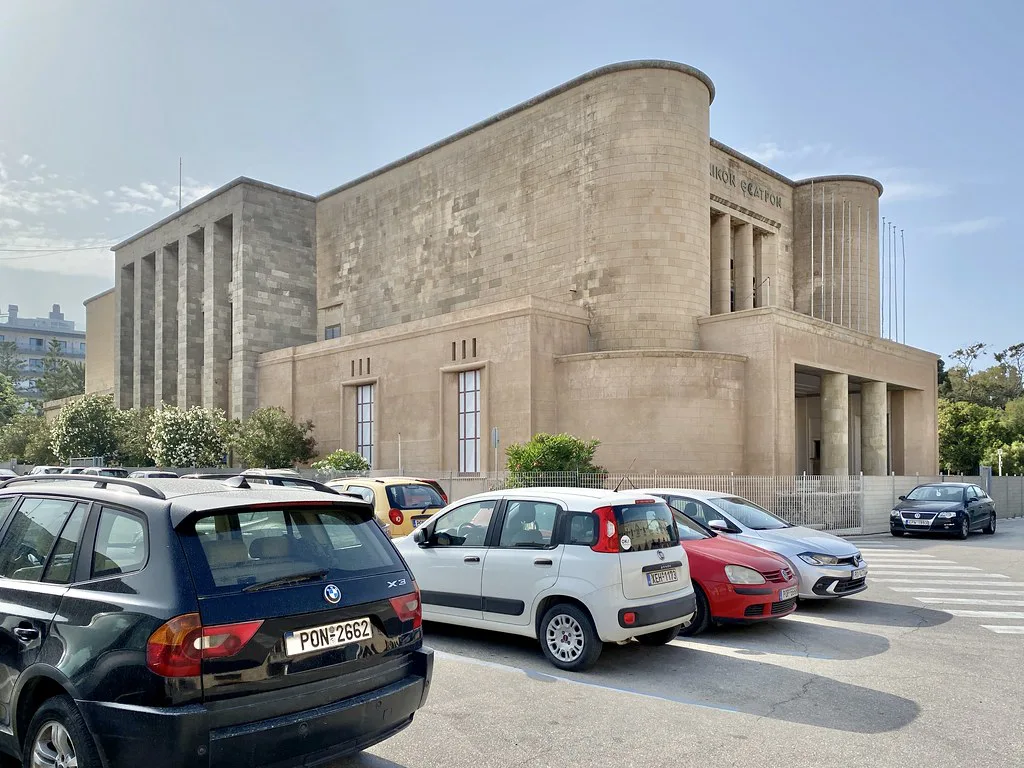
The Italian period left the most impressive architecture in one area beyond Elefterias Square, on the western side of the harbour: the National Theatre, built in 1937 as the Teatro Puccini, the Town Hall completed the same year, the Courts, and the Governor's Palace with its Venetian Gothic detailing. The Church of the Annunciation opposite was originally a Catholic cathedral and reproduces the church of the Knights; the Mourad Reis Mosque stands across the broad avenue, ringed by a small Turkish cemetery.
Near the tip of the peninsula, the Art Deco Aquarium building houses a research centre as well as tanks, and the water behind it is the meeting point of the Aegean and the Mediterranean — the Aegean side is typically windier and cooler. Above the city, Monte Smith holds the Acropolis of Rhodes with a restored stadium, a small theatre and the Temple of Apollo, and the view over the coast is the reward for the climb; local advice notes that admission is free.
Where to Eat Around the Market
The eating in this district clusters around Nea Agora. Next to an excellent gourmet deli on the market's edge is Indigo, a traditional ouzerie — a bar-restaurant where ouzo, the anise-flavoured spirit, comes with small plates of meze. Order a carafe of ouzo with a spread of meze rather than a main course: grilled octopus, small fried fish, fava (yellow split pea purée), olives and bread is the classic pattern. If you like the ouzerie format, our Chania food guide covers the same style of meze-and-ouzo eating on Crete.
The dozen or so grill restaurants around the building are a different proposition: whole chickens and joints of lamb and pork turn on rotisseries through the day, which makes them reliable for an uncomplicated meat lunch. The cafés at the market's front all display similar strawberry sweets and pastries, so pick by seating and shade rather than by menu. For a quick dinner on the main pedestrian street, Nikiforou Mandilara, look for the pitta gyros bar, where a set of gyro plate, fries, sauces, salad, pita and a drink is described in one account at about 5 euros.
Gyros is pork or chicken shaved from a vertical spit and served in pita with tomato, onion and tzatziki, a yoghurt and cucumber dip; a gyro plate turns the same meat into a sit-down meal with fries and salad. Portions are generous, which makes these spots a sensible choice for families and anyone arriving late from the airport. Note that menus and prices shift with the season, so check the board before ordering.
Beaches in the District
Elli Beach, on the eastern side of the peninsula, is the most popular in the city and has sunbed rental, water sports and beachfront tavernas. It is also the most crowded in high season, which is the obvious trade-off for its convenience; come early or late if you want space.
City Beach West, on the Mediterranean side near the Aquarium, behaves differently: it is wilder, with waves and wind, and plenty of room to spread out. A source calls the town beach by the Aquarium one of the cleanest in Greece, though that is an opinion rather than a guarantee. The wind that keeps the western coast cooler also explains why seafront restaurants here tend to be enclosed.
Both beaches are within walking distance of the New Town centre, which removes the need for a car if swimming is your main aim. If you have time for a day trip, the sandy beaches further down the island are a different experience, and a hire car makes them reachable.
Where to Stay in Rhodes New Town
Budget options cluster near the beaches and the harbour. One account names the Svea Hotel as inexpensive and well placed, a few minutes from the beach, Mandraki Harbour and the Old Town — a useful combination if you want to walk everywhere. Many of the most popular hotels sit on the Mediterranean side of the peninsula, including beachfront properties near the Aquarium.
Rooms in the modern grid rarely come with the character of an old-town conversion, so weigh quiet and a lift against courtyard charm. If you want the medieval streets on your doorstep instead, compare the Rhodes Old Town Guide before booking; if you want easy parking and quick airport transfers, the New Town wins on both counts.
Walking Routes Through the City
A half-day route starts at Mandraki, loops past the windmills and the Tower of Saint Nicholas, cuts through the Nea Agora for coffee, then walks the shaded park between the market and the Old Town gate, where street vendors sell sponges, shells and jewellery. Continue west past Elefterias Square for the Italian civic buildings, then follow the coast south toward the Aquarium.
For an evening, the seaside promenade is the local answer: a few kilometres of waterfront, best walked at sunset, with views across to the coast of Turkey on clear days. The climb to Monte Smith is a separate outing — a number 5 bus serves it, and the walk down through the coastal lanes gives you the view without retracing your steps. Check bus times locally, as schedules vary by season.
Who New Town Suits, and Who It Doesn't
This district suits travellers who want a beach and a bed in the same walkable area, families with children, drivers planning day trips, and anyone arriving late who wants an easy taxi drop-off. It also works for people who intend to see the Old Town but would rather not sleep inside the walls.
It suits less if you came for medieval lanes, car-free evenings and courtyards — the traffic lights and apartment blocks are part of the package here. Weigh your priorities before booking, and ask your accommodation about the area around your hotel.
Day Trips and the Rest of the Island
Basing here makes the rest of Rhodes easy to reach, and the most obvious day trip is south to Lindos, where the whitewashed village climbs beneath an acropolis above two sheltered bays. It is a full day out by car or bus rather than a quick stop, so treat it as an alternative to a beach afternoon rather than an add-on. Read the lindos rhodes guide to plan the timing.
Closer to hand, the coastal road north toward Ixia is a scenic walk in its own right, best done early before the heat builds, and the wider island sightseeing options are worth scanning before you commit days to the beach. Compare the Rhodes Attractions: 7 Visitor Guides if you are choosing between archaeological sites and coastal stops.
Plan Your Visit
Treat the New Town as the practical half of Rhodes city: sleep near the beach or the harbour, eat around Nea Agora and on Nikiforou Mandilara, walk the Mandraki loop and the Italian civic core, and cross into the Old Town on foot when the mood takes you. The district rewards a plan built on walking distances rather than a checklist of sights.
Before you travel, confirm the details that change: bus and taxi fares from the airport, opening times for the Aquarium and the archaeological sites on Monte Smith, and whether the venues around the market are running their full summer schedule. Your hotel or the local tourist information offices near Mandraki can confirm all three.
Explore more Rhodes sauna guides
Frequently Asked Questions
Where is the New Town in Rhodes?
The New Town lies outside the medieval walls on the northwest side of Rhodes Town, wrapped around Mandraki harbour and spreading toward the beaches and the airport road. Locals historically called it Neohori. The Nea Agora market, facing the harbour, is the simplest landmark to orient yourself by.
What is the difference between the Old Town and the New Town in Rhodes?
The Old Town is the walled medieval city with narrow lanes and Knights-era buildings, while the New Town is the modern city of wide avenues, Italian-era civic buildings, beaches, hotels and the working market. The New Town is easier for parking, taxis and swimming; the Old Town is stronger on atmosphere.
What is there to see in Rhodes New Town?
The main sights are Mandraki harbour with its windmills, Tower of Saint Nicholas and deer statues; the Nea Agora market; the Italian-built Town Hall, Courts, National Theatre and Governor's Palace beyond Elefterias Square; the Church of the Annunciation; the Art Deco Aquarium; and the Acropolis of Rhodes on Monte Smith.
Can you walk from the Old Town to the New Town in Rhodes?
Yes. Local guidance puts the Old Town about twenty minutes on foot from most of the New Town, and the two are separated by a shaded park with street vendors. It is a practical walk for a day's sightseeing, though the summer heat makes an early start sensible.
Where should I eat in Rhodes New Town?
Eat around Nea Agora, where an ouzerie and a gourmet deli sit alongside grill restaurants turning chickens and lamb on rotisseries, and where the market cafés serve coffee and pastries. For a cheap quick meal, look along the Nikiforou Mandilara pedestrian street for pitta gyros.
Is Rhodes New Town a good place to stay?
It is a strong base if you want beaches, easy parking and quick taxi transfers, with budget hotels near the harbour and beach and larger seafront properties on the Mediterranean side. It is a weaker choice if medieval lanes and courtyard charm are what you came for.