

Lindos, Rhodes: A Practical Guide to the Village, Acropolis and Beaches
Lindos is a whitewashed hill village on the east coast of Rhodes, crowned by an acropolis that has drawn settlers for roughly four thousand years. Cars stay outside, so every visit is a walking visit: lanes wind upward to the ruins and signposted slopes lead down to two very different beaches. This guide treats the climb as the organising fact of a Lindos day and builds the rest of the plan around it.
It is one of the island's most popular stops, and in high season the main shopping lanes can be genuinely busy, so a little route planning pays off. Before you commit to Lindos, it helps to see how it compares with the rest of the island's districts in the Rhodes Neighborhoods: 5 Area Guides, where the medieval Rhodes Old Town and the harbour-side Mandraki, Rhodes sit alongside it.
What Lindos is and where it sits on Rhodes' east coast
Lindos occupies a rocky rise above the sea on the east coast, a compact knot of white houses set between an ancient citadel above and two bays below. The village is pedestrianised, and travel sources describe its cobbled lanes and white-stone architecture as fully car-free once you are inside. Plan on arriving at the edge of the village and covering everything after that on foot.
Its history is layered rather than single-period: the acropolis was founded by Dorian Greeks, and the site later served Romans, Byzantines, Ottomans and the Knights of Rhodes, who wrapped a medieval castle around the ancient summit. That mix is why one climb delivers a classical temple, a Byzantine church later used as a mosque, and heavy Knights' fortifications in a single circuit. Budget time for the ruins themselves, not just the viewpoint.
Who Lindos suits, and who it does not
Lindos rewards travellers who like walking, views and dense village atmosphere, and it works well for a couple of nights of slow wandering rather than a checklist sprint. The trade-off is effort and company: the climb to the top is steady, and the popular lanes fill with day visitors in high season. If you want flat promenades and a city grid of restaurants, base yourself elsewhere on Rhodes and come here as a half-day.
Families with small children will find the main beach the easier end of the village, since the water is shallow and the slope down is clearly signposted. Anyone with limited mobility should weigh the Acropolis climb carefully and treat the village lanes as the main event instead.
Getting there from Rhodes Town: KTEL bus, tour, boat or private transfer
The public KTEL bus leaves from Rhodes Central Bus Station and runs hourly, taking about one hour and forty-five minutes to reach Lindos. The 2024 one-way fare was €5.50, payable at the ticket office or to the driver, and timetables should be checked before travelling since services change by season.
If you are based closer to Lindos, the journey shortens considerably: from the village of Archangelos the bus takes roughly thirty-five minutes. Booked tours handle the transfer for you and then leave you free to explore, while boat trips combine the village with swim stops at Tsambika Beach and Anthony Quinn Bay on the return leg. A private car with a local guide suits small groups or cruise passengers who want other stops folded in.
Travellers staying in Rhodes Town should pick their base with transport in mind, since the long transfer eats into a short trip. Compare the city districts, including the UNESCO World Heritage Site core and Mandraki Harbour with the Tower of Saint Nicholas, before booking.
Orientation on foot: pedestrian lanes, the climb to the Acropolis and signposted beach roads
Treat the village as a vertical route with branches. From wherever the bus or taxi leaves you, follow the signs upward through the lanes to the Acropolis entrance, then come back down and take the marked roads out to either beach. The two bays sit on opposite sides of the village, which means you can reasonably see the village, the ruins and one beach in a single day without retracing much ground.
Wear shoes that grip, because the lanes are cobbled and polished by foot traffic, and carry water for the ascent rather than buying it at the top. If you are the kind of traveller weighing up a longer Rhodes itinerary, the things to do in Rhodes overview is a useful way to see how a Lindos day fits around the island's other sights.
The Acropolis of Lindos: layers of temple, Byzantine church, Ottoman mosque and Knights' walls
The Acropolis is the reason most people climb, and the payoff is a panorama over the sugar-cube rooftops, open sea and the heart-shaped inlet of St Paul's Bay tucked below. Inside the walls you pass the Temple of Athena Lindia, a Byzantine church converted into a mosque under the Ottomans, and the thick medieval towers built by the Knights Hospitaller. Read the panels as you go: without them, the jumble of periods is hard to separate.
Tickets are bought at the entrance, and pre-booking is an option for anyone short on time who does not want to queue in the heat. The site is signposted from the village, so the main decision is timing: go early or late to avoid the middle-of-day sun and the densest arrivals.
Published hours give a working frame rather than a guarantee, so confirm before setting out. The site has been listed as open 8am to 8pm from April to October and 8.30am to 3.30pm from November to March, and those hours are exactly the kind of detail that shifts with the season.
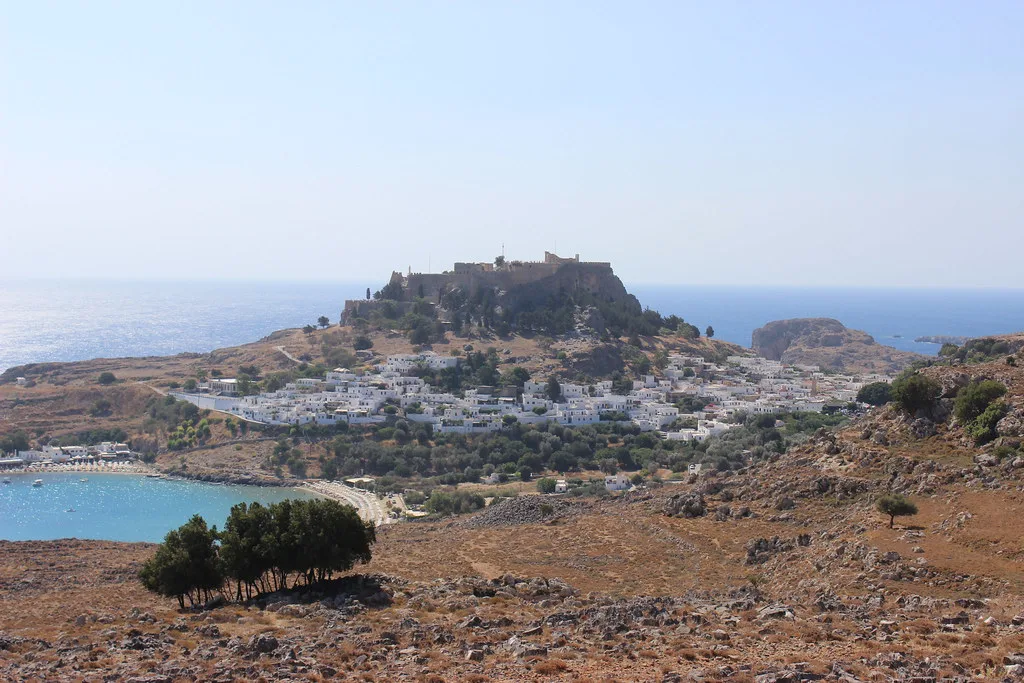
St Paul's Bay: the sheltered inlet below the village
St Paul's Bay is a small, almost enclosed cove connected to open water by a narrow gap in the cliffs, with clear water and a curve of tavernas and sunbeds along the shore. Tradition holds that St Paul first landed on Rhodes here to preach, which explains the name. It is the prettier and more sheltered of the two beaches, and the natural choice if you want a swim with a view and a table within steps of the water.
The trade-off is scale: the bay is tiny, so sunbeds and taverna seats are limited and fill fast when the village is busy. Arrive earlier than you would at a large beach, or treat the bay as a late-afternoon dip after the Acropolis crowds thin.
Megali Paralia (Lindos main beach): the larger, shallower crescent
Megali Paralia, the main beach, sits on the opposite side of the village from St Paul's Bay and is the larger of the two, a golden crescent of sand with shallow water. Sunbeds and pedalos can be hired there, and the sloping road down is clearly signposted and easy to follow. That combination of shallow entry and space makes it the better pick for families with young children.
Choosing between the beaches is really a question of what you want from the day: the inlet for scenery and a sheltered swim, the main beach for room to spread out and easier water for children. Doing both in one visit means a walk back through the village between them, which is no bad thing given the lanes are the attraction in their own right.
Wandering the village lanes: rooftops, shops and quieter side streets
Lindos is best seen at its own pace, and the busiest lanes of gift shops, restaurants and rooftop bars are only part of the picture. Step off the main thoroughfares and the atmosphere changes quickly to quiet stairways and whitewashed courtyards. The practical move is to climb early, wander the busy lanes when you want a coffee, and save the side streets for the middle of the day when the crowds concentrate.
Village cats, rooftop terraces and a labyrinth of steps are the texture of the place; there is no single sight to tick off beyond the Acropolis and the two bays. Give yourself an unhurried hour to get genuinely lost before heading down to the water.
Where to eat in Lindos: rooftop tables, garden cafes and what to order
Lindos eating is concentrated in cafes and tavernas with rooftop or courtyard tables, and three names are worth knowing. Ginger serves breakfast, brunch and lunch, and a roof seat is the reason to go. Melia Cafe offers another rooftop setting, while Village Cafe Lindos hides a shady garden in the heart of the village. None is a grand dinner destination in the sources, so treat them as daytime stops. If you are weighing a longer city stay against village life, our Chania food guide shows how a bigger town's eating scene compares.
For a light, very Greek bite, order spanakopita, a filo pastry pie filled with spinach and usually feta, which the Village Cafe Lindos is noted for. Greek coffee is a small, strong, unfiltered cup served with a glass of water; ask for it sketo if you want it unsweetened. Prices are not published here, so check the menu board before sitting down, especially on a rooftop with a view.
Where to stay in Lindos: village guesthouses vs beachside studios
The main choice is between staying inside the pedestrian village and staying down by the beach. Villa Zinovia is a traditional guesthouse in the heart of Lindos, which puts the lanes, cafes and the start of the Acropolis climb on your doorstep but means carrying bags through cobbles. Beachside options include Thalassa Luxury Studios next to the beach, where the suite with an outdoor terrace is the one to request, and Chrysanthi Studios, a beachfront apartment with a sea-view patio.
Village stays suit travellers who want evening atmosphere and rooftop dinners without a walk home in the dark; beach studios suit swimmers and families who want sand at the door. Neither is the wrong answer, but the walk between the two ends of Lindos is uphill in one direction, so pick the end you will use most. No rates are quoted in the sources, so compare prices directly with each property for your dates.
How long to allow: day trip vs a couple of nights
A day trip from Rhodes Town is workable but tight, given the bus takes about an hour and forty-five minutes each way, leaving you a compressed window for the Acropolis, the lanes and one beach. Do the maths before booking a single-day visit: two long transfers can swallow half the daylight.
A couple of nights is a better fit, and it lets you split the Acropolis and the two beaches across separate mornings and afternoons rather than cramming them together. Staying overnight also gives you the village after the day visitors leave, which is when the lanes become genuinely quiet.
Practical notes: summer heat, crowds and seasonal opening
Summer afternoons on an exposed rock are punishing, so climb in the morning or the late afternoon and keep the middle of the day for shade, lunch or the beach. High season brings real congestion in the main lanes, and the practical counter is to move against the flow: side streets when the main street is packed, beaches when the Acropolis queue builds.
One check-current-details reminder is worth keeping for the Acropolis: published opening hours vary by season, so verify before you plan a day around them. For the rest, use the official Rhodes Attractions: 7 Visitor Guides hub to see how Lindos compares with the island's other ticketed sites.
Plan Your Visit
Build your Lindos day around the climb: up to the Acropolis early, back down for a rooftop lunch, then one beach chosen for its character rather than both on autopilot. Book a village guesthouse if evenings in the lanes appeal, or a beach studio if you would rather swim first thing, and confirm transport times and site hours before you travel.
Frequently Asked Questions
Is Lindos worth visiting on Rhodes?
Yes, if you accept that it is a walking village on a hill. The Acropolis combines a Dorian temple, a Byzantine church later used as a mosque and Knights' fortifications, with views over the rooftops and St Paul's Bay. The two beaches below give you a swim on either side, and the lanes reward slow wandering. It suits travellers who like steps, views and dense village atmosphere more than those wanting flat, car-friendly streets.
How do you get from Rhodes Town to Lindos?
The KTEL public bus leaves Rhodes Central Bus Station and runs hourly, taking roughly one hour and forty-five minutes. Booked day tours handle the transfer and leave you free time, boat trips add swim stops at Tsambika Beach and Anthony Quinn Bay, and a private car with a guide suits small groups wanting extra stops. Check the current timetable and fare before travelling, since services and prices change by season.
How long does it take to walk up to the Lindos Acropolis?
The sources describe the climb through the village lanes to the Acropolis entrance without giving a timed figure, so treat it as a steady uphill walk rather than a fixed number of minutes. Add time at the top for the temple, church and castle walls, and go early or late to avoid the heat. Signposts lead the way from the village.
Which beach in Lindos is better, St Paul's Bay or the main beach?
They serve different purposes. St Paul's Bay is a small, sheltered inlet with tavernas and sunbeds close to the water and is the more scenic option, but space is limited. Megali Paralia, the main beach, is larger, with shallow water, sunbeds and pedalos, making it the better pick for families. Pick one, or walk between them through the village.
Where should you eat in Lindos village?
For daytime food, Ginger serves breakfast, brunch and lunch with a roof worth requesting, Melia Cafe offers another rooftop setting, and Village Cafe Lindos has a shady garden in the heart of the village. The sources point to its spinach pie, known in Greek as spanakopita, a filo pie filled with spinach and usually feta. Menus and prices are best checked on site before you sit down.
Should you stay in Lindos village or by the beach?
Village stays such as Villa Zinovia put the lanes, cafes and the start of the Acropolis climb on your doorstep, but bags must be carried over cobbles. Beach options include Thalassa Luxury Studios next to the beach, where the suite with an outdoor terrace is the one to ask for, and Chrysanthi Studios, a beachfront apartment with a sea-view patio. Choose the end of the village you will use most, since the walk between them is uphill one way.
How many days do you need in Lindos?
A day trip is possible but compressed, because the bus from Rhodes Town takes about one hour and forty-five minutes each way. A couple of nights is a better fit: it lets you split the Acropolis and the two beaches across separate mornings and afternoons, and gives you the village after the day visitors leave. If your time on Rhodes is short, weigh a Lindos day against time in Rhodes Town itself.